- An installation record describes its named job; a product label compares the named model under its rating method.
- An EnerGuide home evaluation models the house under stated conditions. Household bills record different quantities, periods and charges.
- Before quoting an improvement, keep the complete comparison and ask what can explain the change. Future savings need their own assumptions.
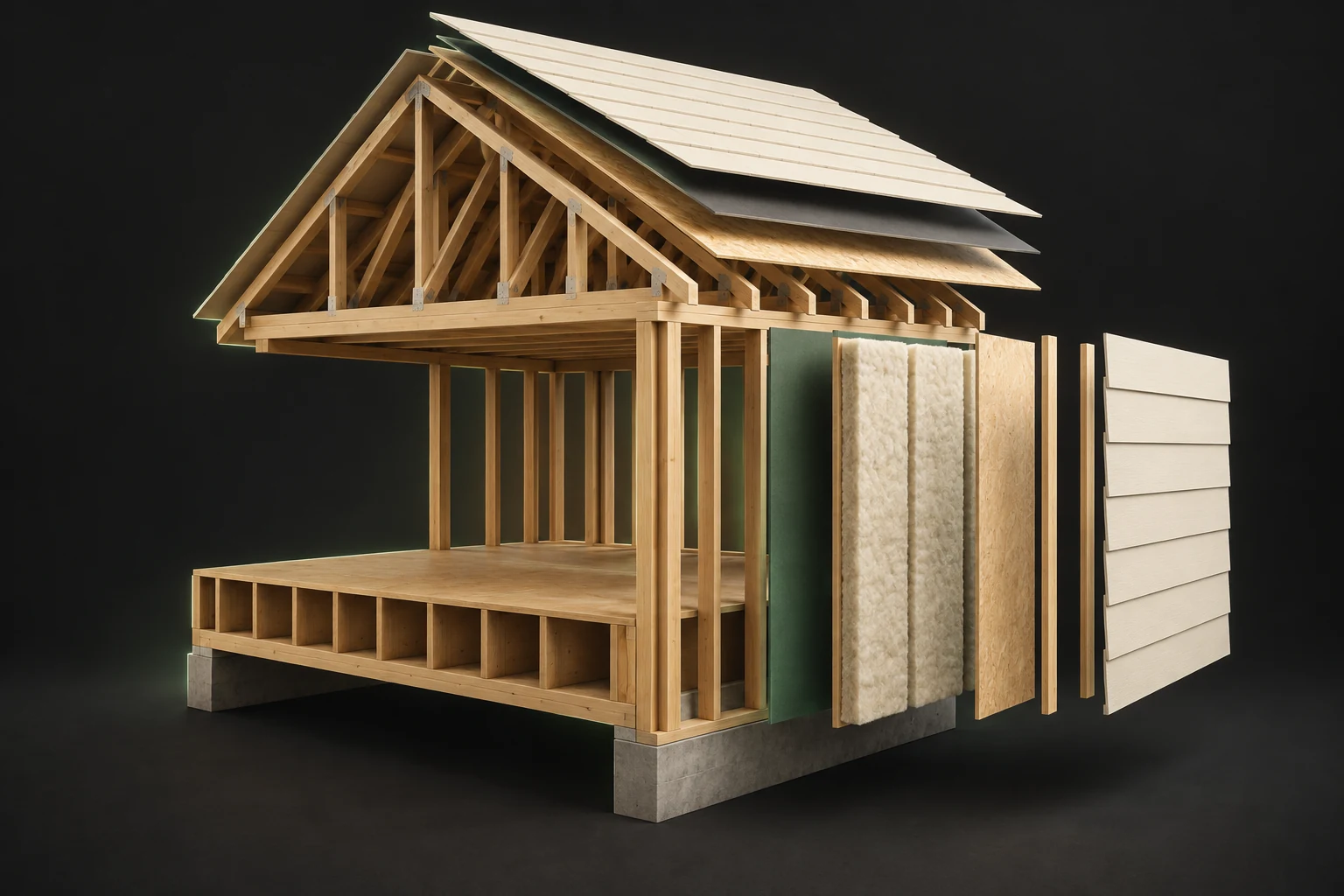
Conceptual architecture. Layout, sizes and routes are illustrative; the picture does not describe your home’s condition.
Explore this in the visual atlas ↗2 picture lessons appear beside the questions in this guide. Use them to understand the explanation, then consider what it means for your home.
What exactly is the claim I want to make?
An energy upgrade can change a component, the home’s modelled performance or the household’s actual energy use. Start by naming which result you want to describe. “Attic insulation added,” “a dated home energy evaluation” and “lower charges on our bills” each tell a different story. A buyer needs the documents behind the particular statement.
Write the proposed listing sentence beside the document that supports it. Note the home or model identity, date, method, work area and important limits. If the sentence describes more than the document covers, narrow it or obtain suitable professional advice. Clear wording lets you explain completed work positively while keeping future performance open to the buyer’s own circumstances.
The useful question is practical: what will the next household learn from this claim? A component record can identify what was installed. An evaluation can explain modelled home performance. Bills can show a dated household history. Keep all three available, rather than turning their different meanings into a single savings promise.
What does an installation record prove?
An installation record helps identify the actual job: component or material, model where relevant, location, date and completed scope. Keep the invoice with related work orders, changes and completion records. A kitchen heat-pump unit or one attic area is a particular work scope; its record should describe that scope clearly.
A quote describes proposed work. A delivery receipt describes supplied items. An invoice records its stated billed tasks. A commissioning or service report describes the checks or findings within its scope. Ask the provider which records explain the completed arrangement and what was checked. Missing follow-up remains a question to ask, rather than a result to invent.
Match the records to the home and later changes. If the final job differed from the first quote, describe the actual work. Ask the applicable authority and qualified provider about relevant permits and completion status. A product brochure can explain a model; it cannot supply this address’s approval or present-condition assessment.
Why is a product label different from a home rating?
A product label helps you compare the named model with similar products under the stated rating method. NRCan’s EnerGuide appliance guidance identifies model information, annual rated energy and the comparison class. A home evaluation has a wider job: it describes the house using collected information and a defined model. The picture below gives these records separate roles.
Read the number’s unit and meaning before quoting it. Rated annual appliance energy, a heating-efficiency measure, equipment capacity and a home rating are different quantities. Keep the model and method with a product claim. Ask the qualified installer or energy advisor which evidence answers a claim about the installed system or the whole home.
The comparison also includes installation records and household bills. None substitutes for the others. The conceptual label in the picture is a record category, not an official EnerGuide mark, a certification or a numerical score. Use the actual complete document when describing the product or property.
Give each energy record its own job
Four parallel illustrated panels name completed work, a product rating, a home evaluation and household bills.
Numbers identify the parts explained below.
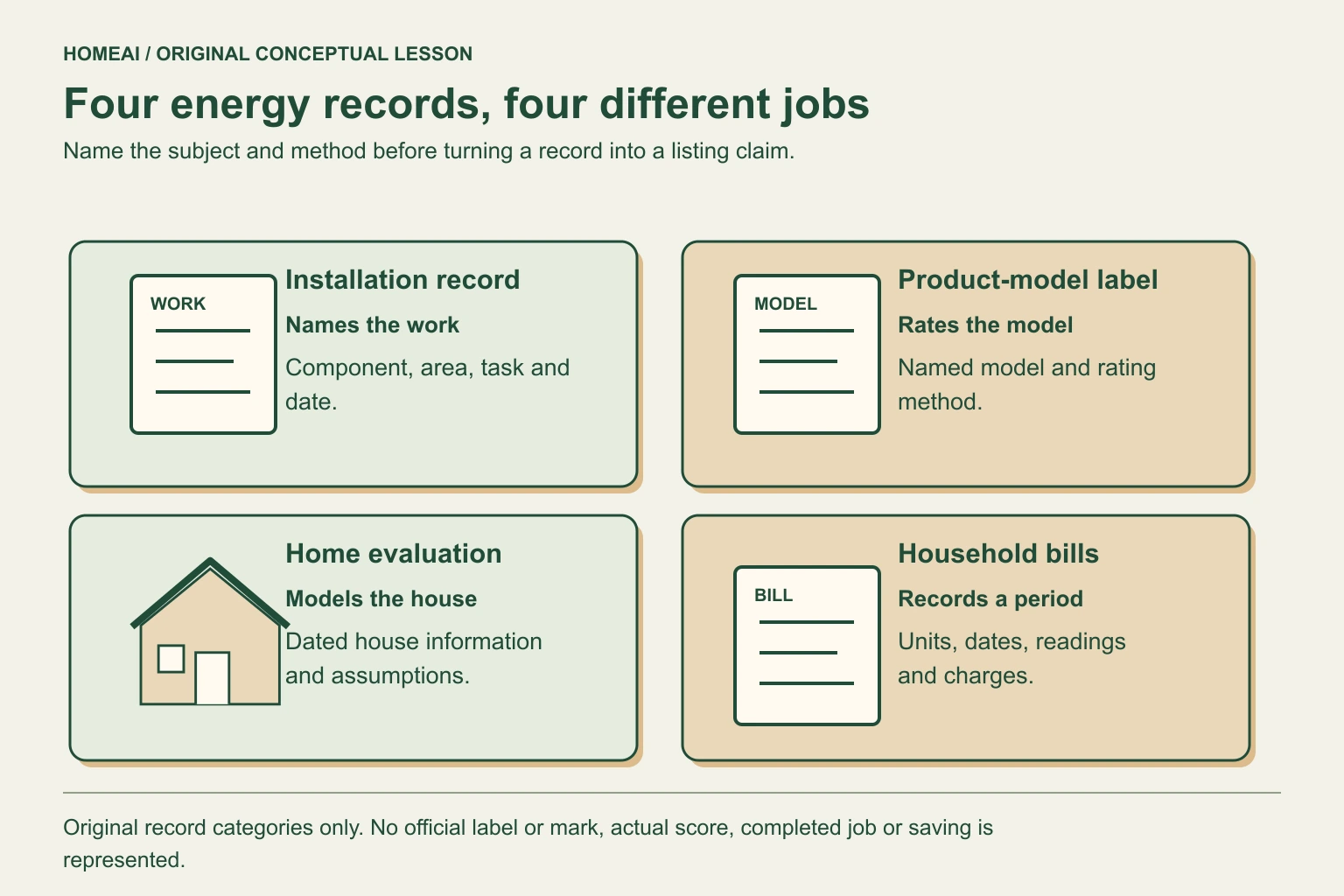
- Work record
Names the actual component, location and tasks in its stated scope.
- Model and home ratings
A product label and a home evaluation use different subjects and methods.
- Household bills
Keep the recorded period and context separate from a future savings promise.
What does this illustration leave out?
The drawings explain record categories. They show no actual model, evaluation score, completed job or saving, and reproduce no official EnerGuide mark. Use the complete original records for the home and product. Read the identity, date, method, units, work scope and important limits before quoting an energy result.
Does the claim describe installed work, a product model, a home evaluation or a household bill history?
Explore this with HomeAI ↗Opens an editable question. Nothing is sent until you choose to send it.Name what the record actually describes.
A work record, product-model label, home evaluation and household bills supply different information. Keep each original document and its dates, subject, method and limitations.
- Installation record
- Its job: Describes the named component, work area, task and date in the actual completed-work records.
- Next question: What was done here, and which assessment or follow-up has its own record?
- Product-model label
- Its job: Describes the named model under its product rating method and comparison class.
- Next question: Which model, unit and conditions apply to the quoted number?
- Home evaluation
- Its job: Combines collected house information and modelling under the evaluation’s method.
- Next question: Which home and date were evaluated, and which assumptions and upgrades are represented?
- Household bills
- Its job: Record account quantities and charges for the identified periods.
- Next question: Which readings, dates, weather and household conditions accompany the proposed comparison?
Four records with different jobs
- Installation recordNames the completed work described, component, area and date. Ask separately about assessment and follow-up.
- Product-model labelExplains the named model’s rating under the applicable method and comparison class. It does not evaluate the whole home.
- Home evaluationCombines collected house information and modelling under its method. Keep the full dated reports and assumptions.
- Household billsDescribe recorded quantities and charges for their periods. Keep read status and household/weather context before comparing.
What is actually in an EnerGuide evaluation?
NRCan describes an evaluation by a registered energy advisor representing the selected service organization. The advisor collects information about the house, including insulation, windows, equipment and airtightness, and enters it into energy simulation software. The result combines collected information and modelling; it is not a meter reading of every future year.
Keep the supplied label, homeowner information sheet and renovation upgrade report with the property identity and evaluation date. Ask the advisor to explain uncertain entries, access limits and the collected information behind the result. A later evaluation should be read with the upgrades that preceded it; an earlier report cannot describe work completed afterward.
Let the advisor arrange the evaluation and explain preparation and safety for the actual visit. Do not recreate a blower-door test or adjust fuel-burning equipment to check the rating yourself. This guide explains document roles; the evaluation’s procedures, findings and qualifications belong with the responsible service organization and advisor.
Do recommended upgrades count as achieved improvements?
A recommended upgrade is a plan for work, with estimated results under its assumptions. It can help you decide what to do. It does not record that the work happened. If you completed only part of a recommendation, identify that part from the actual job records and keep the earlier recommendation labelled with its original status.
Ask the energy advisor what a relevant follow-up needs and how to interpret comparable evaluations. Keep their methods, dates, input changes and qualifications together. Do not add forecast improvements to produce a supposedly achieved rating. A later modelled result may be useful without showing how much of the difference came from one particular component.
For a listing, describe a documented improvement and offer the available report for review. When a performance question remains unresolved, say which further record or assessment would answer it. The buyer can then distinguish completed work from recommended next steps and decide what fresh advice their planned use needs.
Why will a buyer’s bills differ from an EnerGuide number?
The EnerGuide home rating estimates annual net energy using standard operating conditions. NRCan separates those conditions from the household’s own operation and cautions that utility use need not match the estimate. Local weather and ordinary changes in use matter. The homeowner information sheet also identifies atypical loads such as a pool or hot tub.
Keep rated energy, actual utility energy and money charged on separate lines. An annual model result and one month’s bill describe different periods. Charges also depend on the account’s rates and other bill items. Ask the provider or advisor to explain unfamiliar units and entries before using them in a comparison.
A buyer may choose different temperatures, occupancy, equipment or renovations. Provide the rating’s full explanation and the dated household history to help them ask informed questions. Those records cannot promise the next household’s exact consumption or costs. The energy-bill guide explains how to build an ongoing use record.
What makes a billing comparison useful?
Collect complete bills for the periods you want to compare. Record start and end dates, energy units, the read status where identified, and known corrections or missing periods. Separate consumption from the amount charged. Selecting a lower dollar total does not by itself show reduced energy use or explain what caused a change.
Put relevant context beside each period: weather, occupancy, thermostat use, equipment, fuel changes and added loads. Record what the household reports and what a professional actually assessed. The comparison picture below shows a fictional household changing several things at once. Its lower charge cannot isolate the insulation’s contribution.
Ask a qualified analyst or energy advisor whether the available information supports the comparison you want to make. They can explain the appropriate baseline, method and remaining uncertainty. Preserve missing information rather than filling it with favourable assumptions. This page supplies no calculation that turns every bill difference into verified retrofit savings.
Ask what changed between the bills
Two invented periods sit beside rows for work, household use, weather/dates and the bill. More than the insulation changes between the periods.
Numbers identify the parts explained below.
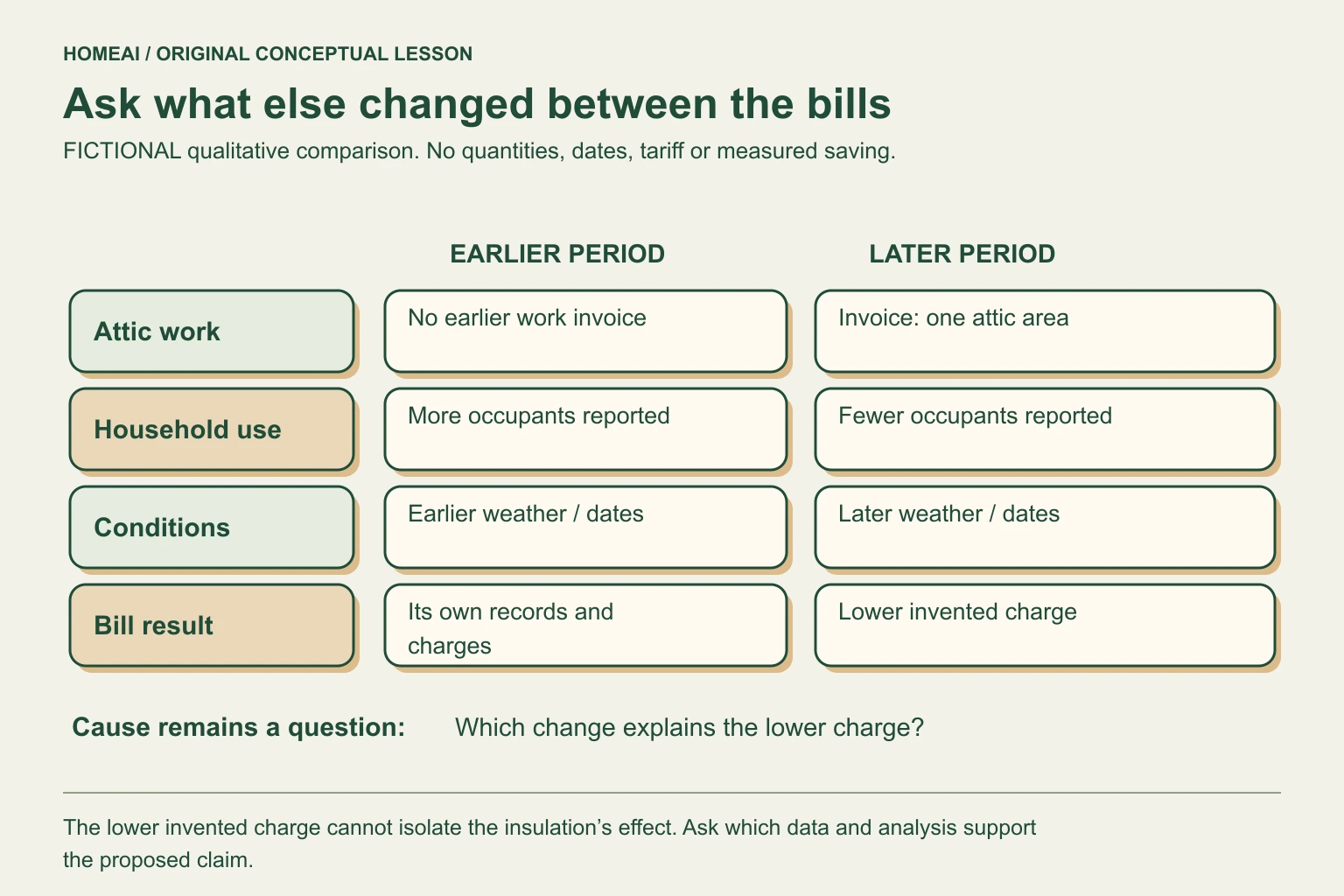
- The upgrade
The invoice names one attic area; its own scope stays identifiable.
- Other changes
Household use and conditions can change alongside the work.
- Cause question
The lower charge still needs an explanation; one visible upgrade cannot supply it.
What does this illustration leave out?
This is a fictional qualitative comparison with no quantities, dates, tariff or actual home result. A lower charge does not isolate a cause. Ask the appropriate analyst which data and method can answer the proposed claim. Fictional teaching comparison only. Preserve actual dates, units, readings, context and missing information.
Which changes and missing data must be understood before attributing a billing result to the upgrade?
Explore this with HomeAI ↗Opens an editable question. Nothing is sent until you choose to send it.Keep the other changes beside the upgrade.
These invented qualitative periods are a reading exercise. They contain no actual measurements, savings percentage or claim about a home.
- Documented work
- Earlier period: No attic work invoice in this invented earlier period.
- Later period: An invoice describes insulation in one named attic area.
- Next question: What is the completed scope, and does any separate assessment describe its result?
- Household use
- Earlier period: The invented seller reports more occupants and a different temperature preference.
- Later period: The invented seller reports fewer occupants and changed temperature use.
- Next question: How could reported household changes affect the comparison?
- Weather and dates
- Earlier period: An earlier period, with its own weather and billing dates.
- Later period: A later period, with different conditions; matched weather analysis is not supplied.
- Next question: Are the periods comparable, and what data or analysis is still needed?
- Bill and claim
- Earlier period: The original bills describe their own quantities, charges and readings.
- Later period: The invented total charge is lower; a complete attributed analysis is not supplied.
- Next question: What explains the change, and which narrower statement does the available file support?
The lower invented total charge does not isolate the insulation’s effect. Read actual quantities, charges, dates, read status, fuel and relevant household/weather changes with the appropriate advisor before making a causal claim.
Questions behind a before-and-after claim
- Periods and unitsAre the dates complete and comparable, and do the records measure the same quantity and location?
- Rates and readsDid charges, tariffs, estimated readings, corrections or the account arrangement change?
- Household and equipmentDid occupancy, thermostat use, appliances, fuel or other upgrades change? Attribute this context to its source.
- Causal conclusionWhich specialist analysis can distinguish the upgrade’s contribution from coincident changes, and what uncertainty remains?
Can I attribute the improvement to one upgrade?
Attribution means explaining what caused a change. New insulation, milder weather and fewer occupants can coincide. A before-and-after comparison can be useful while leaving their individual contributions unanswered. Ask the appropriate specialist what evidence and method would support a causal claim before assigning the whole change to the most visible upgrade.
Keep a forecast, a home model and observed bills identified by their own authors, methods and dates. A forecast explains an estimated outcome under stated assumptions. A billing history describes a household period. Neither automatically establishes the next owner’s result or a percentage caused by one component.
Apply the same care to comfort and environmental claims: state what was assessed and keep the relevant limits. A narrow energy result should not become a broad certification or quantified benefit without support. This guide establishes no payback, resale premium or return on investment for the property.
How should a realtor present the supported information?
Give the realtor the proposed sentences, their supporting documents and remaining questions. Ask them to match listing wording to the dated evidence and current provincial requirements. Ontario’s RECO guidance addresses correct, verifiable information and misleading statements. Alberta’s RECA requires truthful, non-misleading licensee advertising. These examples concern those provinces’ professionals, rather than every seller’s legal duties across Canada.
A useful sentence can name the documented component or work area and its installation date. Another can identify the dated evaluation and offer the report for review. Avoid broader wording that invents completed scope, credentials, approvals or a guaranteed saving. Ask the realtor and relevant specialist how to explain an unresolved performance question.
Share records through the process agreed with your transaction professionals. Ask what personal information to remove and which consent or access is needed. An explanatory index should help readers find the complete original documents. Keep a report’s limits beside its result when preparing the shorter listing description.
How would a fictional seller correct an overstated claim?
Fictional example: Noor has an invoice naming insulation work in one attic area, an earlier upgrade recommendation and two incomplete billing periods. Noor proposes “fully upgraded home with guaranteed lower bills.” The invoice supports its named task. The recommendation describes earlier proposed work, and the bills leave the comparison context incomplete.
Noor changes the file to identify the documented attic work and keeps the old recommendation in its original role. An energy advisor is asked whether a relevant later evaluation would help answer the performance question. The realtor reviews supported wording under the applicable local framework. Noor preserves the unanswered billing questions alongside the records.
These invented records belong to no actual home, owner, installer or evaluation. The example does not establish that the upgrade failed or that a saving exists. It teaches how narrower, well-supported wording gives buyers a useful starting point for their own document review and specialist questions.
What should the next owner receive?
Provide the installation records, matching manuals, complete evaluation documents, relevant commissioning and service reports, warranties and outstanding recommendations. Keep their authors, dates, units and important limits. Label household observations as that household’s history and professional findings as the named assessment’s conclusions.
Organize the handover by component and question. A buyer should be able to find the attic work scope, the dated home evaluation and the complete billing periods without guessing which one supports the listing sentence. Keep account credentials and unrelated personal information out of shared copies. Ask the transaction professionals how and when to transfer the appropriate material.
The next household’s plans may need fresh advice. Added loads, changed occupancy or renovations can alter the energy question. HomeAI helps explain the existing file and prepare useful questions; qualified providers assess the installed home, and transaction professionals handle the sale. A readable handover supplies information without promising the buyer’s future bills.
Practice the distinction.
Noor narrows a broad savings claim
Fictional example: Noor has an attic-area work invoice, an earlier recommendation and two incomplete billing periods.
Reported observations
- The invoice names one attic work area.
- The recommendation came before the documented work.
- The imagined bill sequence lacks important periods and context.
Compare the explanations
Expand each possibility to see the evidence needed to distinguish it. Similar symptoms can have different mechanisms.
The named work can be described clearly
The invoice can support its stated task and location without a whole-home performance promise.
The matched complete work record and related changes or completion documents.
The energy result needs another answer
No comparable later evaluation or adequate analysis is supplied to attribute a saving to the upgrade.
The appropriate advisor’s explanation of needed data, evaluation scope and comparison method.
A useful next question
Noor describes the documented attic work, preserves the earlier recommendation and takes proposed performance wording to the energy advisor and realtor.
No actual home, rating, retrofit result, saving, return or listing approval is represented.
Know what the words mean.
- Energy claim boundary
- The component or home, period, method and result that the supported sentence describes. Keep the sentence within that scope.
- Rated energy
- Energy information for a model or home under its stated rating conditions. It differs from a household’s actual use.
- Upgrade forecast
- An estimated result for proposed work, with its author and assumptions. It does not record completed work or an achieved saving.
- Billing context
- The dates, readings, rates, household changes and conditions needed to understand a utility comparison.
- Attribution
- Explaining what caused a change. An upgrade occurring between two bills does not isolate its contribution.
Questions to bring
to the conversation.
- What exact task, component, work area and date does the installation record describe?
- Is the quoted result a product rating, home model, forecast, recorded energy or money charged?
- Which upgrades preceded the evaluation, and which recommendations remain proposed?
- Do the compared periods have complete units, dates, readings and relevant household and weather context?
- Does the realtor’s proposed wording match the supported result and current local requirements?
Separate a showing observation, an existing record and a new professional assessment. Unknown means a question remains; it does not automatically mean a defect.
Use the evidence planner ↗Go to the source.
Original HomeAI explanation informed by these public references. Sources support the underlying guidance; they have not reviewed or endorsed HomeAI. Diagrams are conceptual, and calculator outputs depend on your inputs.
Chapter references reviewed for this refresh on October 5, 2026. NRCan distinguishes product labels, modelled home evaluations and household bills. RECO and RECA advertising guidance is regional licensee guidance, not a complete statement of every seller’s duties. Have supported wording and current local transaction questions reviewed appropriately.
Publication & source review
First published .
Sources reviewed .
- Natural Resources Canada · After your EnerGuide home evaluation
Where this reference applies
Jurisdiction: Canada · EnerGuide home methodology
Edition: Modified November 28, 2025; observed October 2, 2026
House rating, homeowner information, upgrade recommendations, standard operating assumptions and differences from household utility use. No guaranteed savings or resale result.
- Natural Resources Canada · EnerGuide home evaluations
Where this reference applies
Jurisdiction: Canada · EnerGuide evaluation process
Edition: Modified December 23, 2024; observed October 2, 2026
Registered advisor, collected home information, airtightness test and simulation process. Evaluation access and safety procedures remain with the advisor.
- Natural Resources Canada · The EnerGuide product label
Where this reference applies
Jurisdiction: Canada · product rating and labelling
Edition: Modified March 31, 2026; observed October 2, 2026
Product-model labels and comparison classes. Product ratings and ENERGY STAR certification are distinct from a home energy evaluation or actual household bill.
- Real Estate Council of Ontario · Advertising requirements
Where this reference applies
Jurisdiction: Ontario real estate brokerages and agents
Edition: Official page modified June 21, 2026; observed October 2, 2026
Bounded article reading: definition of advertising, clear/verifiable information and false/misleading/deceptive statements. This is Ontario licensee guidance, not a complete account of every seller’s legal duties.
- Real Estate Council of Alberta · Advertising
Where this reference applies
Jurisdiction: Alberta licensed real estate, mortgage and property-management professionals
Edition: Current official page observed October 2, 2026; page modification date not displayed
Licensees must advertise truthfully and without misleading statements. Linked detailed guidelines were not independently reviewed for this draft.
Have a question about your home?
Start with the symptom, timing and what you have observed.
Ask HomeAI