Jump to a question in this guide
- What does a comparable sale help you understand?
- Which transaction details make a sale relevant?
- How do you compare the homes rather than just their prices?
- Why is repair cost different from a value adjustment?
- What can renovation photographs and invoices prove?
- How should unknown condition in a comparable be handled?
- What changes when an apartment's concern is shared?
- How do purpose, date and assumptions limit a value opinion?
- Can you learn anything from a simple price-per-area number?
- What does a fictional condition comparison reveal?
- Who should answer the market and technical questions?
- What should the buyer retain before deciding?
- A completed comparable sale, an asking price and a renovation invoice are different evidence.
- Match property, area basis, transaction date and known condition before interpreting price differences.
- A repair cost is not automatically a dollar-for-dollar market-value adjustment.
- Keep unknown comparable condition, subject repair cash and the appraiser’s assumptions visible.
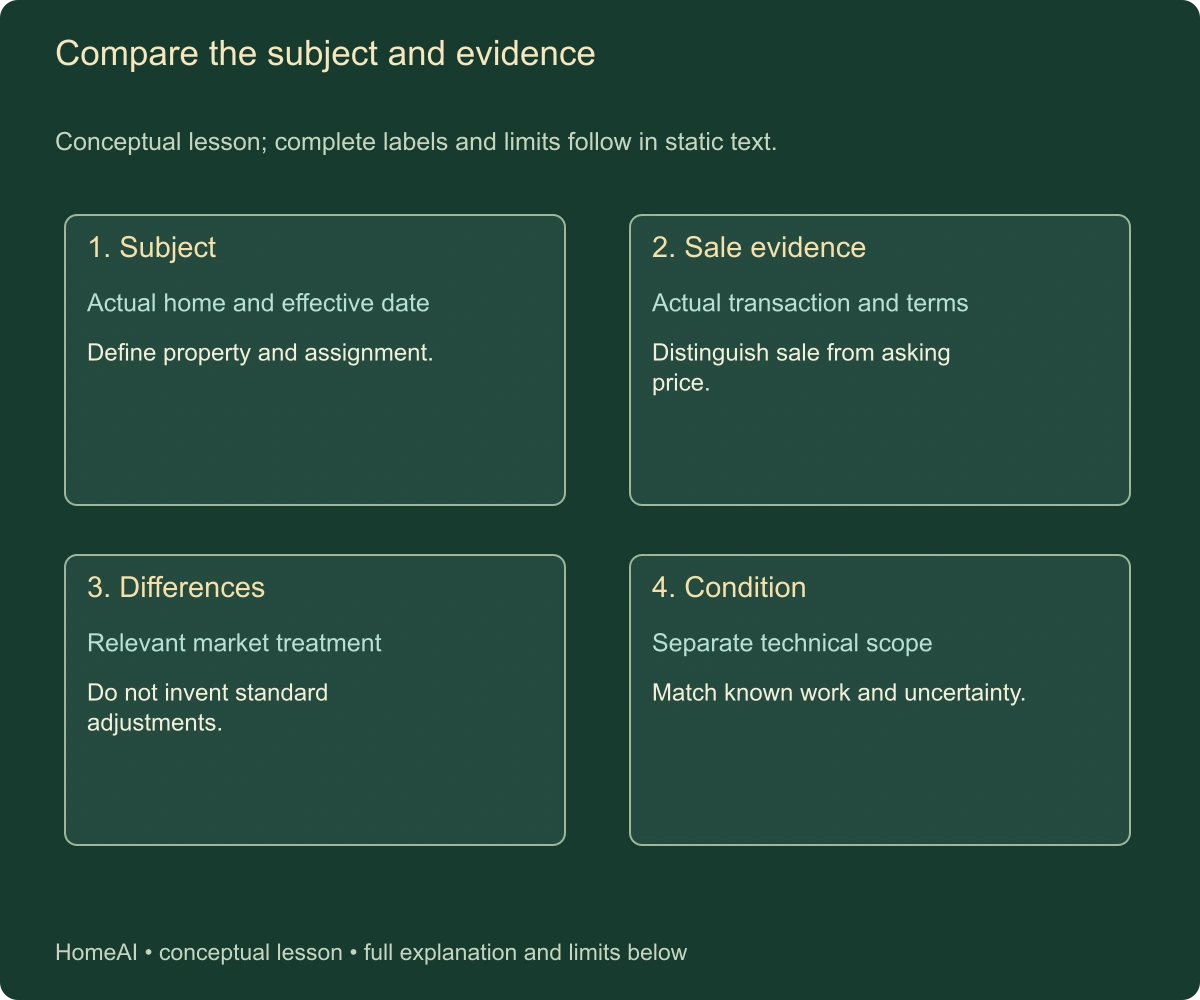
The subject, transaction, differences and condition each supply a different part of the comparison.
About this illustration
No selected comparable or value opinion. This is a conceptual teaching model, not an assessment of your home.
6 picture lessons appear beside the questions in this guide. Use them to understand the explanation, then consider what it means for your home.
What does a comparable sale help you understand?
A comparable sale is evidence from another property transaction that helps inform an opinion about the subject property's value. It is useful because it records what happened in a market, rather than only what a seller hopes to receive. Its usefulness depends on how well the transaction and property match the question being asked. A nearby address and an attractive photograph are only the beginning.
Start with the subject home: location, property type, size information, features, ownership arrangement and the relevant valuation date. Then ask which actual sales illuminate that home in that market. The Appraisal Institute of Canada's consumer guide describes the comparison of similar recent transactions and adjustments for relevant differences. It does not supply a universal amount to add for a garage or subtract for an older roof.
Condition belongs alongside the comparison because two apparently similar homes can differ in identified work, uncertainty and usable features. Keep the technical question visible: what is known about each home's condition, what was merely reported and what was not assessed? The absence of a defect in a listing description is not evidence that a specialist examined and excluded it.
This guide follows the comparison itself rather than repeating the general distinction between appraisal and inspection. The buyer needs to understand why a sale is relevant, how its differences were considered and what remains unknown about the subject home. A value opinion and a repair assessment can inform the same decision while retaining different purposes, methods and limits.
Compare the subject and evidence
The subject, transaction, differences and condition each supply a different part of the comparison.
Numbers identify the parts explained below.
- Subject
Actual home and effective date. Define property and assignment.
- Sale evidence
Actual transaction and terms. Distinguish sale from asking price.
- Differences
Relevant market treatment. Do not invent standard adjustments.
What does this illustration leave out?
No selected comparable or value opinion. This illustration explains an idea. It is not an installation guide.
Which actual records and qualified advice answer this distinction?
Explore this with HomeAI ↗Opens an editable question. Nothing is sent until you choose to send it.Compare the subject and evidence
Conceptual lesson; complete labels and limits follow in static text.
- Subject
- Actual home and effective date. Define property and assignment.
- Sale evidence
- Actual transaction and terms. Distinguish sale from asking price.
- Differences
- Relevant market treatment. Do not invent standard adjustments.
- Condition
- Separate technical scope. Match known work and uncertainty.
The subject, transaction, differences and condition each supply a different part of the comparison.
What remains unknown: No selected comparable or value opinion.
A useful question: Which actual records and qualified advice answer this distinction?
Which transaction details make a sale relevant?
Ask for the actual sale evidence available to the professional, with the transaction date and source. An asking price records an invitation to buy. A completed sale records a transaction, subject to the information available about its terms. Keep those categories distinct. A collection of current listings may help describe competition without becoming a set of completed comparable sales.
Timing matters because the market being considered has an effective date. A sale from an earlier period may need analysis before it can inform a later value opinion. Ask the valuation professional how the selected evidence relates to that date and what market information supports the treatment. This guide provides no current price-growth rate or automatic monthly adjustment.
Location is more specific than a shared city name. Access, surrounding uses and the relevant neighbourhood market can differ between homes that look close on a map. Ask which differences buyers in that market appear to recognize and how the professional assessed them. Avoid assuming a road, school boundary or transit feature always changes value by a standard amount.
Transaction circumstances can also affect interpretation. Ask what is known about the sale terms and whether information is missing. The professional can explain the evidence's suitability within the assignment. Do not invent concessions, motivation or unusual terms to force a chosen sale into the comparison. If those facts cannot be established, the uncertainty should remain visible rather than becoming an unsupported adjustment.
How do you compare the homes rather than just their prices?
Build a plain description of the subject and each proposed comparable before looking for an adjusted total. Identify property type, relevant size measures, layout, parking, outdoor space, significant improvements and known condition differences. Use the source's actual definition for a size figure. Numbers that measure different things cannot safely become a precise price-per-area comparison merely because both are labelled size.
Ask which characteristics are materially similar and which differ. Two homes may have the same bedroom count while differing in layout, usable space or the status of an altered area. A photograph can show a room's appearance without establishing its permissions, dimensions or suitability for the claimed use. Retain the relevant property records and professional findings rather than filling the gap with a listing label.
The valuation professional's adjustment concerns how a difference contributes to value in the relevant market and assignment. It is not automatically the cost to build or replace the feature. AIC explains that renovation expenditure is not necessarily returned in market value. Ask what evidence supports the particular treatment and whether the information allows a conclusion at all.
A comparison table should therefore explain the differences in words as well as showing any professional numerical adjustments. A reader should be able to follow why a sale was included and what assumption was made about its condition. An unexplained adjusted price can look authoritative while concealing a very weak match. Clarity about the reasoning helps the buyer understand both usefulness and limits.
Why is repair cost different from a value adjustment?
A repair estimate addresses defined work under stated assumptions: investigation, materials, access, labour, reinstatement and other included items. A value adjustment addresses the market contribution of a difference within a valuation assignment. They concern related facts but are not the same calculation. An invented CAD15,000 repair estimate does not establish an equal CAD15,000 reduction in market value.
The scope of the proposed work matters before its cost can be useful. A ceiling stain might lead to an enquiry about a roof, plumbing or another cause. A quotation to repaint the ceiling does not address every possible source of the mark. Obtain the appropriate technical assessment and identify what work the estimate actually includes rather than using the cheapest visible finish repair as the complete condition difference.
Conversely, a replacement proposal may include an upgrade beyond addressing the identified concern. Ask which part restores the intended function and which part changes materials, performance or appearance by choice. The valuation professional needs the actual distinction when considering the property. Neither a premium upgrade price nor an owner's original expenditure automatically becomes market value.
Keep the buyer's own cash requirement separate as well. A purchaser may need funds and access to do necessary work soon after completion even if the market's value treatment differs from the quoted cost. The purchase decision can therefore involve value, near-term cash, disruption and unresolved technical questions. A single negotiated price cannot make those different requirements disappear.
A visible mark is not a repair scope
Observation can prompt investigation; a finding can inform a repair scope. Value treatment is a separate professional task, not an automatic subtraction.
Numbers identify the parts explained below.
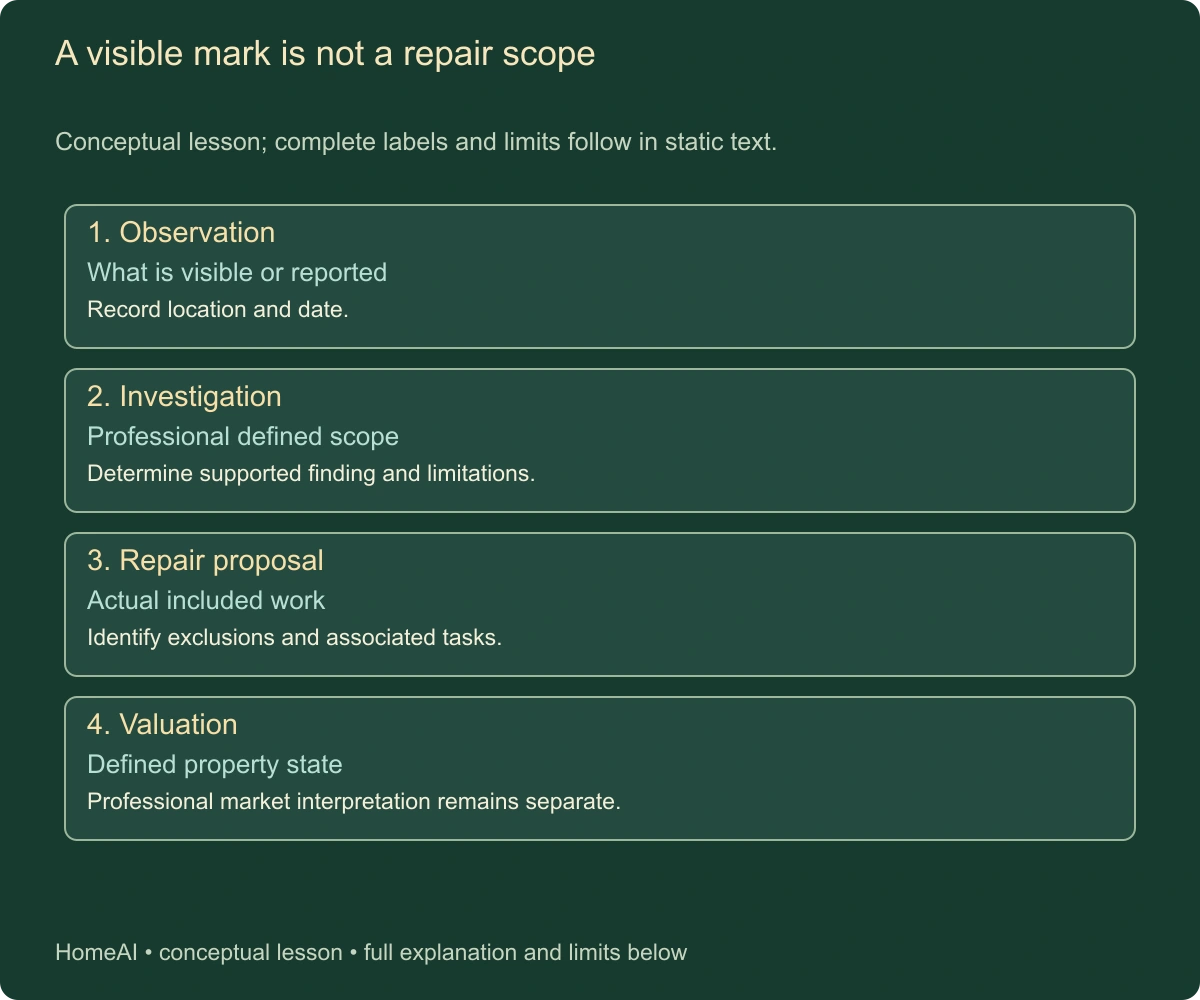
- Observation
What is visible or reported. Record location and date.
- Investigation
Professional defined scope. Determine supported finding and limitations.
- Repair proposal
Actual included work. Identify exclusions and associated tasks.
What does this illustration leave out?
No defect cause, repair cost or market adjustment. This illustration explains an idea. It is not an installation guide.
Which actual records and qualified advice answer this distinction?
Explore this with HomeAI ↗Opens an editable question. Nothing is sent until you choose to send it.What does a visible condition difference leave unresolved
The roof and upstairs ceiling mark locate two different condition questions. The mark is an observation; deciding whether roof work, another source or a separate cause explains it needs the actual investigation. Use the view to identify the area and request the matching scope, rather than subtracting an assumed roof repair from a comparable price. Concealed services and the cause are not shown.
Numbers identify the parts explained below.
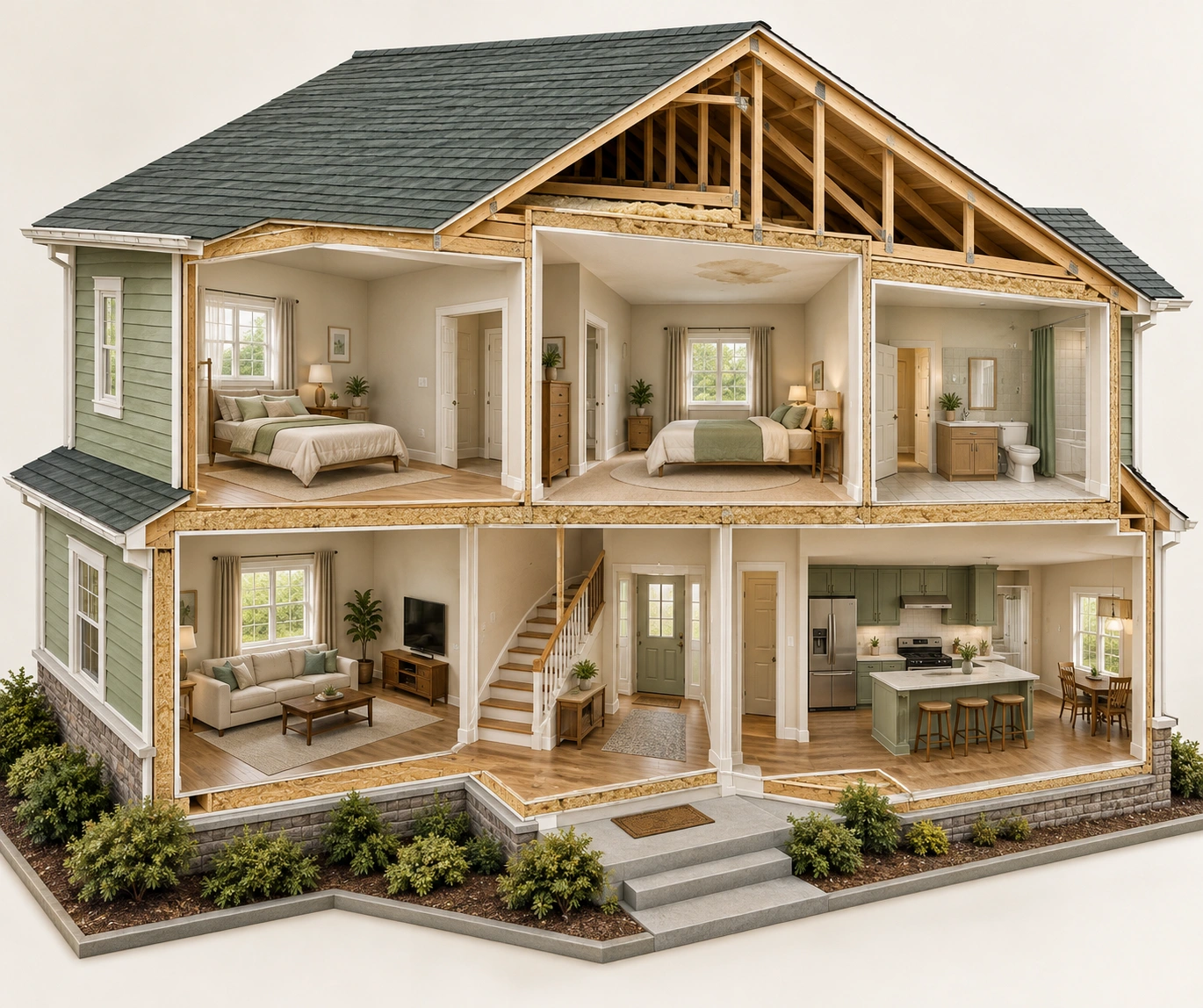
- Visible context
Roof and upstairs stained ceiling visible; no cause shown. Concealed services not visible.
- Limit
Conceptual generated context. No actual property, installed design, topology, measured performance, approval, ownership or responsibility established.
What does this illustration leave out?
Conceptual generated context. No actual property, installed design, topology, measured performance, approval, ownership or responsibility established. This illustration explains an idea. It is not an installation guide.
What does a visible condition difference leave unresolved?
Explore this with HomeAI ↗Opens an editable question. Nothing is sent until you choose to send it.A visible mark is not a repair scope
Conceptual lesson; complete labels and limits follow in static text.
- Observation
- What is visible or reported. Record location and date.
- Investigation
- Professional defined scope. Determine supported finding and limitations.
- Repair proposal
- Actual included work. Identify exclusions and associated tasks.
- Valuation
- Defined property state. Professional market interpretation remains separate.
Observation can prompt investigation; a finding can inform a repair scope. Value treatment is a separate professional task, not an automatic subtraction.
What remains unknown: No defect cause, repair cost or market adjustment.
A useful question: Which actual records and qualified advice answer this distinction?
What does a visible condition difference leave unresolved
Roof and upstairs stained ceiling visible; no cause shown. Concealed services not visible.
What remains unknown: Conceptual generated context. No actual property, installed design, topology, measured performance, approval, ownership or responsibility established.
A useful question: What does a visible condition difference leave unresolved?
What can renovation photographs and invoices prove?
A photograph can show visible finishes at the time it was taken, within its frame. An invoice can describe billed work by the named provider. Neither automatically proves the concealed scope, permissions, present performance or completion of every related part. Ask which actual work the records describe and whether other completion or technical documents are relevant.
A kitchen with newer cabinet fronts can still contain older adjacent finishes and systems. The new appearance is real; the inference that everything was renewed is not established by appearance alone. Record what is visibly different, what the seller reports and what the documents support. That gives the appraiser and technical professional a better starting point without treating a cosmetic change as a whole-system replacement.
Ask for dates and scope rather than a broad statement that the home was fully renovated. Which rooms, assemblies or equipment changed? What was retained? What inspections, commissioning or other completion evidence actually apply? Requirements depend on the work and jurisdiction. This guide does not issue a compliance finding from an invoice or promise that an older project followed today's requirements.
AIC's consumer material warns against assuming every renovation dollar returns on sale. Market preferences and the subject property's context affect contributory value. The buyer should therefore avoid adding up invoices and treating their total as a proven premium over another home. The proper enquiries concern the actual improvements, their documented scope, condition and contribution within the relevant market evidence.
Spending and market contribution differ
Four separate boxes prevent a renovation invoice from becoming proof of condition or a dollar-for-dollar value increase.
Numbers identify the parts explained below.
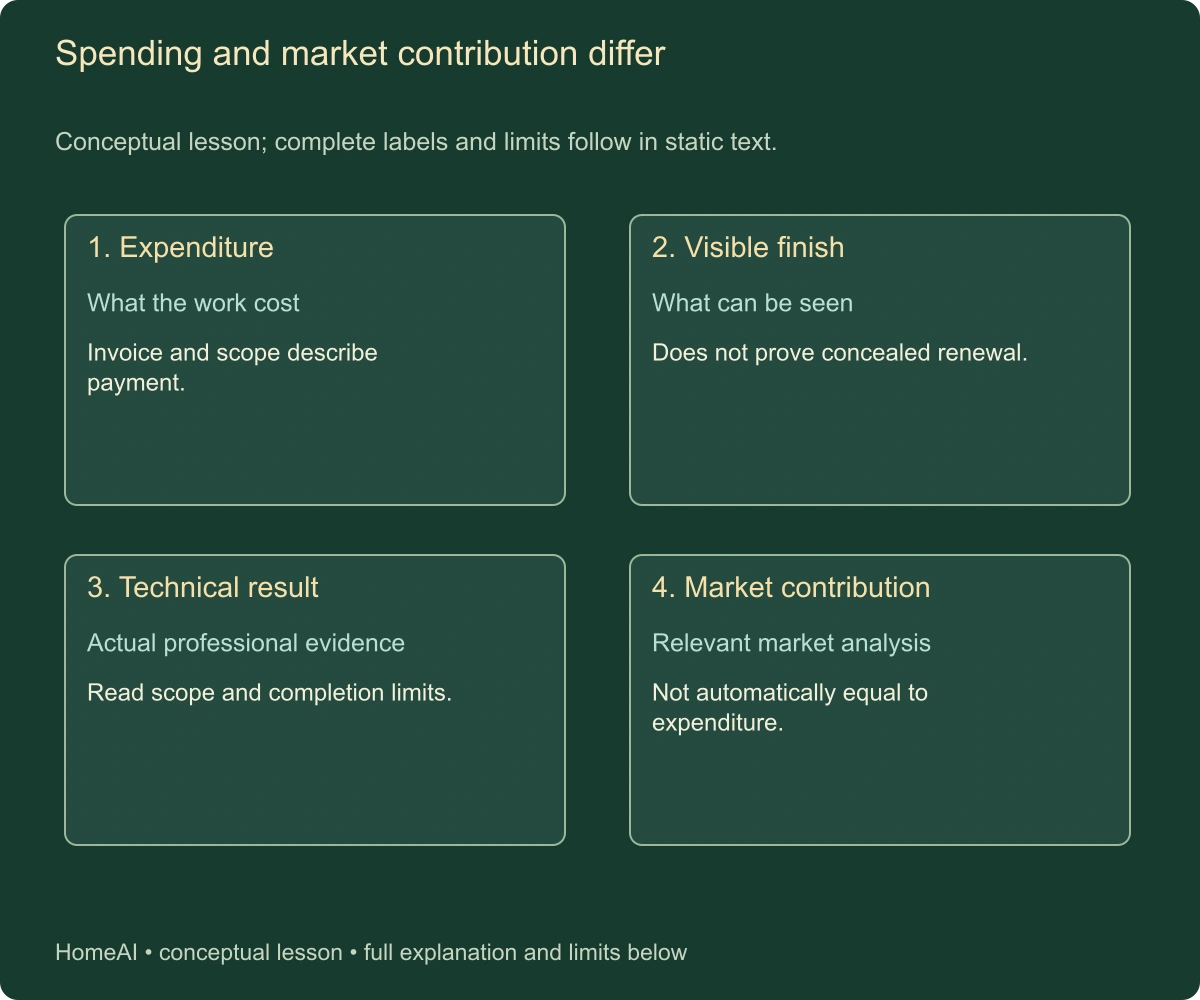
- Expenditure
What the work cost. Invoice and scope describe payment.
- Visible finish
What can be seen. Does not prove concealed renewal.
- Technical result
Actual professional evidence. Read scope and completion limits.
What does this illustration leave out?
No percentage return, market forecast or hidden-work certification. This illustration explains an idea. It is not an installation guide.
Which actual records and qualified advice answer this distinction?
Explore this with HomeAI ↗Opens an editable question. Nothing is sent until you choose to send it.Which improvements are visible, and which scope still needs records
The newer-looking cabinet fronts, floor finishes and window trim show visible improvement work a buyer can describe. That appearance does not identify which cabinet boxes, services or concealed assemblies were retained. Match the visible changes to dated invoices and technical records before treating the renovation as either a whole-system renewal or a dollar-for-dollar market premium.
Numbers identify the parts explained below.

- Visible context
Sage cabinet fronts, contrasting tile/wood floor and wood window trim visible; no concealed system renewal proof.
- Limit
Conceptual generated context. No actual property, installed design, topology, measured performance, approval, ownership or responsibility established.
What does this illustration leave out?
Conceptual generated context. No actual property, installed design, topology, measured performance, approval, ownership or responsibility established. This illustration explains an idea. It is not an installation guide.
Which improvements are visible, and which scope still needs records?
Explore this with HomeAI ↗Opens an editable question. Nothing is sent until you choose to send it.Spending and market contribution differ
Conceptual lesson; complete labels and limits follow in static text.
- Expenditure
- What the work cost. Invoice and scope describe payment.
- Visible finish
- What can be seen. Does not prove concealed renewal.
- Technical result
- Actual professional evidence. Read scope and completion limits.
- Market contribution
- Relevant market analysis. Not automatically equal to expenditure.
Four separate boxes prevent a renovation invoice from becoming proof of condition or a dollar-for-dollar value increase.
What remains unknown: No percentage return, market forecast or hidden-work certification.
A useful question: Which actual records and qualified advice answer this distinction?
Which improvements are visible, and which scope still needs records
Sage cabinet fronts, contrasting tile/wood floor and wood window trim visible; no concealed system renewal proof.
What remains unknown: Conceptual generated context. No actual property, installed design, topology, measured performance, approval, ownership or responsibility established.
A useful question: Which improvements are visible, and which scope still needs records?
How should unknown condition in a comparable be handled?
The subject home may have a detailed assessment while a comparable has only listing photographs and limited description. That is an unequal evidence position. Identify it directly. Do not label the comparable defect-free merely because no inspection report was available, and do not assume it shared the subject home's concern simply because the buildings have a similar age or appearance.
Ask the valuation professional what condition information was available for each sale and how that affected confidence in the comparison. Some differences may be supportable; others may require assumptions or reduce the weight placed on that evidence. A useful explanation can say the information is insufficient for a precise adjustment. Invented precision does not repair a missing record.
The buyer can request relevant available information through the proper transaction channels without entering another property or seeking private documents without authority. Preserve the source and status of what is received. A public description, a seller's report and a qualified assessment carry different limits. The professional decides how they can be used within the actual assignment.
If a sale is otherwise a close match but its condition is uncertain, compare it with other evidence rather than letting one unexplained number dominate. Ask whether the overall range and conclusion remain reasonable under the disclosed uncertainty. This is a question for the valuation professional, not an instruction to manufacture a discount or apply a generic percentage for unknowns.
What changes when an apartment's concern is shared?
An apartment's visible interior is only part of its property context. Shared structure, envelope or services can affect the purchaser's responsibilities and future work enquiries. Ask whether the proposed comparable evidence concerns similar ownership arrangements and whether any known shared projects or obligations were considered. A newer kitchen cannot answer the building's parkade-renewal question.
Keep the building documents tied to the specific property and dates. A reserve study, project notice, technical report and funding decision describe different things. The established condominium-reserve guide explains those records in depth. Here the comparison question is narrower: what known shared condition or obligation differentiates the subject from the selected sales, and what evidence supports the professional's treatment?
Avoid subtracting a project's entire announced budget from one apartment's value. The household's actual responsibility, timing and funding treatment need review of the governing documents and professional advice. A building-wide cost is not automatically a unit's cash requirement, and a unit's cash requirement is not automatically a dollar-for-dollar market adjustment. Keep each enquiry and calculation separate.
A sale from the same building may be informative without resolving every difference. Units can differ in floor, outlook, size, alterations, parking and transaction date. They may also have been sold before or after relevant information became available. Ask how these differences were addressed rather than assuming a shared street address makes the prices directly interchangeable.
How do purpose, date and assumptions limit a value opinion?
AIC's consumer guide explains that an appraisal has a client, an intended use, an effective date and stated assumptions or limiting conditions. Those details tell the reader what question the opinion addresses. A report prepared for a lender's financing decision is not automatically an unrestricted report for every purchaser purpose or later date.
Ask who may receive and rely on the report and what authorization is needed. AIC's current residential-owner page explains that the person paying for a lender-ordered appraisal is not necessarily the appraiser's client. The actual engagement and report should identify the relevant parties and uses. Do not treat payment of a fee as permission to reuse the opinion for a different transaction or dispute.
Read any assumptions about completion or condition carefully. A value opinion based on identified work being complete answers a different question from a value opinion of the present property under its observed condition. Ask which state is being considered and what evidence would be needed to establish completion. The report's assumption does not perform the repair or certify the resulting condition.
A later technical finding or changed market date can require the relevant professional to reconsider the assignment. Keep the original report intact and ask for the appropriate response rather than editing its figures yourself. A report can have been properly prepared for its original purpose while no longer answering the household's changed question. That distinction is more useful than calling every old opinion wrong.
Align the property, date and scope
A comparison is clearer when property, date and condition describe the same enquiry before the household decides.
Numbers identify the parts explained below.
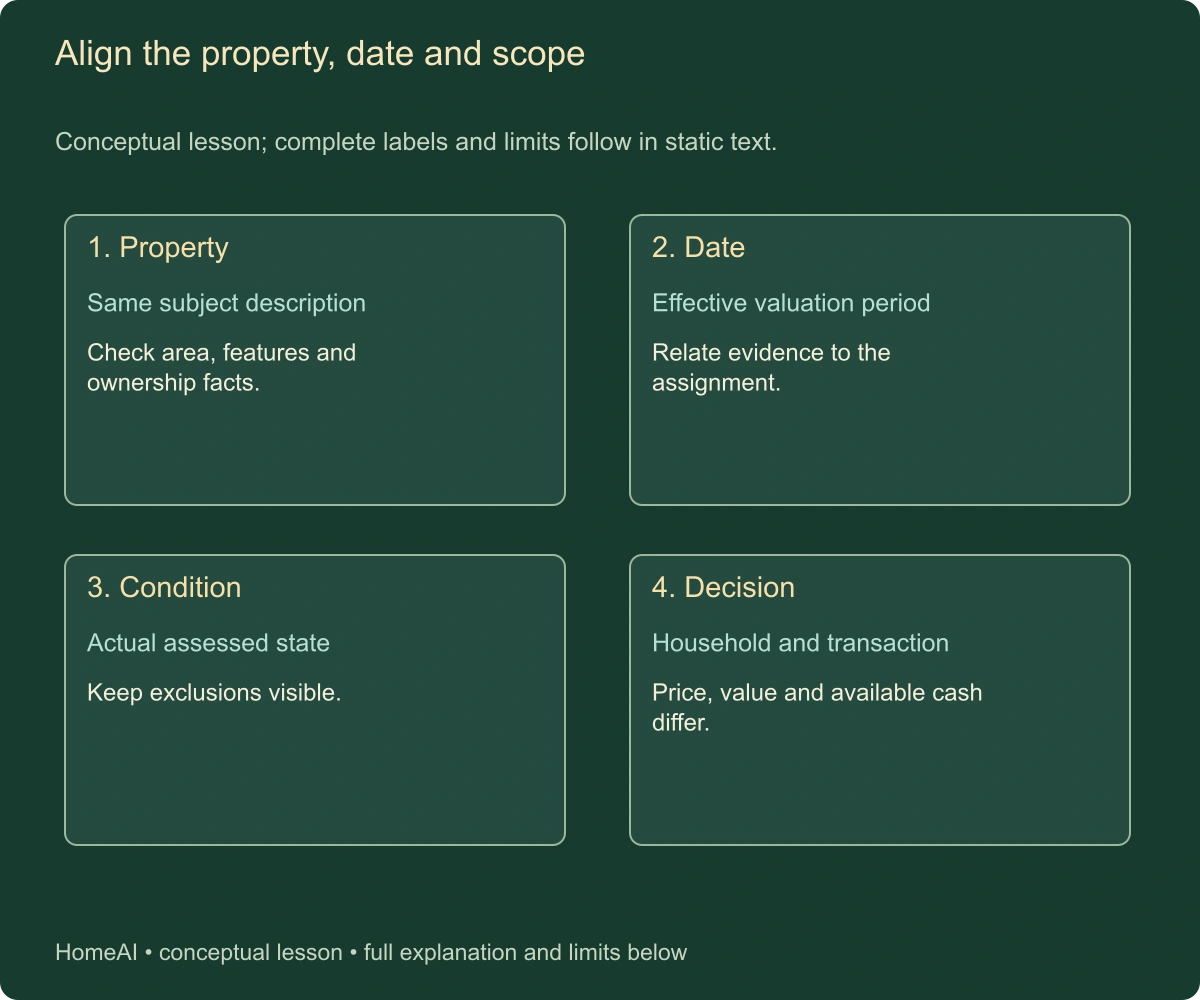
- Property
Same subject description. Check area, features and ownership facts.
- Date
Effective valuation period. Relate evidence to the assignment.
- Condition
Actual assessed state. Keep exclusions visible.
What does this illustration leave out?
No offer recommendation or appraisal acceptance. This illustration explains an idea. It is not an installation guide.
Which actual records and qualified advice answer this distinction?
Explore this with HomeAI ↗Opens an editable question. Nothing is sent until you choose to send it.Align the property, date and scope
Conceptual lesson; complete labels and limits follow in static text.
- Property
- Same subject description. Check area, features and ownership facts.
- Date
- Effective valuation period. Relate evidence to the assignment.
- Condition
- Actual assessed state. Keep exclusions visible.
- Decision
- Household and transaction. Price, value and available cash differ.
A comparison is clearer when property, date and condition describe the same enquiry before the household decides.
What remains unknown: No offer recommendation or appraisal acceptance.
A useful question: Which actual records and qualified advice answer this distinction?
Can you learn anything from a simple price-per-area number?
A price-per-area ratio divides a stated price by a stated area. It can be a descriptive starting point when the underlying measures are comparable. It is not a complete valuation method for a household's decision. A ratio alone does not explain layout, location, condition, site features, ownership obligations or the transaction circumstances behind the price.
Check the denominator before comparing ratios. Ask what the area includes, how it was measured and whether the same basis applies to each property. A finished lower-level area, an exterior measurement or a shared-area allocation may be treated differently in different records. This guide supplies no universal measurement convention. The professional should identify the actual basis used.
Even with matching area definitions, the relationship between size and price need not be a simple multiplication that preserves every other difference. A larger home may differ in layout, market appeal or other features. Ask the valuation professional how the comparable evidence supports their analysis instead of scaling one sale's ratio to produce a supposedly precise value for another home.
Keep ratios as supporting descriptions with their limits stated. If they conflict with the broader comparison, investigate why rather than choosing whichever produces the preferred conclusion. A neat calculation can be arithmetically correct while answering an incomplete question. The buyer still needs the actual property differences, condition enquiries and professional reasoning that make the comparison useful.
What does a fictional condition comparison reveal?
Fictional buyer Priya considers a subject home and two invented sales. Sale A is CAD680,000 and Sale B is CAD710,000. For this classroom example, Priya knows only that the homes have broadly similar advertised sizes and different visible finishes. These made-up figures are not local market evidence, and the example supplies no professional value opinion or actual comparable adjustments.
The subject has an invented CAD18,000 quotation for defined roof work. Priya cannot conclude that its value is exactly CAD18,000 below Sale B. The quote addresses stated work; the market contribution needs valuation analysis. Priya also cannot conclude that Sale A required no roof work because its listing did not mention a concern. That missing condition information remains part of the comparison.
Suppose the fictional quote excludes interior reinstatement and assumes access that has not been confirmed. The household's potential cash requirement is then not fully described by CAD18,000. Priya asks the technical provider to explain the scope and exclusions, while asking the valuation professional how the available sales and condition information inform the value enquiry. Neither answer is invented here.
The useful result is a better question list, not a selected winning price. Priya needs reliable property descriptions, transaction evidence, subject-condition findings and a professional explanation of relevant differences. If those records remain incomplete, the decision should reflect the uncertainty. The example deliberately supplies no approval, negotiated discount or assurance that the repair is straightforward.
Who should answer the market and technical questions?
A valuation professional addresses the defined value assignment using the relevant evidence and methods. A technical specialist addresses the identified condition, investigation or repair scope within their expertise. The transaction representative helps obtain appropriate market and property information within their role. The legal professional addresses contractual, title and responsibility questions. These contributions can be coordinated without treating them as interchangeable endorsements.
Ask the technical provider to state locations, access, observations, methods and limits. Ask the valuation professional what property state, date and evidence their opinion assumes. Then make sure the two answers describe the same subject and issue. A roof quotation for one building section should not become evidence that every roof area was assessed or renewed.
Specialist work should be arranged through appropriate authorized access. The buyer can record ordinary visible observations from permitted spaces and report them accurately. Do not climb onto roofs, open shared plant rooms, disturb finishes or operate unfamiliar equipment to improve a comparison. The professional decides what investigation is appropriate under the actual property conditions and permissions.
For regional questions, identify the actual province or territory and municipality. Contract forms, property rights, permits and professional scope can differ. The AIC consumer guide currently served at a filename containing 2023 prints an October2018 update date; that edition is retained here rather than relabelled as new2023 guidance. No historical legal rule or current code threshold is adopted from it.
What should the buyer retain before deciding?
Keep the subject description, selected sales, source dates and the professional explanation of significant similarities and differences. Retain condition records and repair scopes with their own dates and limits. A comparison should be reproducible enough for the reader to understand why the evidence was relevant, even when some information remains unavailable or a conclusion requires professional judgment.
Preserve the separation between value, price and household choice. A value opinion is prepared for its stated purpose and date. An offer price is a transaction decision under real terms. The household also considers available funds, required work, timing and suitability. They can influence one another without becoming the same number or proving that a property is safe or affordable for every buyer.
If new information arrives, ask which part of the decision changes. A revised technical scope may affect cash and disruption; a corrected area may affect the comparison; a changed transaction date may affect market relevance. Do not rewrite every figure indiscriminately. Obtain the relevant professional response and retain the earlier version so the reason for the change remains clear.
The final useful explanation is plain: these sales inform the subject for these reasons, these differences were considered, this condition evidence supports the work enquiry, and these questions remain open. That gives the purchaser a decision they can review. It avoids turning photographs, invoices or a convenient neighbouring sale into certainty that the available evidence never supplied.
A missing condition detail for a comparable is not automatically a reason to assume it matches the subject. Ask the valuation professional how the unavailable information affects the evidence and conclusion. The answer may involve a limitation, different evidence or a wider range of judgment. The household should not fill the gap with an invented repair allowance simply to make the table look complete.
Likewise, a corrected subject description should be given to the relevant professional promptly. If the area, renovation scope or ownership information changes, ask whether the existing opinion remains suitable for its stated purpose. Retain the professional response rather than independently shifting every comparable by the same amount. A consistent table can still be wrong when its starting description is wrong.
Keep learning about the connected parts
- Appraisal, inspection and specialist assessment answer different questions
- Before you make an offer: what to check, who to ask
- Renovation records: what was proposed, approved and built?
Canadian context and authorities · Visual atlas · Learning labs
Practice the distinction.
What does a fictional condition comparison reveal?
Fictional buyer Priya considers a subject home and two invented sales. Sale A is CAD680,000 and Sale B is CAD710,000. For this classroom example, Priya knows only that the homes have broadly similar advertised sizes and different visible finishes. These made-up figures are not local market evidence, and the example supplies no professional value opinion or actual comparable adjustments.
Reported observations
- The subject has an invented CAD18,000 quotation for defined roof work. Priya cannot conclude that its value is exactly CAD18,000 below Sale B. The quote addresses stated work; the market contribution needs valuation analysis. Priya also cannot conclude that Sale A required no roof work because its listing did not mention a concern. That missing condition information remains part of the comparison.
- Suppose the fictional quote excludes interior reinstatement and assumes access that has not been confirmed. The household's potential cash requirement is then not fully described by CAD18,000. Priya asks the technical provider to explain the scope and exclusions, while asking the valuation professional how the available sales and condition information inform the value enquiry. Neither answer is invented here.
A useful next question
The useful result is a better question list, not a selected winning price. Priya needs reliable property descriptions, transaction evidence, subject-condition findings and a professional explanation of relevant differences. If those records remain incomplete, the decision should reflect the uncertainty. The example deliberately supplies no approval, negotiated discount or assurance that the repair is straightforward.
Know what the words mean.
- Comparable sale
- A transaction used as evidence for the subject’s defined value enquiry.
- Subject property
- The actual home being considered.
- Effective date
- The date to which the value opinion relates.
- Adjustment
- Professional treatment of a relevant difference, supported by evidence.
- Condition scope
- What the technical provider actually examined and reported.
- Contributory value
- A feature’s market contribution, distinct from its expenditure.
- Intended user
- A person identified within the professional report’s authorized use.
Questions to bring
to the conversation.
- Why is each selected sale relevant to this subject and effective valuation date?
- Do the area figures measure the same thing, and which material features differ?
- What condition information is actually known for the subject and each comparable?
- Which work and exclusions does the repair estimate cover, separately from any market adjustment?
- Who may rely on the value opinion, for which purpose and property state?
Separate a showing observation, an existing record and a new professional assessment. Unknown means a question remains; it does not automatically mean a defect.
Use the evidence planner ↗Go to the source.
Original HomeAI explanation informed by these public references. Sources support the underlying guidance; they have not reviewed or endorsed HomeAI. Diagrams are conceptual, and calculator outputs depend on your inputs.
Primary Canadian bodies read with the recorded editions and jurisdiction limits. Generic illustrations and fictional cases establish no actual result. Actual documents, provider terms and qualified advice control.
Publication & source review
First published .
Sources reviewed .
Have a question about your home?
Start with the symptom, timing and what you have observed.
Ask HomeAI