Jump to a question in this guide
- What are you taking over with the home?
- How do a pool and a hot tub differ?
- How does water move around the system?
- Why are filtration and disinfection separate jobs?
- What does saltwater treatment mean?
- What should you understand about hot-tub heat?
- How is access to the water controlled?
- Which equipment hazards need specialist attention?
- What do the shell, support and yard contribute?
- Which permits and completed records should you request?
- What can be assessed when the system is closed for the season?
- How can you estimate the ownership work and cost?
- How would a fictional buyer resolve a promising but incomplete handover?
- What should happen before the first use and after possession?
- Learn the actual circulation, filtering, treatment and heating jobs instead of relying on clear water or an automatic-equipment label.
- Water quality, access protection, equipment and structure/site need their own appropriate assessment scopes.
- Match the transaction decision and handover to actual records, seasonal limitations, qualified advice and ongoing responsibility.
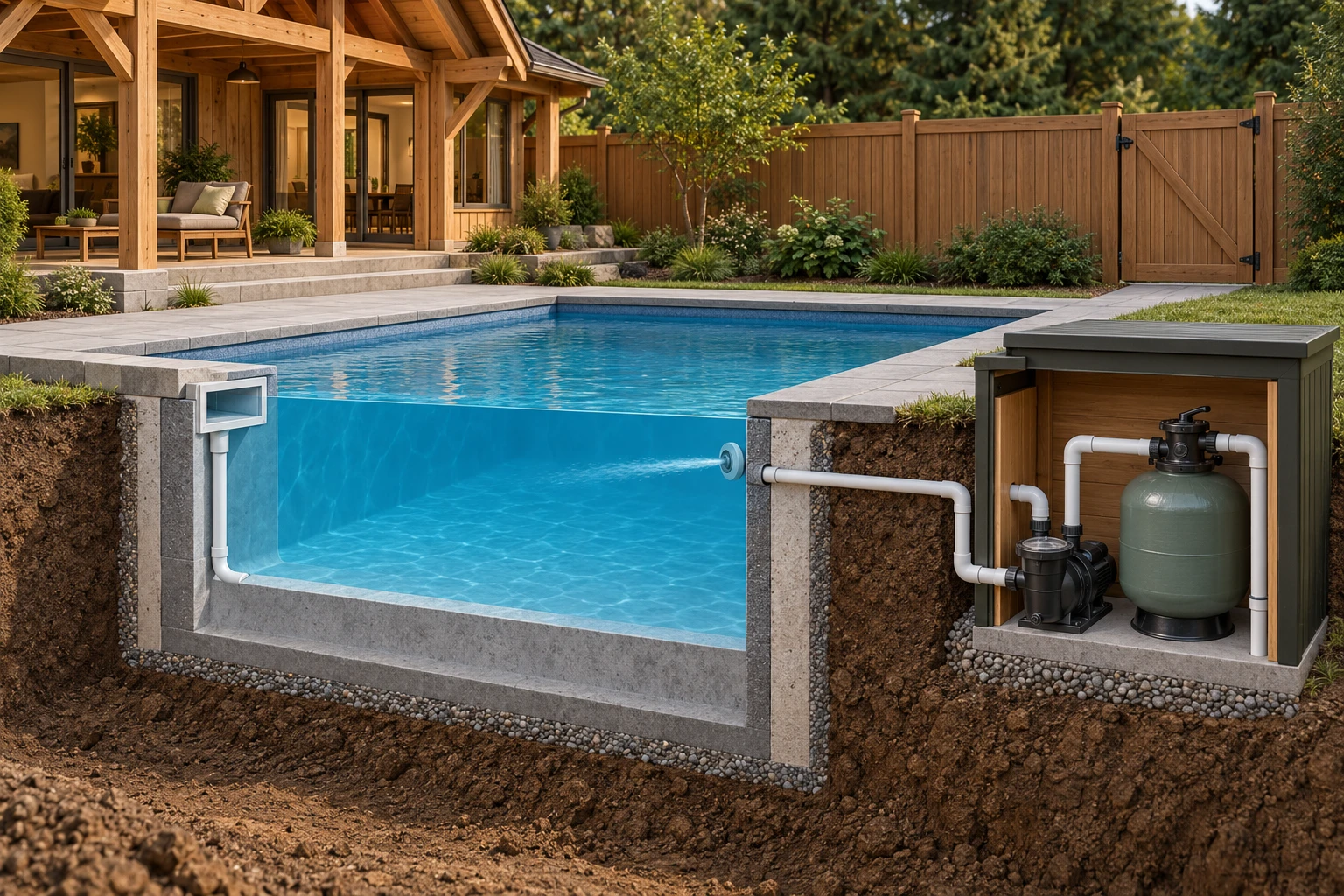
The pool shell contains the water. The pump moves water through the connected equipment, and the filter retains particles. The fence and gate concern access to the pool rather than water treatment. A buyer should therefore ask separate questions about circulation, water quality, access protection and the structure beneath and around the water.
About this illustration
The complete collection and return loop is not drawn clearly; use the labelled circulation lesson for those jobs. The image establishes no suction design, flow, disinfection, barrier compliance, shell condition or approved site detail. This is a conceptual teaching model, not an assessment of your home.
5 picture lessons appear beside the questions in this guide. Use them to understand the explanation, then consider what it means for your home.
What are you taking over with the home?
A pool or hot tub brings a water system, a place people use and an ongoing care responsibility into the purchase. Start by identifying what is included: the basin or shell, circulation and treatment equipment, heating if present, controls, access protection and surrounding surfaces. Then ask who has maintained each part and who can explain it to the next owner.
The useful buyer question is not simply whether the water looks inviting. Can the system be used as intended, what work is outstanding, and what will ownership require? Separate water quality, access safety, equipment condition and structural or site questions. One appointment may coordinate those enquiries, but it should identify which qualified person actually assesses each task.
Arrange permission and a suitable assessment before operating unfamiliar equipment or entering the water. HealthLink BC advises staying out when maintenance or water quality is uncertain. A showing is not an opportunity to try a hot tub, lift heavy covers, open equipment cabinets or test suction outlets. Immediate safety concerns take priority over a routine purchase checklist.
This national guide supplies a framework for learning and handover. Local health advice, municipal requirements, the actual equipment and the purchase agreement determine the specific work. A private residential pool also differs from a shared condominium, rental amenity or public facility; involve the authorized operator where the system is shared.
How do a pool and a hot tub differ?
Both hold water that needs suitable circulation, treatment and maintenance. A hot tub is intended for hot-water bathing and may have separate jet and circulation functions. A swimming pool has its own size, equipment and use pattern. Learn the actual arrangement rather than treating a small pool, swim spa and hot tub as interchangeable names for one machine.
Temperature, water volume and use affect the care question. Health Canada identifies temperature, number of bathers, frequency of use, contamination and recent rain among factors affecting sanitizer needs. A care programme written for a particular pool therefore should not be copied into a hot tub simply because both use a familiar chemical brand.
Ask the seller or service provider to identify the product, operating purpose and connected equipment. Is heating present? Which pump provides ordinary circulation, and which control operates jets? What treatment is installed? Which accessories belong to the sale? Model-specific answers make it possible to obtain applicable instructions and meaningful service proposals.
The handover should teach the buyer what the parts do in normal use before explaining reminders and messages. It can distinguish the water-care task from comfort settings and jet operation. A glossy brochure about relaxation is less useful than a clear component list, an appropriate operating explanation and a provider who can answer the actual system questions.
How does water move around the system?
Recirculation means moving water through equipment and back to the pool or tub. In a conceptual pool loop, water is collected from the basin, moved by a pump, passed through the filtering and other specified equipment, and returned to the basin. The connected route matters because the equipment treats water that actually reaches it.
A pump provides movement; a filter supplies a separate cleaning function. Heating and treatment devices may add further jobs along the route. Their order and connections must be identified from the actual installation. The picture lesson explains these functions, while its companion diagram makes the complete conceptual loop readable; neither is an as-built pipe drawing.
Ask the service provider to explain where water is collected, which route passes through each device and where it returns. Request a simple map matched to the equipment list. A buried line or concealed branch may require a separately agreed assessment; tracing it is not an invitation for a buyer to remove covers, operate valves or excavate the yard.
HealthLink BC notes that some hot tubs have secondary circulation arrangements that can bypass some lines. Ask how the identified model handles its different routes and what care it requires. A running pump sound or moving surface water cannot explain every concealed connection. The useful outcome is a matched operating plan, not a universal pump schedule borrowed from another system.
The pool, circulation equipment and barrier have different jobs
The pool shell contains the water. The pump moves water through the connected equipment, and the filter retains particles. The fence and gate concern access to the pool rather than water treatment. A buyer should therefore ask separate questions about circulation, water quality, access protection and the structure beneath and around the water.
Numbers identify the parts explained below.
- Pool shell and water
The containing shell and surrounding site need their own assessment. Water that looks clear does not establish water quality or the absence of leakage.
- Pump and filter
These illustrate water-moving and particle-retention equipment. Have the actual route and components identified; the image does not show every intake or return connection.
- Fence and gate
Access protection is a separate responsibility. Obtain current local requirements and qualified advice for the actual barrier, gate and any cover.
What does this illustration leave out?
The complete collection and return loop is not drawn clearly; use the labelled circulation lesson for those jobs. The image establishes no suction design, flow, disinfection, barrier compliance, shell condition or approved site detail. This illustration explains an idea. It is not an installation guide.
Which parts of the circulation, water treatment, barrier and shell were actually assessed, and which questions need another provider?
Explore this with HomeAI ↗Opens an editable question. Nothing is sent until you choose to send it.Follow the circulation loop before blaming one component
Collection, pumping, filtration and return work together. Water reaches the equipment through the collection route, the pump moves it through the connected system, the filter retains particles and the return route carries it back. Changed flow can involve more than one component. Circulation and filtration still need a separate water-treatment and quality plan.
Numbers identify the parts explained below.
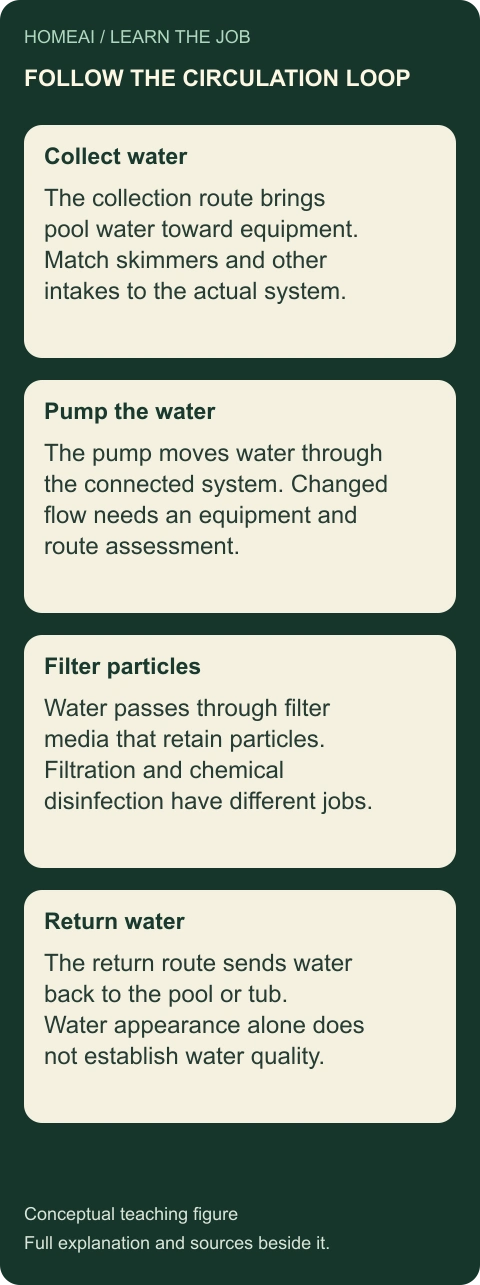
- Collection
The collection route brings water toward the equipment. Have skimmers and other actual intakes identified without opening equipment or approaching a suction outlet.
- Pumping
The pump supplies movement through the connected system. Ask what an equipment assessment includes when flow, sound or operation changes.
- Filtration
Water passes through media that retain particles. Filtration has a different job from chemical disinfection, and clearer appearance does not establish adequate treatment.
- Return
The return route carries water back to the pool or tub. Ask which actual branches, valves or other equipment were included in the assessment.
What does this illustration leave out?
This conceptual sequence gives no suction design, flow rate, drain arrangement, installation detail or troubleshooting procedure. Actual pool and hot-tub layouts differ. This illustration explains an idea. It is not an installation guide.
Can the specialist explain the complete actual circulation route and what the reported change suggests within that assessment?
Explore this with HomeAI ↗Opens an editable question. Nothing is sent until you choose to send it.Follow the conceptual water loop
- CollectWater enters the connected route from the basin.
- MoveThe pump provides movement through the route.
- Filter and treatIdentified equipment performs its own specified jobs.
- ReturnWater returns to the basin; the actual connected routes require confirmation.
A conceptual circulation explanation, not an as-built route, equipment order, flow measurement or operating schedule.
Further reading: HealthLink BC · Residential hot tubs and pools: Safe water quality.
Why are filtration and disinfection separate jobs?
Filtering addresses material carried by water, while disinfection controls microorganisms through the specified treatment. Recirculation moves the water through those jobs. Together they help explain why equipment maintenance and water chemistry belong in the same ownership plan, even though they answer different questions.
Clear water can still contain microorganisms. Health Canada therefore calls for daily water-balance testing, especially during high use, rather than judging suitability by appearance. HealthLink BC also explains that disinfectant effectiveness depends on conditions including concentration, temperature, pH and contact time. Learn which measurements the actual care programme requires and how to obtain reliable instruction.
A filter-service invoice and a current chemistry record are useful in different ways. The invoice identifies stated equipment work; the measurements describe the recorded parameters at a particular time. Ask a pool professional to interpret them together with the system and recent use. A tidy equipment area does not substitute for that explanation.
Do not use the purchase process to experiment with treatment. Obtain an appropriate provider’s assessment when the history is incomplete or the water condition is uncertain. The guide gives no chemical addition, shock treatment, filter-opening or dosing procedure. A buyer needs a clear decision about assessed condition and responsibility before a lesson in routine operation.
What does saltwater treatment mean?
A saltwater chlorine generator uses electrical energy to produce chlorine from salt in the water. “Saltwater” therefore does not mean chlorine-free. Identify the generator, its role in the actual treatment programme and the maintenance instructions that belong to it. A description such as “automatic” should lead to those questions rather than ending them.
Other devices have different jobs. Health Canada distinguishes sanitizer generation, chemical dispensing, ionization and ozone equipment; a dispenser is not the same as a sanitizer-producing device. Ask the qualified provider to identify which function is present, the applicable product instructions and the compatible registered or scheduled products relied on for microbial control.
Health Canada specifically warns against using sodium bromide or other bromine products with ionizers, ozone-generating devices or UV devices in pools and spas. Keep that warning beside the device discussion. This guide does not adopt the more general bromine-with-UV-or-ozone wording in HealthLink BC File 27b or supply a substitute chemical combination.
Treat unlabelled containers, unexplained products or an undocumented device change as a reason for professional clarification. Health Canada says to follow product labels and manuals and not mix different chemicals or use contents of unlabelled containers. The buyer should receive an identified, compatible care plan; the seller’s collection of containers is not itself such a plan.
What should you understand about hot-tub heat?
The heating function adds heat to the water; the control system manages the identified equipment’s operation. A cover closes over the water when the tub is not in use, and its access-protection role needs separate attention. The body-picture lesson points out these jobs without pretending to show the internal design of a closed heater or controller.
Ask the service provider to explain the actual operating controls, what the displayed temperature represents and how the model responds to a fault. Keep the manufacturer’s instructions with that explanation. A comfortable-looking setting or recently illuminated screen is not an assessment of the heater, controller or complete water-care arrangement.
Hot-water use also has health considerations. HealthLink BC warns that prolonged hot-water exposure can cause serious heat illness, advises prompt exit for symptoms such as dizziness or faintness, and says to keep small children, especially infants, out of hot tubs because they overheat quickly. Children around either system still require continuous supervision.
Obtain individual health advice where it is relevant, including questions involving pregnancy, illness or medicines. This purchase guide provides no temperature or duration that clears a particular person to use a hot tub. The handover should connect equipment instruction, the applicable public-health advice and supervision planning instead of treating a thermostat value as the whole safety answer.
A hot tub moves, filters and heats its water
A hot tub combines a containing shell with circulation, filtration and heating. The pump moves water, the filter retains particles, and the heater adds heat. Those jobs do not replace disinfection or access protection. The cover is another part to identify at handover, with its own instructions and suitability questions.
Numbers identify the parts explained below.
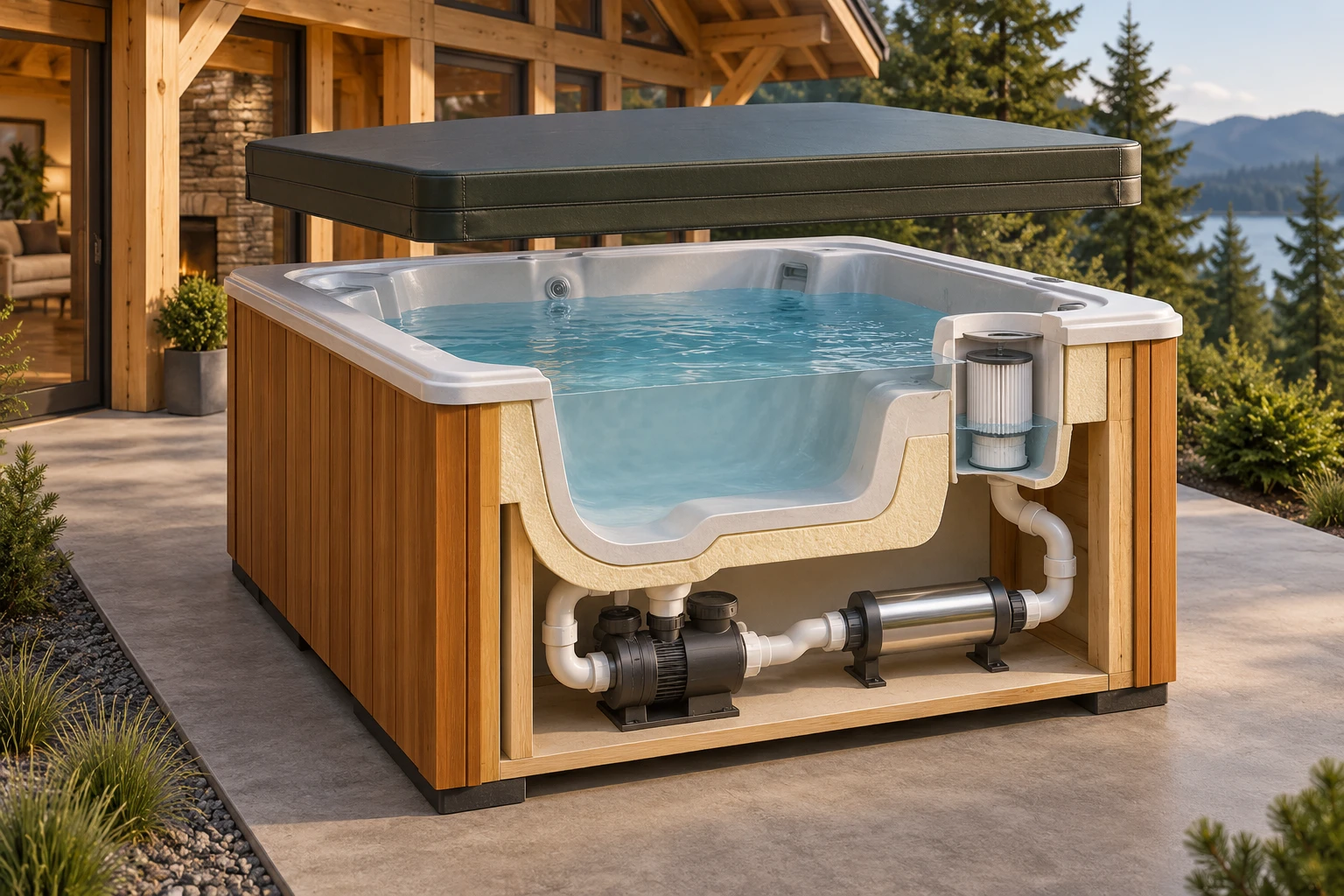
- Filter pocket
The cartridge illustrates particle filtration. Ask which filter the actual tub uses and how its manufacturer-directed care fits the whole operating plan.
- Pump and heating component
The lower components illustrate water movement and heat addition as separate jobs. A qualified assessment should identify the actual equipment and changed operating behaviour.
- Shell, support and cover
The shell contains the water; its supporting site and cover need separate questions. Match the equipment and instructions to the household rather than assuming one inspected component covers the whole tub.
What does this illustration leave out?
This generic cutaway omits complete jets, circulation routes, controls and electrical connections. It gives no heating output, temperature, sanitation result, cover certification, support design or installation procedure. This illustration explains an idea. It is not an installation guide.
Who will explain the actual circulation, heating, treatment, cover and seasonal-care requirements before handover?
Explore this with HomeAI ↗Opens an editable question. Nothing is sent until you choose to send it.How is access to the water controlled?
Access protection helps keep someone from reaching water unintentionally or without supervision. Depending on the actual site and local requirements, that enquiry can involve the enclosure, gate, doors, cover and the route from the house or yard. Walk the accessible route with permission and ask a qualified assessor to explain the protection as a connected arrangement.
HealthLink BC calls for restricted access and continuous child supervision, and advises covering and locking a hot tub when it is not in use. Physical protection and supervision serve related but different jobs. Discuss how the household will manage visitors, children and times when nobody is using the system.
Ask the municipality about the rules applicable to the location, installation and proposed changes. A pool and hot tub can have different local requirements; a locking cover shown in a photograph is not a universal exemption from an enclosure. This guide withholds fence heights, latch dimensions and cover exceptions because they require current jurisdiction-specific confirmation.
Request assessment of actual function and condition, not merely a statement that a fence exists. The scope should say which gates, covers or other access points were examined and what follow-up is needed. Do not deliberately defeat a lock, climb a barrier or move a heavy cover to create a buyer test. Arrange the proper demonstration and documentation.
Which equipment hazards need specialist attention?
Water, powered equipment and sometimes fuel-fired heating meet in a pool installation. Ask who is qualified to assess the identified electrical and heating equipment, and whether that work is included in the pool-service visit. Keep the installation assessment separate from a demonstration that a pump starts or a heater display turns on.
Suction outlets are another important system question. HealthLink BC describes underwater entrapment risks and the need for properly constructed and installed protective screens. Request qualified assessment of the actual outlets and associated arrangement. Do not approach an outlet to feel suction, remove a screen, place a body part near it or use the water as a test environment.
The eventual operator should receive appropriate instruction about the actual emergency pump shut-off and response plan. A buyer can ask for that teaching without operating unfamiliar electrical controls. If there is damaged equipment, water near electrical parts, an unusual fuel concern or unsafe access, obtain the appropriate professional assistance rather than continuing a showing demonstration.
Keep four assessment scopes visible: water quality, access protection, equipment, and structure or site. An electrician’s scope differs from a water-care provider’s scope; a structural engineer’s scope differs again. Ask each report to name the components, conditions and limitations actually addressed so the purchase decision rests on the right expertise.
One pool needs several different kinds of assessment
A water-quality record, an access-protection review, an equipment assessment and a shell or site finding answer different questions. Keep them together in the buying decision, while retaining each provider’s actual scope. This prevents a reassuring service invoice from becoming a claim about every part of the installation.
Numbers identify the parts explained below.
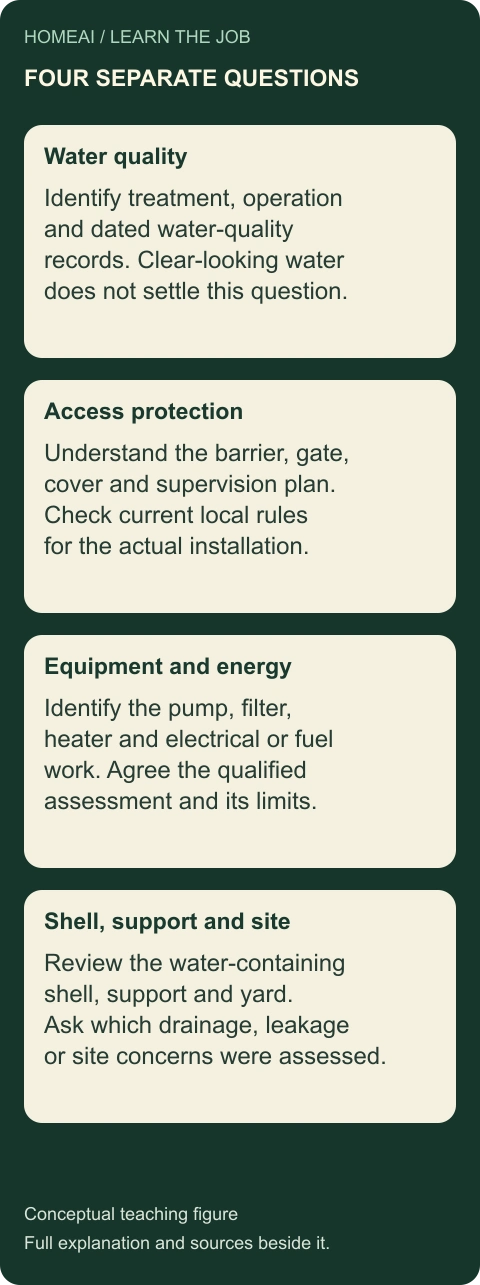
- Water quality
Identify treatment and operation, then review dated water-quality and maintenance records. Ask the appropriate adviser about the actual testing question.
- Access protection
Understand the barrier, gate, cover and supervision plan. Check current local rules for the actual pool or tub.
- Equipment and energy
Identify the pump, filter, heater and electrical or fuel work. Agree who is qualified to assess each part and what remains outside the visit.
- Shell, support and site
Review the water-containing structure, its support and surrounding yard. Ask which leakage, drainage or other site concerns were assessed.
What does this illustration leave out?
No actual assessment, jurisdiction-wide code rule, condition finding, repair approval or insurance decision is supplied. Requirements depend on the installation and location. This illustration explains an idea. It is not an installation guide.
Which separate finding or record would change the purchase decision, and who is responsible for answering it?
Explore this with HomeAI ↗Opens an editable question. Nothing is sent until you choose to send it.Four questions need the appropriate assessment
- Water qualityIdentify treatment, compatible products and dated chemistry/maintenance information.
- Access protectionAssess the actual enclosure, gate, cover and household supervision plan.
- EquipmentObtain appropriate electrical, heating and operating-function assessment.
- Structure and siteAddress shell, support, surrounding surfaces, access and drainage questions.
An organizing framework; a single reassuring record or demonstration does not complete all four scopes.
Further reading: Health Canada · Swimming pool and spa chemicals; HealthLink BC · Residential hot tubs and pools: Health and safety tips; City of Calgary · Hot tubs, pools and ponds.
What do the shell, support and yard contribute?
The basin or shell contains the water. Its support transfers the combined load into the ground or supporting construction. Surrounding surfaces provide access and a place to stand; the yard and drainage arrangement affect how that area is used and maintained. These jobs remain relevant even when the treatment equipment appears well organized.
Ask about the original installation, later repairs and changes to decks, patios or nearby construction. If a hot tub stands on an elevated structure, obtain an appropriate structural scope rather than inferring capacity from the size of visible boards. Calgary’s project page specifically flags elevated support as an engineering question; other locations need their own requirements checked.
Record safely visible concerns from normal accessible areas: a reported water-level change, a damaged edge, movement in surrounding paving or an obstructed access route. Give the specialist the context and timing. Water loss can need investigation of more than one cause; the buyer should not name a leaking shell from a seller’s refill comment alone.
Include the surrounding use and maintenance plan in the enquiry. Ask about drainage, access for future service and removal, and any shared or restricted land involved. Those are useful purchasing questions before a repair or replacement is priced. They do not authorize digging, drain testing, heavy lifting or an owner structural assessment.
Which permits and completed records should you request?
Request records matched to the actual installation and later changes: the equipment identities, project drawings if available, applicable permits, completed inspections, service history and warranties. Confirm which authority holds the relevant records. A permit application, an issued permit and a completed inspection are different stages in the project story.
Use municipal information as a starting point for a current enquiry. Calgary’s public pool and hot-tub page separates project, trade and inspection steps, but retains explicit 2014 Alberta Building Code references in some sections. For that reason, this guide does not present its dimensions, cover exceptions or older code wording as current national requirements.
Ask the responsible authority or qualified professional to connect a record to the installed work and date. If a later heater, barrier, deck or equipment change is reported, ask how it fits the documented history. A missing record should become a defined enquiry, rather than an automatic conclusion that the installation is either approved or defective.
Bring consequential gaps to the professionals helping with the purchase agreement. Ask what further assessment is available within the transaction, who can arrange it and how an unresolved scope affects the decision. This is not legal advice about contract wording, required disclosures or remedies; those depend on the actual transaction and applicable jurisdiction.
What can be assessed when the system is closed for the season?
A seasonal closure changes what an assessment can observe. Ask the service provider which parts can be reviewed in the current state, which require authorized reopening and which remain inaccessible. Record that distinction before relying on an assessment described only as a “pool inspection.” The scope should fit the season and the actual equipment.
Request the last opening and closing records, identified work, reported problems and the provider responsible. Ask what was done to the particular equipment and what remains required before use. A cover, a drained component or a winter-service invoice supplies context, but the provider should explain the condition that can actually be assessed today.
Do not reopen or energize unfamiliar equipment to fill a purchase-information gap. An authorized service provider can explain feasible follow-up, timing and limitations. If operation cannot be assessed before a decision, retain that unresolved question and discuss its implications with the transaction professionals rather than writing an invented successful test into the home file.
Separate seasonal care from eventual replacement or removal. Ask the municipality and service provider about local discharge, disposal and access requirements. Calgary’s disposal page, for example, warns against pouring pool or hot-tub water into storm drains, streets or alleys. That local guidance is not a nationwide drain-connection instruction or a buyer draining procedure.
How can you estimate the ownership work and cost?
Build the estimate from the actual system and intended use. Ask for current service proposals, required consumables, testing supplies, opening or closing work if relevant, and identified repairs. Add the time and responsibility for routine care. A seller’s phrase such as “low maintenance” cannot tell the next household which jobs are included.
Heating and pumping contribute to the energy question, but whole-home bills do not automatically isolate them. Request dated bills with the seller’s explanation of operating periods and other major household changes. Use that history as context and ask for an appropriately scoped estimate where needed. This guide supplies no invented pool-only consumption, savings or annual operating cost.
Separate routine spending from known work and uncertain future work. A consumable quote is different from a proposed repair; an equipment age is different from a predicted remaining life. Ask providers to identify the assessed condition and basis for their proposals. Comparable scopes make it easier to understand why two prices differ.
Connect the result to the home purchase rather than promising a resale premium. The amenity may suit one household’s use and burden another with unwanted work. Compare the asking price, broader property condition and the assessed pool or tub responsibilities with the advisers handling the transaction. This guide gives no market-value adjustment or return-on-investment percentage.
How would a fictional buyer resolve a promising but incomplete handover?
Fictional buyer Maya considers an invented home with a seasonal pool and a separate hot tub. The seller supplies one pool-closing invoice, a photograph of the hot-tub display and a folder containing older project paperwork. Maya likes the amenity but has not received a current water-quality or equipment assessment. No actual property, inspection or approval is represented.
Maya first creates a component and responsibility list with the seller’s authorized service provider. The provider explains what can be assessed while the pool is closed and identifies the information needed before reopening. A separate qualified scope addresses the powered equipment, and the relevant authority is asked about the project records. The questions now have named owners.
The water-care discussion identifies the hot tub’s actual treatment devices and products. If compatibility is unclear, the provider resolves it before use; Maya does not combine inherited chemicals or try a dosing experiment. Access protection and the support arrangement receive their own assessment. A reassuring pump demonstration is not allowed to stand in for those other jobs.
Maya compares actual proposals for identified work and routine ownership, then discusses unresolved seasonal questions with the transaction advisers. The example ends with a clearer purchase decision and handover scope. It contains no invented chemistry result, approved barrier, structural finding, repair outcome, contract remedy or guaranteed operating budget.
What should happen before the first use and after possession?
Before first use, obtain the appropriate assessed condition, required work and instruction for the actual pool or tub. The authorized provider should explain the care programme, normal exterior controls, applicable messages, emergency response and who to contact. If maintenance or water quality remains uncertain, keep out and obtain proper advice.
Create a compact handover file: component map and model list; applicable manuals; product and device compatibility information; relevant completed records; service reports; dated water-care information; and clearly assigned future tasks. Keep reports in their original form. A short summary should help the next reader find the evidence rather than replace it.
Make responsibility practical. Who performs the routine measurements and care? Who supervises children and manages access? Who handles service and seasonal work? Who responds if a problem appears? Confirm the first appropriate provider appointment and training rather than relying on memory from a hurried showing.
A useful handover lets the household explain how water moves, how it is filtered and treated, how heat is managed if present, and how people are protected around it. That understanding supports informed ownership. Current local advice and the actual product instructions still govern the system; no illustration or completed checklist can stand in for its continuing care.
Turn the listing into a practical handover
Begin with the identified installation and its work history. Agree appropriate assessments before relying on the feature, connect findings to any proposed work, then obtain the operating information needed at possession. Ongoing maintenance and seasonal care belong in the budget alongside any initial repair proposal.
Numbers identify the parts explained below.
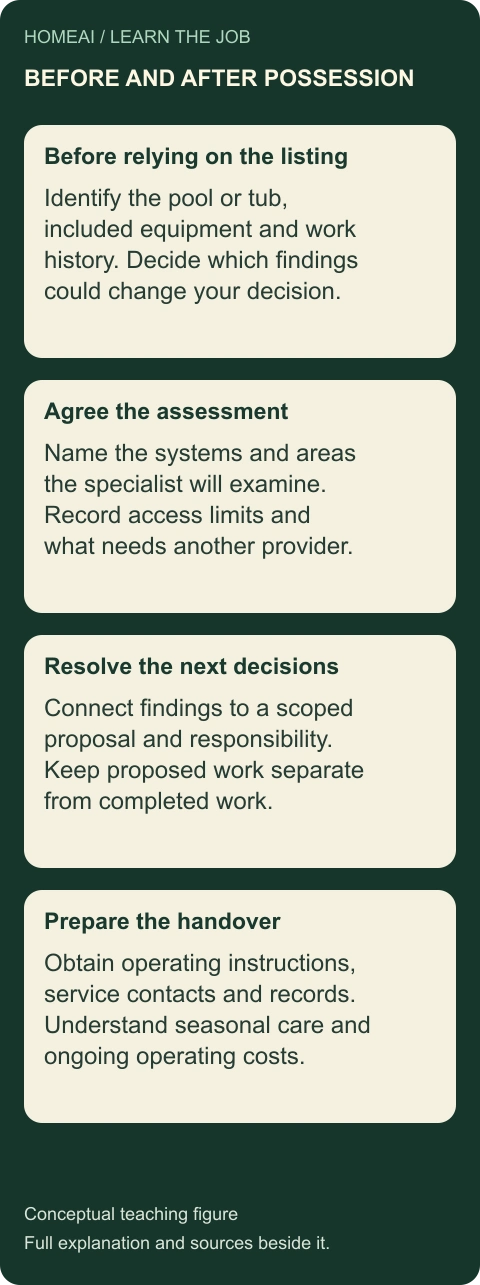
- Listing and included equipment
Identify the pool or tub, included equipment and available history. Ask which concerns matter to the intended household use.
- Agreed assessment
Name the systems and areas the specialist will examine. Keep access limits and referrals to other providers with the findings.
- Work and decisions
Connect findings to a scoped proposal, responsibility and timing. Keep proposed work separate from completed work and later verification.
- Operating handover
Obtain manuals, service contacts, maintenance history and seasonal-care instructions. Clarify ongoing costs using actual equipment and household use.
What does this illustration leave out?
This is a conceptual decision sequence, not a real inspection result, contractor quote, legal opinion or operating procedure. This illustration explains an idea. It is not an installation guide.
What equipment, unresolved findings, operating instructions and responsibilities must be clear before possession?
Explore this with HomeAI ↗Opens an editable question. Nothing is sent until you choose to send it.Make the handover a sequence of useful decisions
- IdentifyMatch components, devices, products, routes and included accessories.
- AssessAssign qualified scopes and record actual seasonal or access limits.
- DecideCompare identified work, actual proposals and unresolved transaction questions.
- Teach and retainArrange the appropriate instruction, keep original reports and assign ongoing tasks.
A purchase and ownership framework, not an inspection result, permission to enter the water or legal contract advice.
Further reading: HealthLink BC · Residential hot tubs and pools: Health and safety tips; HealthLink BC · Residential hot tubs and pools: Safe water quality; Health Canada · Swimming pool and spa chemicals; City of Calgary · Hot tubs, pools and ponds.
Keep learning about the connected parts
- Deck boards, supports and the house connection: what to ask
- In-ground irrigation: understand zones, sprinklers and watering changes
- Renovation records: what was proposed, approved and built?
- Why does a breaker trip? Understand GFCI and AFCI protection
- Your first year in a home: turn findings and bills into a budget
- Build a home-care record that the next person can understand
Canadian context and authorities · Visual atlas · Learning labs
Practice the distinction.
A pool-closing invoice and an appealing hot tub
Fictional Maya considers a home with a seasonally closed pool and a separate hot tub. One closing invoice, a display photo and older paperwork are supplied.
Reported observations
- No current water-quality or equipment assessment is supplied.
- The pool’s closed state limits possible observation.
- The actual treatment devices, products and later changes need identification.
Compare the explanations
Expand each possibility to see the evidence needed to distinguish it. Similar symptoms can have different mechanisms.
A suitable system needs a complete documented handover
The available folder may be incomplete even where equipment is serviceable.
Matched component list, appropriate assessments, completed records and provider instruction.
Identified work or unresolved scopes affect the purchase decision
Seasonal, equipment, access or support questions may require further assessment and actual proposals.
A stated scope and limitations, qualified findings and transaction advice.
A useful next question
Assign the water, access, equipment and structure/site questions; identify compatibility and season limits; compare actual work and ownership responsibilities.
Fictional only; no actual inspection result, chemistry value, approval, structural capacity, repair, contract remedy or annual cost is claimed.
Know what the words mean.
- Recirculation
- Movement of water through the system’s equipment and back to the pool or hot tub.
- Circulation pump
- A pump that moves water through the pool or hot-tub system.
- Pool filter
- Equipment that removes particles from water as it passes through the filtering material.
- Disinfection
- Treatment that controls microorganisms in the water, using products and devices suited to the system.
- Water balance
- The measured water-chemistry conditions managed under the appropriate care programme, rather than a judgement from appearance.
- Saltwater chlorine generator
- A device using electrical energy to generate chlorine from salt in the water.
- Suction outlet
- An opening where water is drawn from the basin into a connected route; its protective arrangement requires qualified assessment.
- Access protection
- The connected barrier, gate, door or cover arrangement intended to restrict unintended or unsupervised access to the water.
- Seasonal assessment limit
- A specific part of the assessment that cannot be completed in the system’s present opened or closed state.
- Handover scope
- The agreed equipment explanation, records, assessed condition, training and remaining tasks passed to the next owner.
Questions to bring
to the conversation.
- What is included, and who can identify the actual parts and treatment products?
- Which water routes, devices and operating functions has the service provider explained?
- Who assesses water quality, access, equipment and support/site?
- Which completed records match the installation and later changes?
- What remains unassessed this season, and how will the purchase decision address it?
- What care, costs, training and access responsibilities will the next household take over?
Separate a showing observation, an existing record and a new professional assessment. Unknown means a question remains; it does not automatically mean a defect.
Use the evidence planner ↗Go to the source.
Original HomeAI explanation informed by these public references. Sources support the underlying guidance; they have not reviewed or endorsed HomeAI. Diagrams are conceptual, and calculator outputs depend on your inputs.
Source bodies were read October 10–11, 2026 and this guide reviewed October 11; exact dates and retained extents appear with each source. Federal chemical/device guidance and British Columbia public-health advice have different scopes. The federal bromine–ionizer/ozone/UV prohibition is retained explicitly; conflicting generic combination wording is not adopted. Calgary is a local records and disposal example only; the retained public project page includes 2014 code references, so no dimensions, exceptions or current nationwide code adoption are supplied. No dosing, shock treatment, draining connection, wiring, fuel work, suction test, equipment opening, temperature prescription or restart procedure is provided.
Publication & source review
First published .
Sources reviewed .
- Health Canada · Swimming pool and spa chemicals
Where this reference applies
Jurisdiction: Canada; federal consumer pool/spa chemical and device guidance
Edition: Page details date June 24, 2024; current full body read October 11, 2026.
Source reviewed: 2026-10-11 · America/Edmonton
Reading scope: Full substantive body through chemical/device compatibility and safety sections independently captured and read October 11 in independent-full-web-source-read.json. Complete body including page details at line 183 is retained and read in independent-pool-hc-full-date-read.json. Earlier web-primary-bodies.json stops at line 76 and is not treated as complete.
Clear water and microbial risk, water-balance testing, chlorine generation from salt, registered/scheduled sanitizers and devices, product instructions and the explicit prohibition on combining bromine products with ionizers, ozone or UV. No dosing or handling procedure is reproduced.
- HealthLink BC · Residential hot tubs and pools: Safe water quality
Where this reference applies
Jurisdiction: British Columbia; residential public-health guidance
Edition: HealthLinkBC File 27b; last updated August 1, 2024.
Source reviewed: 2026-10-11 · America/Edmonton
Reading scope: Complete substantive HTML/text captured and read October 10; complete text reread October 11. Retained research/pool-water-bc.html and .txt.
Different functions of filtration, recirculation, disinfection and temperature; water-chemistry measurement and maintenance. Provincial numeric tables, generic pump schedules and chemical/shock procedures are not transferred. The generic bromine/UV/ozone combination wording is not adopted because Health Canada supplies a specific incompatibility warning.
- HealthLink BC · Residential hot tubs and pools: Health and safety tips
Where this reference applies
Jurisdiction: British Columbia; residential public-health guidance
Edition: HealthLinkBC File 27a; last updated June 6, 2024.
Source reviewed: 2026-10-11 · America/Edmonton
Reading scope: Complete substantive HTML/text captured and read October 10, including all physical-hazard and heat sections; reread October 11. Retained research/pool-safety-bc.html and .txt.
Uncertain maintenance or water quality means stay out; supervision, restricted access, locked hot-tub cover, child overheating, suction entrapment, slip hazards and prompt exit for heat symptoms. No individualized medical clearance or universal temperature/use-time setting.
- City of Calgary · Hot tubs, pools and ponds
Where this reference applies
Jurisdiction: Calgary, Alberta only; municipal project and inspection enquiry
Edition: No substantive revision date established. Current capture contains explicit 2014 code references and a no-legal-status disclaimer.
Source reviewed: 2026-10-11 · America/Edmonton
Reading scope: Complete substantive HTML/text captured and read October 10, including location, construction, code references, application, final inspection and disclaimer; reread October 11. Retained research/pool-permits-calgary.html and .txt.
Local application, trade and final-inspection enquiry; elevated-support and qualified-electrical-contractor questions. The public page retains 2014 Alberta Building Code references; no fence dimensions, cover exemptions, fees, timing or code adoption is taken as current law.
- City of Calgary · How to dispose of hot tubs, spas, pools and saunas
Where this reference applies
Jurisdiction: Calgary, Alberta only; municipal disposal guidance
Edition: No substantive revision date established.
Source reviewed: 2026-10-11 · America/Edmonton
Reading scope: Complete substantive HTML/text captured and read October 10, including special instructions and facility limitations; reread October 11. Retained research/pool-disposal-calgary.html and .txt.
Local disposal and discharge planning. No owner drain-connection method or national discharge rule is supplied.
Have a question about your home?
Start with the symptom, timing and what you have observed.
Ask HomeAI