Jump to a question in this guide
- What does the tree do beside the house?
- How do roots, trunk and leaves support one another?
- Why do soil air, water and space matter to the roots?
- What can the canopy tell us, and what can it leave hidden?
- How do branches and leaves connect with the roof’s water route?
- Does a tree near a sewer prove that roots are inside?
- Can a foundation crack be blamed on the nearest tree?
- What changes when utility lines are nearby?
- How are tree health and the risk to people or structures different?
- Why should an arborist join a construction plan early?
- What should happen after a storm or an unexpected site change?
- Who can authorize work on the actual tree?
- What should a useful arborist proposal contain?
- Which observations and records are useful without owner tree work?
- How would a fictional owner connect a tree, roof and sewer concern?
- What should the next household understand at handover?
- Roots, soil, trunk and canopy are a connected living system.
- Proximity to a pipe or crack is not a cause finding.
- Tree health, risk, utilities and building condition need distinct scopes.
- Construction and later landscaping can affect roots before decline is visible.
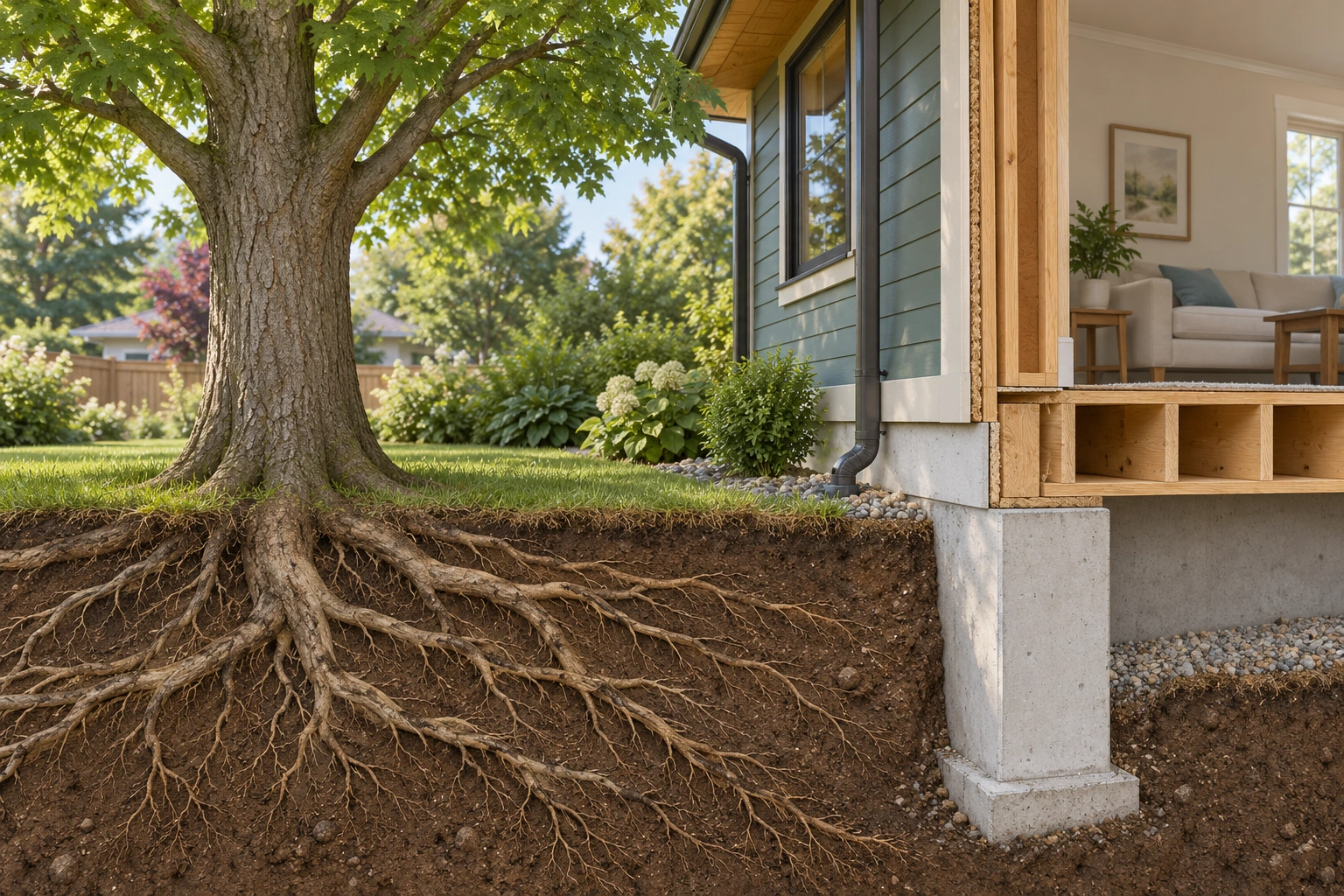
The tree’s canopy, trunk and conceptual roots sit beside a house cutaway with an intact foundation face. The image locates connected living functions and a nearby building without identifying a damage path.
About this illustration
No species, root radius/depth, setback, buried condition, foundation cause or safe tree finding. This is a conceptual teaching model, not an assessment of your home.
9 picture lessons appear beside the questions in this guide. Use them to understand the explanation, then consider what it means for your home.
What does the tree do beside the house?
A tree is a living system sharing space with a building and its services. Roots obtain water and minerals and contribute to support. The trunk and branches carry the canopy and internal transport. Leaves use sunlight, water and carbon dioxide to make sugars that support growth. The house, roof drainage, buried pipes and utility lines have their own jobs. A useful plan considers their relationships instead of treating tree size alone as a defect.
Begin with the actual concern: a branch near the roof, a raised walking surface, a reported sewer root finding, a changed tree or proposed construction. These are different starting questions. Name the tree and location as far as safely known, preserve the observation’s date and ask which professional scope can address it. A large canopy next to a house is neither an automatic removal instruction nor a complete tree-health assessment.
The whole-site cutaway places canopy, trunk, conceptual roots and foundation together without drawing damage. It teaches why above-ground appearance is only part of the discussion. The roots continue beyond the image and do not establish a surveyed root map. The native system figure connects the living functions while keeping actual root extent, building condition and service routes unknown.
This guide owns the tree-and-house relationship and arborist coordination. The sewer guide owns pipe anatomy, camera findings and repair records. The roof and drainage guides own their building routes. The wildlife guide owns species and authorized exclusion. Following those distinct owners lets the tree remain a real planning question without duplicating another system or blaming it for every nearby symptom.
Define the household goal as well as the concern. Preserving shade, planning a new path, resolving a reported service issue and addressing a changed branch are different decisions. The same tree can be relevant to several of them without one provider answering all of them. Stating the goal gives the arborist a useful boundary for its recommendation and lets the owner compare it with building and utility needs. It also prevents an attractive whole-site illustration from becoming an unexamined recommendation either to retain or remove the tree.
A living tree meets a separate building
The tree’s canopy, trunk and conceptual roots sit beside a house cutaway with an intact foundation face. The image locates connected living functions and a nearby building without identifying a damage path.
Numbers identify the parts explained below.
- Canopy
Living leaf context, not a health/risk verdict.
- Trunk and roots
Conceptual connected form with variable real extent.
- Building
Proximity does not establish causation.
What does this illustration leave out?
No species, root radius/depth, setback, buried condition, foundation cause or safe tree finding. This illustration explains an idea. It is not an installation guide.
Which actual tree and site evidence does the assessment need?
Explore this with HomeAI ↗Opens an editable question. Nothing is sent until you choose to send it.How do roots, trunk and leaves support one another?
Roots and canopy are connected by transport and growth. Water taken up at roots moves through the tree toward the leaves. Leaves make sugars through photosynthesis, using sunlight as their energy source. The tree distributes those sugars to growing and storage tissues, including roots. A change below ground can therefore affect the canopy, while removal of leaf-bearing growth can affect the resources available elsewhere.
The Portland municipal physiology article describes these basic relationships using xylem for water transport and phloem for sugar transport. Those names can help explain an arborist’s report, but the useful lesson comes first: the tree needs both an adequate root environment and functioning above-ground growth. The article is US educational context, not a Canadian rule for pruning, planting depth or acceptable root loss.
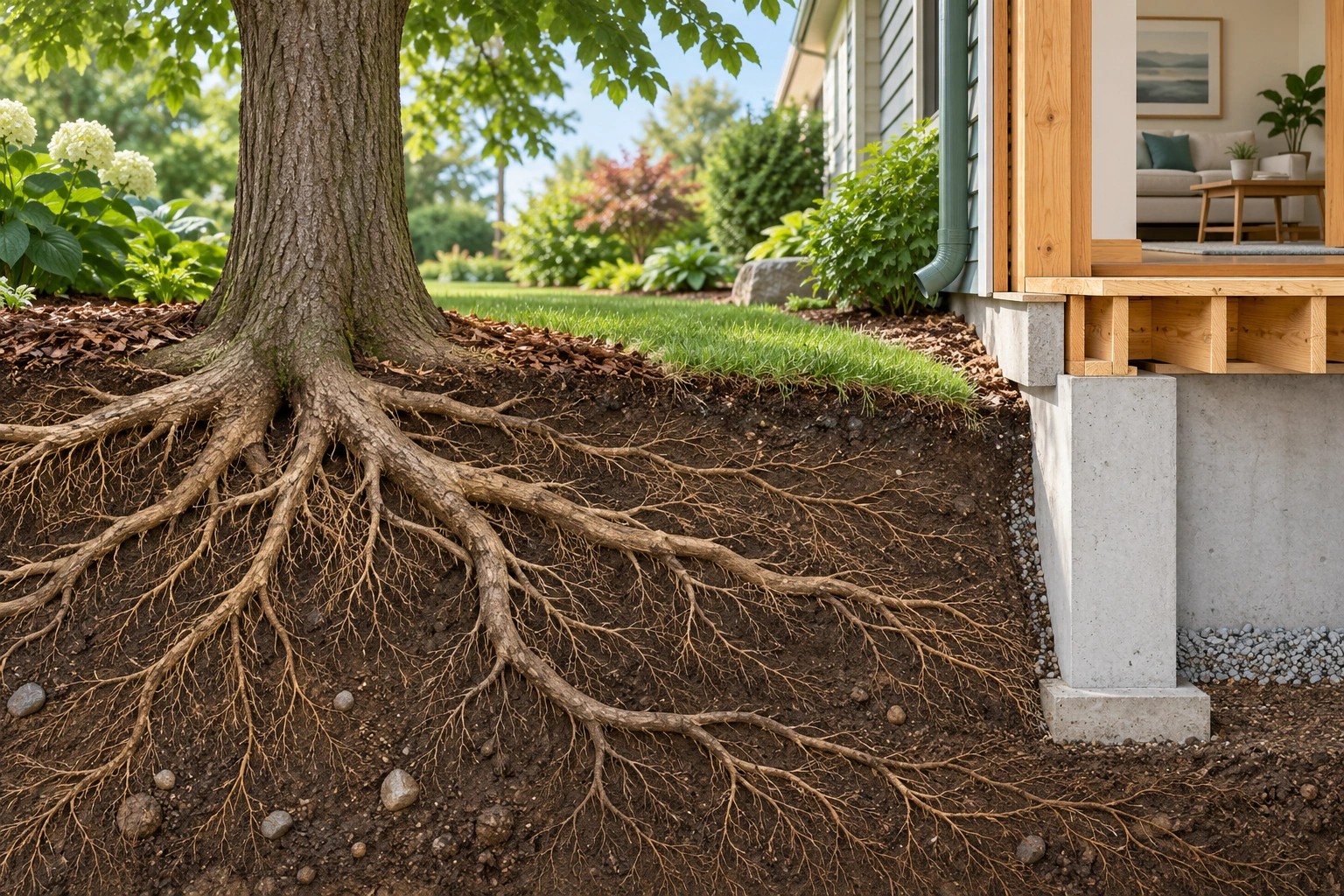
Larger roots near the trunk can contribute to support, while finer absorbing roots perform a different part of the water and mineral task. Their actual arrangement depends on conditions and is not simply a smaller copy of the branch shape. The root close-up illustrates varied branching and off-frame continuation. It supplies no universal radius, depth, diameter or stable footing for the actual tree.
Do not cut roots or reduce the crown to balance an assumed problem yourself. Ask an appropriate arborist to explain how the proposed work affects the connected living and support functions. A diagram can teach the relationship without selecting a treatment. The assessment should identify the tree, site, purpose and limits before a visible change becomes an improvised repair.
These functions help explain why a visible cut is not just a cosmetic change. Leaf-bearing growth participates in sugar production, while roots participate in water uptake and support. A proposed change can affect the relationship rather than simply make the silhouette smaller. Ask the arborist which function the work is intended to address and what response it expects from the actual tree. The explanation should connect to the site and finding, without treating crown reduction as a universal way to compensate for unknown root loss.
Roots, soil and canopy support a living tree
Roots take up water and minerals, while leaves use light to produce sugars. The figure connects those jobs with transport through the tree and root support; it supplies no measured root extent or property-risk finding.
Numbers identify the parts explained below.
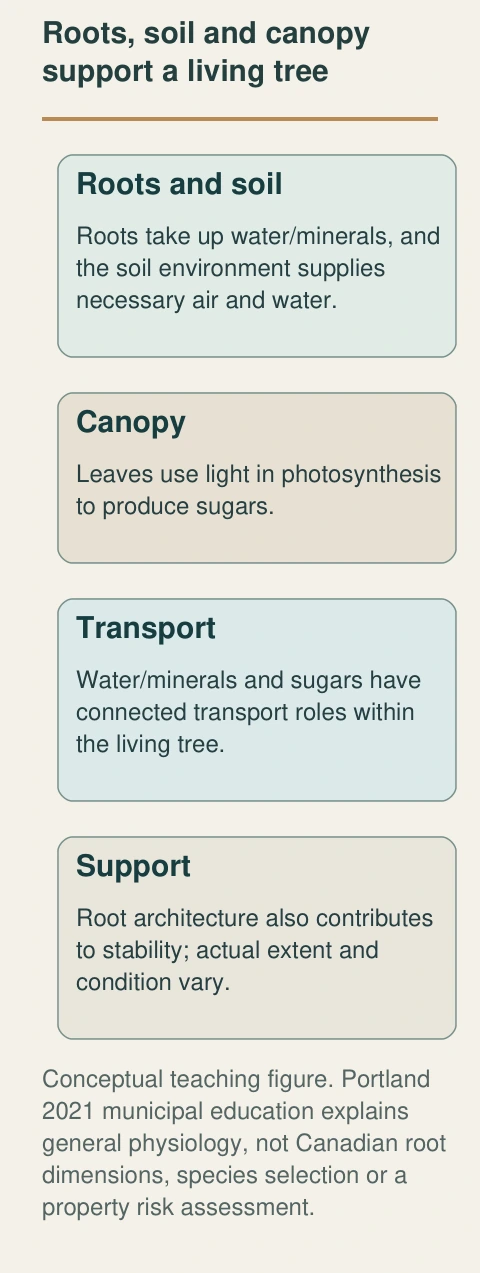
- Roots and soil
Roots take up water/minerals, and the soil environment supplies necessary air and water.
- Canopy
Leaves use light in photosynthesis to produce sugars.
- Transport
Water/minerals and sugars have connected transport roles within the living tree.
- Support
Root architecture also contributes to stability; actual extent and condition vary.
What does this illustration leave out?
Portland 2021 municipal education explains general physiology, not Canadian root dimensions, species selection or a property risk assessment. This illustration explains an idea. It is not an installation guide.
How does the actual site and proposed work affect these connected functions?
Explore this with HomeAI ↗Opens an editable question. Nothing is sent until you choose to send it.Connected parts with different jobs
- Roots and soilWater/mineral uptake, oxygen access and physical support.
- Trunk and branchesSupport and internal transport relationships.
- CanopyLeaf sugar production and above-ground growth.
No measured root architecture or treatment design.
Further reading: Portland Urban Forestry · Tree Physiology Primer: All About Roots.
Read the complete figure
Roots, soil and canopy support a living tree
Original native teaching figure: Roots, soil and canopy support a living tree. The complete labelled relationships distinguish the functions below; they describe conceptual questions rather than an actual property finding.
- Roots and soil
- Roots take up water/minerals, and the soil environment supplies necessary air and water.
- Canopy
- Leaves use light in photosynthesis to produce sugars.
- Transport
- Water/minerals and sugars have connected transport roles within the living tree.
- Support
- Root architecture also contributes to stability; actual extent and condition vary.
What remains unknown: Portland 2021 municipal education explains general physiology, not Canadian root dimensions, species selection or a property risk assessment.
A useful question: How does the actual site and proposed work affect these connected functions?
Why do soil air, water and space matter to the roots?
Soil contains spaces through which air and water can move. Roots need a suitable balance: water for their functions and oxygen for respiration. Dense compaction or excessively wet conditions can change that environment. The physiology and ISA construction sources explain why soil is part of the living system, not merely material holding the trunk upright.
A new path, heavy stored materials, vehicle traffic, added fill or altered drainage can affect the root environment even when no branch is cut. ISA describes these as construction-related concerns and warns that effects can take time to become visible. Their presence is a reason for site-specific assessment, not proof that a particular activity has already killed or destabilized a tree.
The root-zone picture shows irregular roots within a conceptual soil cut face. It does not measure oxygen, compaction, drainage or water content. Ask the arborist which conditions were assessed and what supports any finding. A single surface puddle, dry patch or healthy-looking canopy should not independently determine the condition of the complete root zone.
Have proposed grading, trenching, paving or storage reviewed before it changes the site. The provider should connect the project with an actual tree-protection plan and suitable coordination. This guide supplies no aeration, excavation, fertilizer, irrigation or soil-replacement method. A professional recommendation should explain the intended function and remaining uncertainty instead of offering a generic recipe for every tree beside a house.
Water near a tree is not automatically useful water for its roots. Its location, movement and effect on soil conditions matter. Likewise, a dry-looking soil surface does not independently describe water throughout the actual root environment. The provider should interpret suitable evidence in context rather than prescribe more or less watering from a single photograph. This distinction is useful when a drainage project is proposed: ask how the new route affects both the building’s intended water management and the tree’s assessed root environment.
Roots and their soil environment need separate attention
The soil section shows a conceptual branching root system with fine and larger roots beside the building. Its teaching purpose is the root/soil relationship, not a measured underground map of a property.
Numbers identify the parts explained below.
- Fine-root context
Relates to uptake functions explained in the text.
- Larger roots
Part of a variable supporting living system.
- Soil section
A conceptual environment, not an excavated owner investigation.
What does this illustration leave out?
Root form and scale are illustrative; no actual extent, depth, air/water measurement, foundation finding or digging permission. This illustration explains an idea. It is not an installation guide.
How will the actual work affect the identified root and soil environment?
Explore this with HomeAI ↗Opens an editable question. Nothing is sent until you choose to send it.What can the canopy tell us, and what can it leave hidden?
The canopy is the branch-and-leaf portion of the tree. It provides shade and other site benefits while depending on the roots, trunk and growing conditions. Changes in leaf density, colour or branch condition can be useful observations. They do not independently identify the cause or reveal every root and internal wood condition. Keep the location and timing rather than diagnosing from one photograph.
ISA’s construction-recovery brochure discusses delayed decline and possible canopy changes after damage. That supports retaining a work history and asking about follow-up. It does not mean a sparse canopy proves construction damage, or that a full canopy guarantees structural integrity. An arborist should explain the actual health and risk questions using appropriate observations and methods.
Photographs from ordinary safe positions can show a change over time when their viewpoint and season are known. Seasonal leaf differences need their context. A winter image and summer image do not become a controlled before-and-after comparison simply because the tree appears different. Preserve any known weather, site work or reported event alongside the image.
If a hanging or broken branch, fresh movement or another immediate concern appears, keep people clear and obtain suitable urgent assistance. Do not stand underneath to get a better camera angle or climb to inspect. Utility involvement changes the response further. An ordinary visual record should support the professional, while safety determines where and whether the owner can observe at all.
A safe comparison should identify what was actually observed. Fewer leaves on one part of a canopy, a newly broken branch and a changed leaning appearance are different accounts. Retain the original description and image instead of replacing them with a diagnosis such as root failure. The arborist can decide which observations relate and which need further access or method. A specific account also helps a second provider understand why an assessment was requested, even if the first visit establishes only part of the explanation.
How do branches and leaves connect with the roof’s water route?
A canopy near a roof can introduce questions about contact, falling material, maintenance access and the rainwater route. Leaves on a gutter are an observation; they do not independently establish that it is blocked or that an indoor stain came from it. The roof still has its own covering, flashings, gutters and discharge arrangement, each with an actual condition and scope.
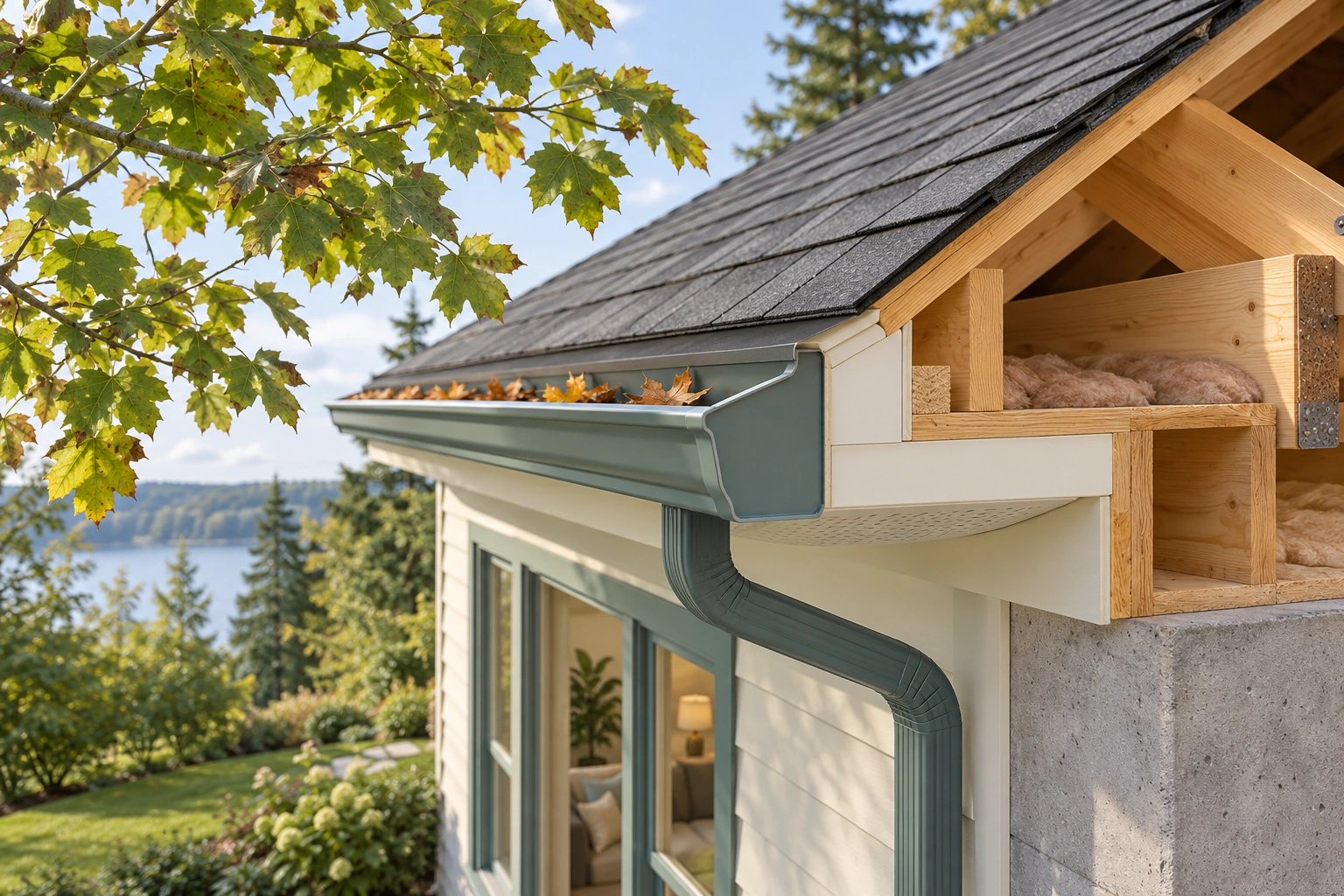
The roof-context picture places a branch near an intact gutter with a few leaves present. It deliberately shows no measured clearance or diagnosed obstruction. Its purpose is to connect the canopy question with the building’s water-management job. The roof and drainage guides explain those mechanisms more deeply, while an arborist and building provider address the relevant actual interfaces.
Ask what the proposed work is intended to accomplish. Is the concern branch condition, contact with a building component, access for roof care or a separately identified drainage issue? One pruning proposal should not be assumed to repair a gutter, and one gutter-cleaning record should not become a tree-risk assessment. Compare the work with the finding that prompted it.
Do not climb, cut an overhead branch or clear a roof as an owner investigation for this lesson. Have the responsible providers coordinate safe access and the appropriate scope. A generic separation distance copied from a picture or another species cannot establish the suitable result. Retain the actual recommendation, completed work and any remaining roof-water question with their dates.
Future maintenance access belongs in the design discussion. A proposal affecting the canopy or roof should explain how the actual providers will reach and maintain the relevant components safely. That does not make the homeowner responsible for climbing or inventing an access system. It means the project should not solve one visible concern while leaving an inaccessible gutter or a new conflict with an equipment route. Ask what ongoing work the completed arrangement requires and which party should provide the applicable instructions and follow-up.
Canopy, leaves and the roof water route are connected questions
Branches and leaves sit near an intact eave and gutter in the teaching view. Some leaves are visible at the gutter, locating a water-route enquiry without establishing blockage or a permitted pruning response.
Numbers identify the parts explained below.
- Nearby canopy
Arborist scope remains distinct from roof work.
- Gutter leaves
Visible material does not measure drainage performance.
- Eave
Roof and attic interfaces retain building scope.
What does this illustration leave out?
No actual roof damage, drainage capacity, branch clearance, tree risk or owner roof/pruning method. This illustration explains an idea. It is not an installation guide.
Who addresses the actual canopy and roof-water findings separately?
Explore this with HomeAI ↗Opens an editable question. Nothing is sent until you choose to send it.Does a tree near a sewer prove that roots are inside?
No. Proximity is a site observation, while roots within a pipe are an assessed pipe finding. Calgary’s poplar page explains roots using faults that offer water and air. That local example supports asking about the actual pipe and route; it does not identify every root source or establish that a tree caused an opening. Keep the tree, pipe location and camera findings as separate evidence.
The buried-service picture keeps roots visibly outside an intact pipe. It teaches the boundary between an illustrated nearby root zone and a real inside-pipe result. It supplies no surveyed route, root identity or defect. The native relationship figure then distinguishes the tree assessment from a plumber’s camera and location scope without drawing guaranteed intrusion beneath the house.
If a report identifies roots, ask where they were observed, which pipe stretch was examined and what limitations remained. The sewer guide owns the deeper recording, access, cleaning and repair questions. A root-cleaning task can change passage without addressing the actual entry interface; the relevant plumbing provider should explain that distinction and suitable next work.
Do not jump from a pipe finding to tree removal or cut roots along an assumed route. Arborist, utility, pipe and permission questions may need coordination. A camera distance is not itself a property-line or tree-ownership determination. This guide supplies no chemical root treatment, cleaning interval, barrier design or promise that removing a particular tree resolves the sewer problem.
Root source attribution can be a separate question from identifying roots in a recording. Several trees or other plants may be near an incompletely mapped route, and the image inside a pipe does not display their entire underground connection. Ask the relevant specialists what can actually be established and what remains uncertain. The tree decision should retain that limit. A plumber’s finding about passage is still useful even when it does not identify a particular tree, while an arborist’s site assessment remains distinct from the inside-pipe inspection.
Tree proximity raises different building questions
Branches beside a roof, roots beside a pipe, soil beside a foundation and nearby utilities raise different questions. The figure assigns each interface its own evidence and provider scope rather than treating proximity as a cause.
Numbers identify the parts explained below.
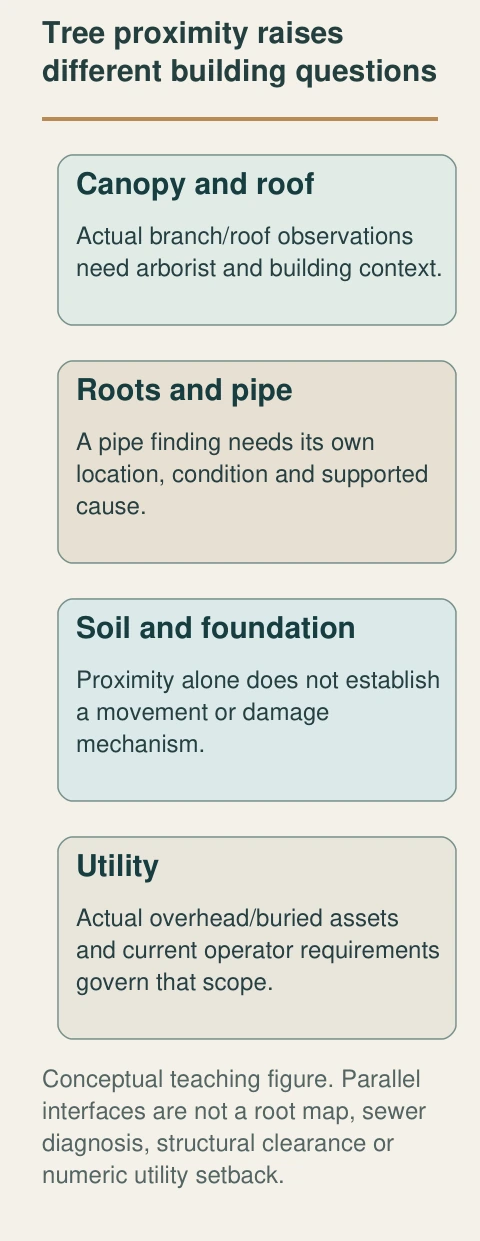
- Canopy and roof
Actual branch/roof observations need arborist and building context.
- Roots and pipe
A pipe finding needs its own location, condition and supported cause.
- Soil and foundation
Proximity alone does not establish a movement or damage mechanism.
- Utility
Actual overhead/buried assets and current operator requirements govern that scope.
What does this illustration leave out?
Parallel interfaces are not a root map, sewer diagnosis, structural clearance or numeric utility setback. This illustration explains an idea. It is not an installation guide.
Which actual evidence connects this tree with the reported condition?
Explore this with HomeAI ↗Opens an editable question. Nothing is sent until you choose to send it.Roots beside an intact pipe are not a sewer diagnosis
The conceptual soil section places roots outside an intact closed pipe beside the house. It intentionally shows no pipe interior or root penetration; the actual sewer record must establish its own location and condition.
Numbers identify the parts explained below.
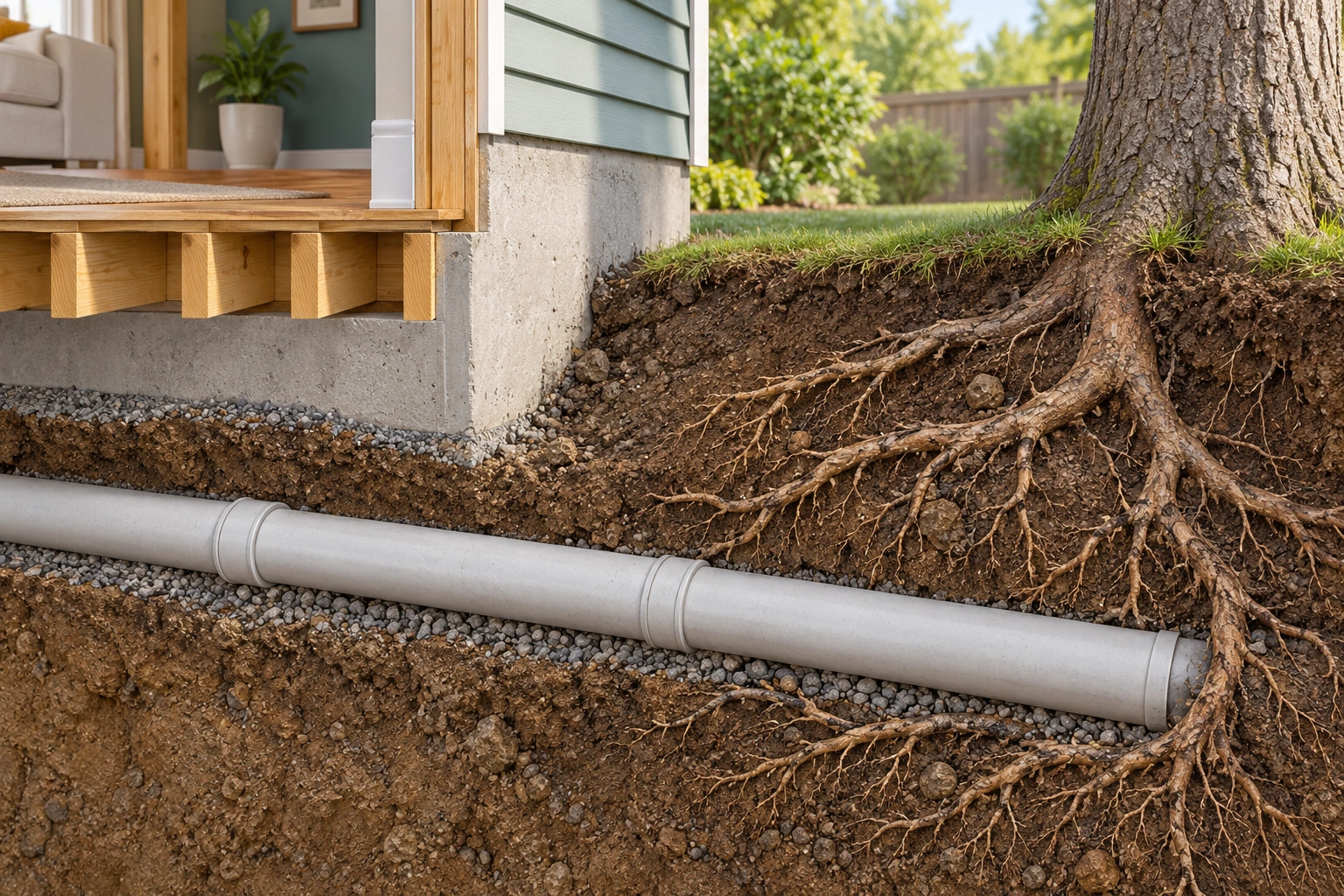
- Roots outside
Proximity alone is not an interior finding.
- Closed pipe
Interior and joints remain unassessed.
- House context
Actual line location and responsibility require records.
What does this illustration leave out?
No intrusion, leak, pipe ownership, camera result, root cause or universal root-to-pipe distance is identified. This illustration explains an idea. It is not an installation guide.
What actual pipe evidence connects the reported condition with a tree?
Explore this with HomeAI ↗Opens an editable question. Nothing is sent until you choose to send it.Read the complete figure
Tree proximity raises different building questions
Original native teaching figure: Tree proximity raises different building questions. The complete labelled relationships distinguish the functions below; they describe conceptual questions rather than an actual property finding.
- Canopy and roof
- Actual branch/roof observations need arborist and building context.
- Roots and pipe
- A pipe finding needs its own location, condition and supported cause.
- Soil and foundation
- Proximity alone does not establish a movement or damage mechanism.
- Utility
- Actual overhead/buried assets and current operator requirements govern that scope.
What remains unknown: Parallel interfaces are not a root map, sewer diagnosis, structural clearance or numeric utility setback.
A useful question: Which actual evidence connects this tree with the reported condition?
Can a foundation crack be blamed on the nearest tree?
A crack is a building observation. A nearby tree is a site observation. Connecting the two requires an appropriate assessment of the actual foundation, soil, water, history and other relevant conditions. A photograph showing both cannot establish cause. The tree’s roots may also remain unmapped, making a confident underground explanation particularly unsupported.
Calgary’s poplar page cautions against assuming its described roots caused foundation or sewer cracking. The page’s local species context should not be expanded into an absolute claim that roots can never affect any construction or soil. Ask the qualified building or geotechnical professional what explanation is supported in this property, while the arborist addresses the tree’s own conditions and proposed work.
Keep weather, drainage changes, renovations and prior findings with the building record when known. Do not rewrite a remembered sequence into proof that tree growth preceded and caused movement. The foundation and drainage guides retain their distinct ownership of those mechanisms. A tree consultation can be useful without diagnosing the house or deciding which repair a crack requires.
No excavation, root severing, foundation probing or monitoring threshold is supplied here. Arrange the appropriate specialist scope and preserve access limits. A useful report may establish one plausible relationship or leave several unresolved. Either result should remain tied to the evidence and method, rather than becoming a reason to remove a tree or repair a foundation from an online rule.
The wording of a report matters when several mechanisms remain possible. A specialist may say a condition is consistent with one explanation without establishing it as the only cause. Preserve that qualification and the actual next recommendation. Ask what additional evidence would change the decision and whether its collection is appropriate for the project. The owner should not convert a tentative relationship into a certainty because it makes the repair story easier to tell. A truthful unresolved cause can still support a useful scoped investigation.
Keep the evidence boundaries clear
- Nearby treeA site relationship.
- Inside-pipe rootsA scoped plumbing finding.
- Foundation crackA building observation needing its own explanation.
- Cause and next workSupported specialist interpretation, not an inferred nearest-tree verdict.
Calgary poplar context does not decide every species, soil or construction.
Further reading: City of Calgary · Problems with poplar trees.
What changes when utility lines are nearby?
Overhead electricity introduces a safety boundary independent of tree health. ENMAX warns that a branch need not touch a line for arcing to occur. Keep clear of damaged lines and call emergency services if a tree or branch has damaged one; do not remove debris from wires. The local utility determines the appropriate response and equipment-related scope.
The utility-context picture keeps the tree and overhead system separate with no measured work distance. Its spacing is illustrative, not a safe approach boundary or pruning specification. Ask the actual utility to identify uncertain lines and explain who handles the relevant work. A cable between buildings may have a different owner or role from the utility infrastructure beside it.
An ordinary arborist credential does not automatically describe every required utility-tree qualification. ENMAX calls for certified utility tree trimmers in its stated context. Confirm the appropriate local provider and coordination elsewhere. A household should not modify a line, add a barrier or trim around it because the branch is part of its own tree.
Buried services are a separate planning question. Before a project is designed around trenching, planting or root work, ask how the actual utilities and required locate information are established. A root illustration is no utility map. This guide gives no dig depth, locator procedure, clearance distance or permission to excavate after receiving a generic map; the actual current local process and qualified work scope govern.
Line identity should remain uncertain until the responsible source confirms it. Height, colour, attachment and proximity do not give an owner permission to approach or work around a cable. The utility can explain its own system and the process for a private-line question. Retain that advice with the proposed tree work, rather than asking an ordinary contractor to assume the line is harmless. If a line or branch is damaged, the emergency response takes priority over identifying ownership or completing a photograph for the file.
A tree and a utility line need the actual operator’s scope
The yard view keeps a tree, house and overhead utility context visibly separate. It illustrates why identifying the actual asset and operator precedes tree work; the drawn spacing is not a safe clearance.
Numbers identify the parts explained below.
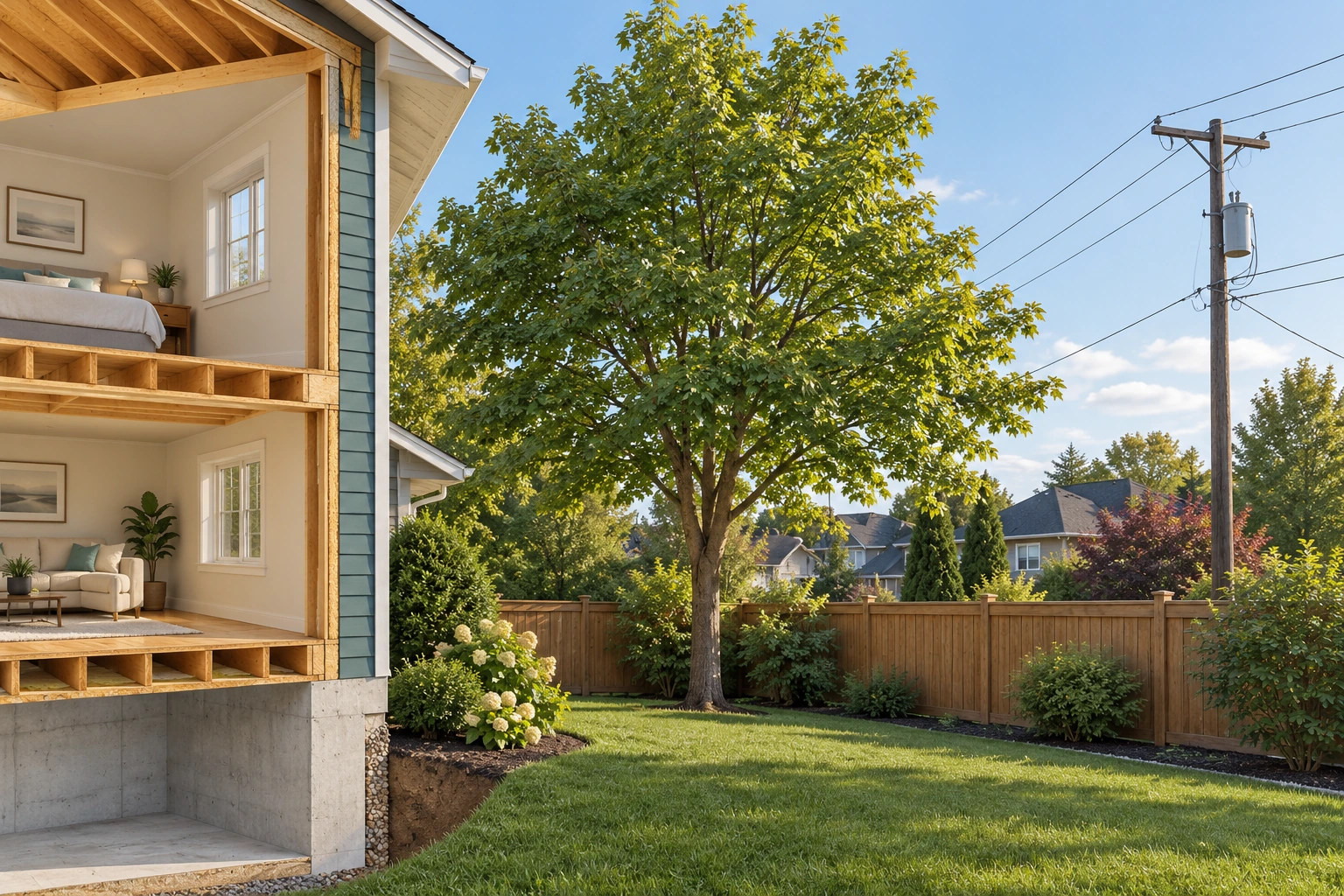
- Tree
Actual work belongs with the appropriate qualified scope.
- Overhead line
Keep clear; geometry is not an operating clearance.
- House and yard
Buried services need their own planning question.
What does this illustration leave out?
No numeric setback, arcing boundary, buried locate, line ownership or permission to approach, cut or climb. This illustration explains an idea. It is not an installation guide.
Which current operator and qualified provider requirements govern this tree work?
Explore this with HomeAI ↗Opens an editable question. Nothing is sent until you choose to send it.How are tree health and the risk to people or structures different?
Health concerns the living condition of the tree. Risk assessment considers possible failure and what could be affected under the actual circumstances. The two questions can be connected without being identical. A green canopy does not independently clear every structural concern, and a damaged-looking branch does not establish a complete risk rating for the site.
ISA’s construction-recovery brochure directs concern about health or structural integrity to an arborist assessment. Ask the provider what its assignment covers, which parts were examined, what method it used and what remains inaccessible. A simple consultation, detailed risk assessment and treatment proposal can have different deliverables. The report should explain its actual scope in terms the household understands.
Identify the relevant setting: ordinary occupied space, a walking route, neighbouring property, vehicles or utilities. These are context for the professional assessment, not an owner formula for deciding a tree must come down. Changing how the space is used can be part of a suitable professional plan, but this article prescribes no exclusion radius or probability score.
If immediate instability or a damaged overhead line is suspected, keep people clear and obtain urgent appropriate help. Do not pull, climb, strike or load a tree to test it. A quiet inspection day cannot reproduce every wind or weather condition, and an assessed finding should retain its time and limits. The useful outcome is a supported next step rather than a whole-tree safety certificate.
A risk discussion also has a time and intended-use boundary. A report may describe the conditions assessed during a visit and recommend changes or reassessment under specified circumstances. Ask which new event would justify contacting the provider again. Do not turn the absence of a recommendation for immediate removal into a promise that no branch can ever fail. Equally, a recommendation for a defined task should keep its reason and scope, rather than become an unsupported assertion that every tree on the lot is dangerous.
Why should an arborist join a construction plan early?
Construction can affect roots and soil before the finished project appears. Grading, excavation, paving, stored materials and machinery can change the tree’s environment. ISA’s construction brochure recommends involving an arborist during planning, with protection carried into later phases. The reason is functional: avoiding or adapting a conflict early can be different from trying to address damage after it occurs.
The work-zone cutaway shows a conceptual protection boundary and materials outside it. Its fence has no prescribed radius. The actual protection area and restrictions should be defined for the tree, site and project by the appropriate professional, then coordinated with the contractor. A stock circle drawn around the trunk is not evidence of a suitable root-protection plan.
Ask how access, storage, utilities, grading and later landscaping are included. A project can preserve the visible trunk while damaging the root environment elsewhere. The plan should explain who monitors the boundary, how changes are approved and what happens if work unexpectedly conflicts with it. This is coordination, not an instruction for the owner to prune roots or redesign a trench.
Retain the pre-work condition, agreed protection and actual changes with dates. ISA notes that damage can become apparent later, so a post-construction plan may be relevant even when the tree initially looks unchanged. A completion photograph should not erase the earlier conditions or replace the follow-up responsibility. No survival guarantee, irrigation design or universal maintenance interval is supplied.
Protection needs to survive changes in the construction plan. A new delivery route, relocated material pile or revised service trench can affect the original assumptions even when the building footprint stays the same. Ask who brings those changes back to the arborist and how the agreed protection is updated. The contractor should work from the current plan rather than an old sketch left in the folder. This is particularly useful when several trades visit at different times and may not have heard the original site discussion.
Agree on protection before construction changes the site
Excavation, storage, changed grade and drainage can affect a tree’s root and soil environment. The figure places arborist review and coordination before the relevant project, then retains completed changes and follow-up.
Numbers identify the parts explained below.
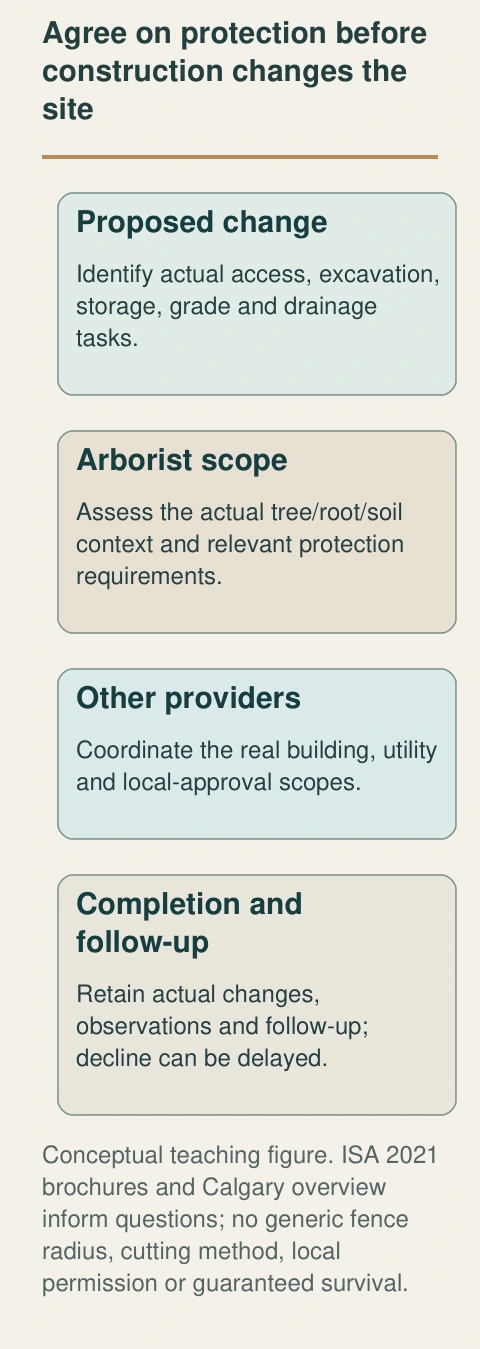
- Proposed change
Identify actual access, excavation, storage, grade and drainage tasks.
- Arborist scope
Assess the actual tree/root/soil context and relevant protection requirements.
- Other providers
Coordinate the real building, utility and local-approval scopes.
- Completion and follow-up
Retain actual changes, observations and follow-up; decline can be delayed.
What does this illustration leave out?
ISA 2021 brochures and Calgary overview inform questions; no generic fence radius, cutting method, local permission or guaranteed survival. This illustration explains an idea. It is not an installation guide.
Who reviews a changed work route before it affects the tree’s site?
Explore this with HomeAI ↗Opens an editable question. Nothing is sent until you choose to send it.Protect the actual site before work changes it
A conceptual fence marks a protected tree area beside stored construction materials and the house model. It locates access and storage coordination without depicting the protection extent required for any actual tree.
Numbers identify the parts explained below.
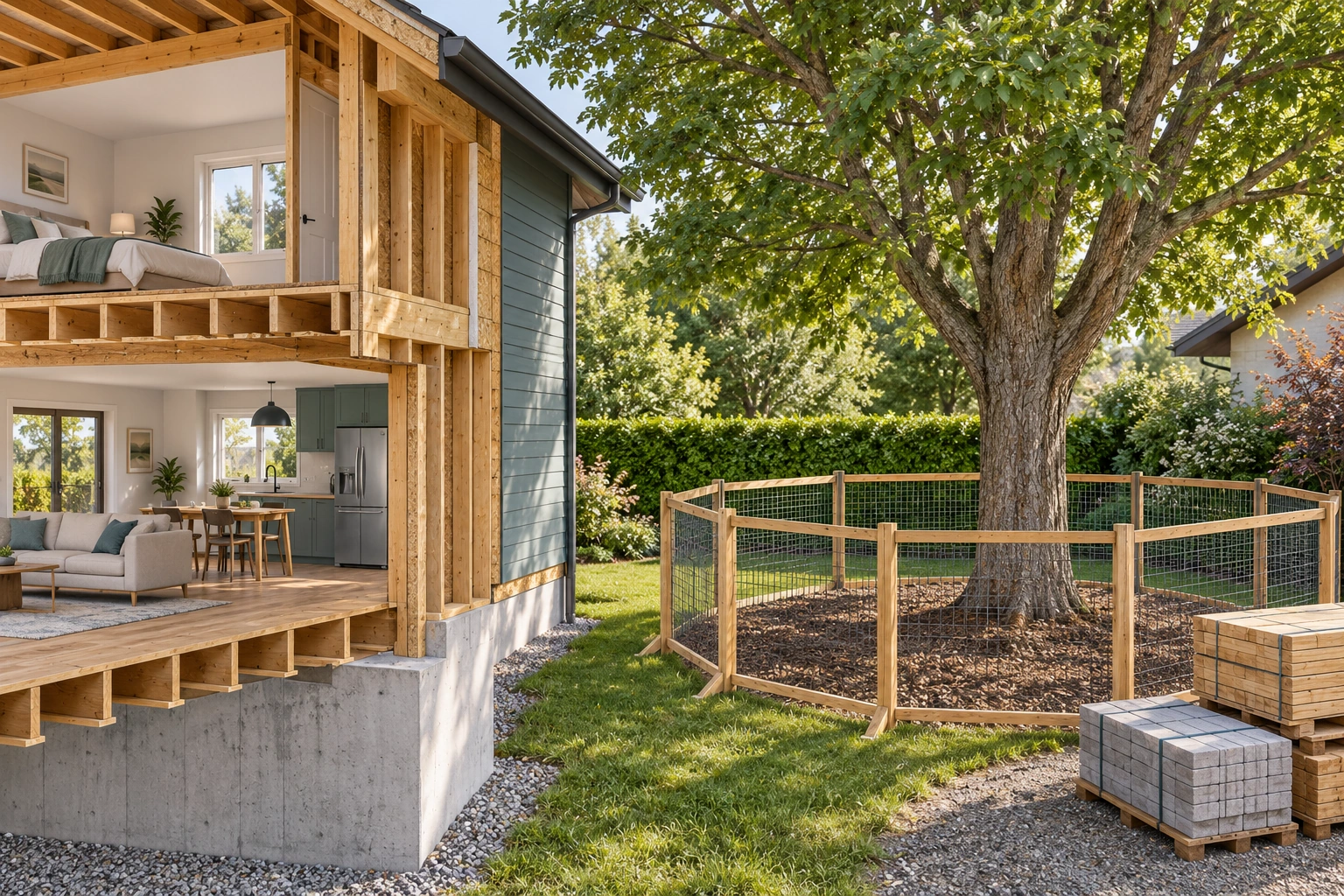
- Boundary
Actual extent must come from the project-specific scope.
- Stored material
Storage and movement can affect the site plan.
- Tree and house
Arborist, building and utility tasks need coordination.
What does this illustration leave out?
Fence radius and material placement are illustrative, not an arborist protection design, survival guarantee or work permission. This illustration explains an idea. It is not an installation guide.
Who defines and reviews the actual protection area and changed access route?
Explore this with HomeAI ↗Opens an editable question. Nothing is sent until you choose to send it.Protection continues through a project
- PlanningIdentify the tree and conflicts with an arborist.
- Before workDefine actual protection and contractor responsibilities.
- During workCoordinate changes and retained access limits.
- After workDocument changes and appropriate delayed-effect follow-up.
No numeric zone, owner root work or survival guarantee.
Further reading: International Society of Arboriculture · Avoiding Tree Damage During Construction; International Society of Arboriculture · Treatment of Trees Damaged by Construction.
Read the complete figure
Agree on protection before construction changes the site
Original native teaching figure: Agree on protection before construction changes the site. The complete labelled relationships distinguish the functions below; they describe conceptual questions rather than an actual property finding.
- Proposed change
- Identify actual access, excavation, storage, grade and drainage tasks.
- Arborist scope
- Assess the actual tree/root/soil context and relevant protection requirements.
- Other providers
- Coordinate the real building, utility and local-approval scopes.
- Completion and follow-up
- Retain actual changes, observations and follow-up; decline can be delayed.
What remains unknown: ISA 2021 brochures and Calgary overview inform questions; no generic fence radius, cutting method, local permission or guaranteed survival.
A useful question: Who reviews a changed work route before it affects the tree’s site?
What should happen after a storm or an unexpected site change?
A storm, impact, trench or changed drainage pattern can create a new question after an older assessment. Record what is safely known about the event and obtain appropriate current advice. Do not assume the previous report covered conditions that did not then exist. A dated assessment remains useful history while the new concern needs its own scope.
Keep clear of damaged branches, unstable areas and utility involvement. The utility’s emergency response governs damaged lines; the appropriate tree professional addresses the actual tree concern. A building specialist may need to assess roof or other property damage separately. One responder resolving an immediate threat does not automatically complete the tree, building and service records.
For non-emergency follow-up, ask what changed and how it affects the prior plan. The arborist may recommend a defined assessment or revised care, with a clear explanation of limits. ISA’s recovery brochure discusses both immediate assessment and delayed decline, but its treatment examples are not copied here as owner pruning, fertilization or cabling methods.
Preserve requested work, completed work and assessed results separately. A storm-removal invoice can describe a specific branch without documenting the complete remaining tree. An apparent recovery in leaves can be encouraging while leaving the risk or root question open. The file should help the next provider see the change rather than compress several stages into the phrase tree fixed.
Emergency work and longer-term assessment can have different deliverables. A responder may make an immediate area clear while another visit is needed to assess remaining branches, root conditions or property effects. Keep those milestones separate. The household can retain the emergency record without assuming it is the final arborist or building report. Ask the responsible provider which question remains and how urgently it should be addressed. This avoids both delaying necessary follow-up and inventing a complete failure diagnosis from the fact that emergency work occurred.
Who can authorize work on the actual tree?
First establish the relevant property and tree responsibility. A tree beside the yard may be on public land or subject to a shared or uncertain boundary. Calgary’s overview directs people to confirm City jurisdiction rather than deciding from proximity to a sidewalk. Elsewhere, obtain the current local process. A photograph cannot settle ownership or grant pruning or removal permission.
Keep the arborist’s technical recommendation separate from legal or municipal authorization. A provider can recommend a task while another party or authority must decide whether and how it may proceed. Boundary, neighbour, easement and shared-building questions belong with the appropriate local authority and advisers. This article gives no national neighbour-pruning rule or cost allocation.
Wildlife can introduce another requirement. ECCC’s overview explains that tree work may affect protected birds and nests, with species, occupancy and other laws relevant. Do not disturb or search a nest to clear a project. Have the responsible qualified people address the actual current requirements before disruptive work, preserving uncertainty where the evidence is incomplete.
An older permit, generic bylaw page or contractor’s available date is not present permission for every activity. Retain the actual current advice and authorization with its scope. No complaint, registry entry, permit application, neighbour message or service booking is sent by this guide. Its purpose is to make the missing decision visible before work changes the tree or someone else’s property.
The apparent trunk location may not settle every boundary question. A current survey, title arrangement, municipal tree record or other appropriate evidence may be needed for the actual decision. Ask the relevant authority or adviser what establishes responsibility here. Keep that administrative finding beside the technical recommendation, with its source and date. This lets an arborist’s useful proposal proceed through the right authorization without expanding the arborist’s role into a legal ownership determination or treating a neighbour’s recollection as a surveyed boundary.
What should a useful arborist proposal contain?
The proposal should identify the tree, location, concern, assessed scope and actual recommended work. Ask what supports the recommendation and what alternatives were considered for the stated goal. Consultation does not have to mean immediate tree work. Calgary’s arborist education notes that a consultation can occur without commissioning treatment, which helps separate understanding the problem from choosing a service.
Confirm relevant experience, credentials, insurance and any specialized utility qualification with the responsible provider. ISA certification describes a professional knowledge credential; it is not a universal authorization for every electrical, building or legal task. Ask who will perform the work and what must be coordinated with other roles. Avoid turning a logo on a vehicle into an assumption about scope.
Compare proposals using the same task. Pruning, inspection, monitoring, source investigation and removal are different deliverables. Ask what is included, what remains excluded and how new findings or changed access affect the plan. This guide supplies no price, preferred company, treatment ranking or promise that the cheapest or broadest-sounding package is suitable.
Agree what record the household receives afterward and which follow-up remains. The useful completion account names the actual work, locations, date, changes and limits. A paid invoice is not automatically a risk assessment or building clearance. A guarantee, if offered, has its actual written terms; it should not replace an explained recommendation linked to the property and decision.
An alternative should be compared against the same stated goal. A limited pruning proposal, changed project layout, monitoring assignment or removal recommendation may address different functions and uncertainties. Ask the provider to explain which outcome each option is intended to support and what evidence or permission it requires. This guide ranks none in advance. The comparison becomes useful when the owner can see both the proposed benefit and its remaining limits, rather than treating the amount of visible change as the measure of success.
Which observations and records are useful without owner tree work?
Keep safe ground-level images, familiar location descriptions, reported event times and known work history. Distinguish direct observation from a neighbour’s report or an old recollection. A dated series can be useful when its viewpoint and conditions are clear, but the owner does not need to climb, expose roots or create a hazard to make a professional request legitimate.
Retain arborist findings, protection plans, relevant authorization, utility correspondence and completed-work accounts together. Keep pipe and building reports separate within the same file, with the relationship explained. This prevents an inside-pipe root finding from becoming a whole-tree diagnosis or an arborist consultation from certifying the foundation.
Use a simple sequence: reported concern, actual assessment, agreed plan, authorized work, completed record and follow-up. Missing stages remain named. If a document concerns one tree or branch, retain that boundary instead of assigning it to every tree on the lot. If an old site sketch differs from the current arrangement, ask for clarification rather than quietly editing the history.
The home-care record can store dated tasks and references, while sensitive contracts or personal information remain appropriately private. A later buyer can ask how the records match the present concern, and a seller can explain the actual work without declaring roots harmless everywhere. The purpose is a useful evidence history, not a certificate generated from the number of documents in a folder.
A location sketch can help organize the file if it is labelled as a sketch. Mark familiar buildings and the described tree or observed area, retaining uncertainty about root and buried-service positions. Do not draw a precise underground line from a rough camera distance or the canopy outline. A later qualified survey or locate can be stored separately and compared with the original enquiry. The sketch’s purpose is communication, while the actual measurement or legal boundary remains the job of the appropriate source and method.
How would a fictional owner connect a tree, roof and sewer concern?
Sasha is a fictional owner with a mature tree beside the house. Leaves are observed in a gutter, and an older sewer report mentions roots in a limited inspected stretch. Neither record identifies the present tree’s root system or establishes that it caused a pipe opening. There is no current tree-risk finding. Sasha begins with three distinct questions instead of one removal decision.
An appropriate arborist is asked to assess the actual tree and site concern. A plumbing provider clarifies the old recording, current relevant scope and any location or repair question. A roof provider addresses the gutter and any separate drainage symptom. Their findings keep their original purposes. The household does not dig, cut roots, climb or deliberately reproduce a blocked drain to connect the observations.
In the invented records, the sewer-camera excerpt covers a named inspected stretch and shows roots there without identifying their source tree. The arborist proposal identifies a canopy task for tree T1 but supplies no buried-root map. The gutter quote covers removal of accumulated leaves, not a pipe repair. Sasha can compare and commission each supported task for its own reason while leaving the root-source question open; none of those documents alone supports removing T1 to solve the sewer concern. Access, utilities, authorization and tree protection still need coordination before relevant work.
This case supplies no real root identity, defect, risk score, pruning design, removal permission, repaired sewer or cost. Its useful outcome is a supported division of responsibilities and a reviewable next step. A mature tree can remain part of the property discussion without a nearby symptom automatically becoming either proof of harm or an assurance that no relationship is possible.
Consider a different branch of the fictional case: the current plumbing assessment does not establish a relationship with the tree, while the arborist identifies a separate canopy task. Sasha can still address that task for its own supported reason. The absence of a pipe connection does not make the consultation useless, and the canopy recommendation does not retrospectively prove the old root story. Each provider’s actual result remains meaningful at its own boundary. The next household receives those distinctions instead of a simplified narrative that the tree caused everything.
What should the next household understand at handover?
Explain the tree’s familiar parts and the actual concern first. Then provide the relevant site history, professional findings, current authorizations, completed work and follow-up. Identify the tree and locations clearly enough that another provider can connect the documents with the yard. Keep root extent and buried service routes unknown unless suitable evidence actually establishes them.
Follow the canonical guide for the question that remains. Sewer inspection explains a camera result; foundation and drainage education explains building-water questions; roof education explains the rain route; wildlife education explains species and authorized exclusion. The tree guide joins the site relationships and professional coordination rather than replacing those specialized mechanisms.
A property professional can help organize the transaction record, while arborists, utilities and building or plumbing specialists supply their actual findings. Local legal advice addresses agreements and disputed boundaries. A handover should preserve those roles and avoid promising that a past consultation determines every future weather event, tree change, neighbour question or system condition.
The reader should finish able to explain how soil, roots and canopy depend on one another, why nearby pipes and cracks need their own evidence, and why utility and construction work require coordinated qualified scope. They should know which observations are useful from ordinary safe access and which decisions remain with responsible professionals. That practical understanding supports care and planning without inventing an actual tree or building outcome.
Keep the next action concrete. It might be obtaining a missing report, confirming a utility line, arranging an arborist-defined follow-up or coordinating tree protection before a proposed project. Name the task and responsible contact without inventing a date or outcome. A useful handover leaves the next person able to continue the work from the actual evidence. It does not require the folder to look complete when an important condition is still unassessed, and it does not turn a conceptual root picture into a measured map.
Keep learning about the connected parts
- Home sewers explained: drains, buried pipes, roots and camera reports
- Follow rain away from your foundation
- Understand the roof above the home you are buying
- How a house is supported: floors, walls, beams and changes
- Build a home-care record that the next person can understand
Canadian context and authorities · Visual atlas · Learning labs
Practice the distinction.
Sasha separates a tree, gutter and old sewer finding
Fictional mature tree, gutter leaves and a limited older root finding; present tree identity, cause and risk are unconfirmed.
Reported observations
- The fictional camera excerpt records roots only within its named inspected stretch and attributes no source tree.
- The T1 arborist proposal concerns canopy work, without a buried-root map.
- The gutter quote concerns leaves, without a pipe-repair scope; no excavation, root cutting or roof access is staged.
Compare the explanations
Expand each possibility to see the evidence needed to distinguish it. Similar symptoms can have different mechanisms.
A supported site relationship informs a defined task
Actual findings can connect the relevant tree, service and building questions.
Scoped current assessments and the records behind the recommendation.
Another boundary remains unresolved
One provider’s finding does not establish the complete root map, pipe or foundation condition.
Explicit location/access limits and the next appropriate assessment.
A useful next question
Commission only the finding-matched tasks, retain the unproved root-source relationship, and coordinate utility, authorization and tree-protection requirements before relevant work.
No real risk score, root source, defect, treatment design, permission or cost.
Know what the words mean.
- Root zone
- The actual soil and roots supporting the tree’s living and physical functions, not a universal circle copied from a canopy.
- Photosynthesis
- The leaf process using sunlight, water and carbon dioxide to make sugars supporting the tree.
- Tree protection zone
- A site-specific area and restrictions defined for the actual tree and project by the appropriate professional.
- Tree risk assessment
- A scoped professional consideration of possible failure and what could be affected; distinct from a general health observation.
- Utility-tree scope
- Work coordinated with the relevant utility and suitably qualified provider; not ordinary owner pruning.
Questions to bring
to the conversation.
- Which actual tree, location and concern are identified?
- What do the root/soil and canopy findings support?
- Which utility, ownership and wildlife requirements need confirmation?
- How does the proposal coordinate tree protection with building/service work?
- What completion and follow-up evidence remains?
Separate a showing observation, an existing record and a new professional assessment. Unknown means a question remains; it does not automatically mean a defect.
Use the evidence planner ↗Go to the source.
Original HomeAI explanation informed by these public references. Sources support the underlying guidance; they have not reviewed or endorsed HomeAI. Diagrams are conceptual, and calculator outputs depend on your inputs.
Complete current substantive Calgary/ENMAX/Portland bodies, full two-page ISA 2021 brochures and ECCC bird overview personally read October 14. General physiology is explicitly US municipal education; Calgary poplar and utility contexts remain local. No universal root radius, root-caused crack verdict, impervious-material promise, numeric clearance, owner instructions for pruning, cutting, trenching, cabling, fertilization or irrigation, legal permission, current programme offer, risk score or real outcome. Source-linked studies, laws and model details not independently read. Fictional Sasha case supplies no property result.
Publication & source review
First published .
Sources reviewed .
- Portland Urban Forestry · Tree Physiology Primer: All About Roots
- International Society of Arboriculture · Avoiding Tree Damage During Construction
- International Society of Arboriculture · Treatment of Trees Damaged by Construction
- City of Calgary · Problems with poplar trees
- City of Calgary · Bylaws related to trees and shrubs
- City of Calgary · Why Hire an Arborist?
- ENMAX · Trees and power lines
- City of Calgary · Privately-owned trees
- Environment and Climate Change Canada · Guidelines to avoid harm to migratory birds
Have a question about your home?
Start with the symptom, timing and what you have observed.
Ask HomeAI