Jump to a question in this guide
- What are we trying to learn from a hole, dust or an insect?
- Do carpenter ants eat wood like termites do?
- Why can moisture and decay matter without proving the pest cause?
- What do holes and sawdust-like material tell us?
- Does an old exit hole mean insects are still active?
- How do subterranean termites connect soil and wood?
- Can a furniture insect be different from a structural infestation?
- What should the pest professional’s report answer?
- When does the building need a separate structural assessment?
- Why must moisture repair, pest control and wood repair be coordinated?
- What changes with location, building type or earlier history?
- What should follow-up look for after the work?
- How would a fictional owner organize a timber-and-dust concern?
- What should the final record help the next person understand?
- Carpenter ants excavate nesting wood; termites feed on wood.
- A visible hole and its discovery date do not establish current activity.
- Pest identification and structural capacity need different assessments.
- Moisture repair, control and material repair have separate completion evidence.
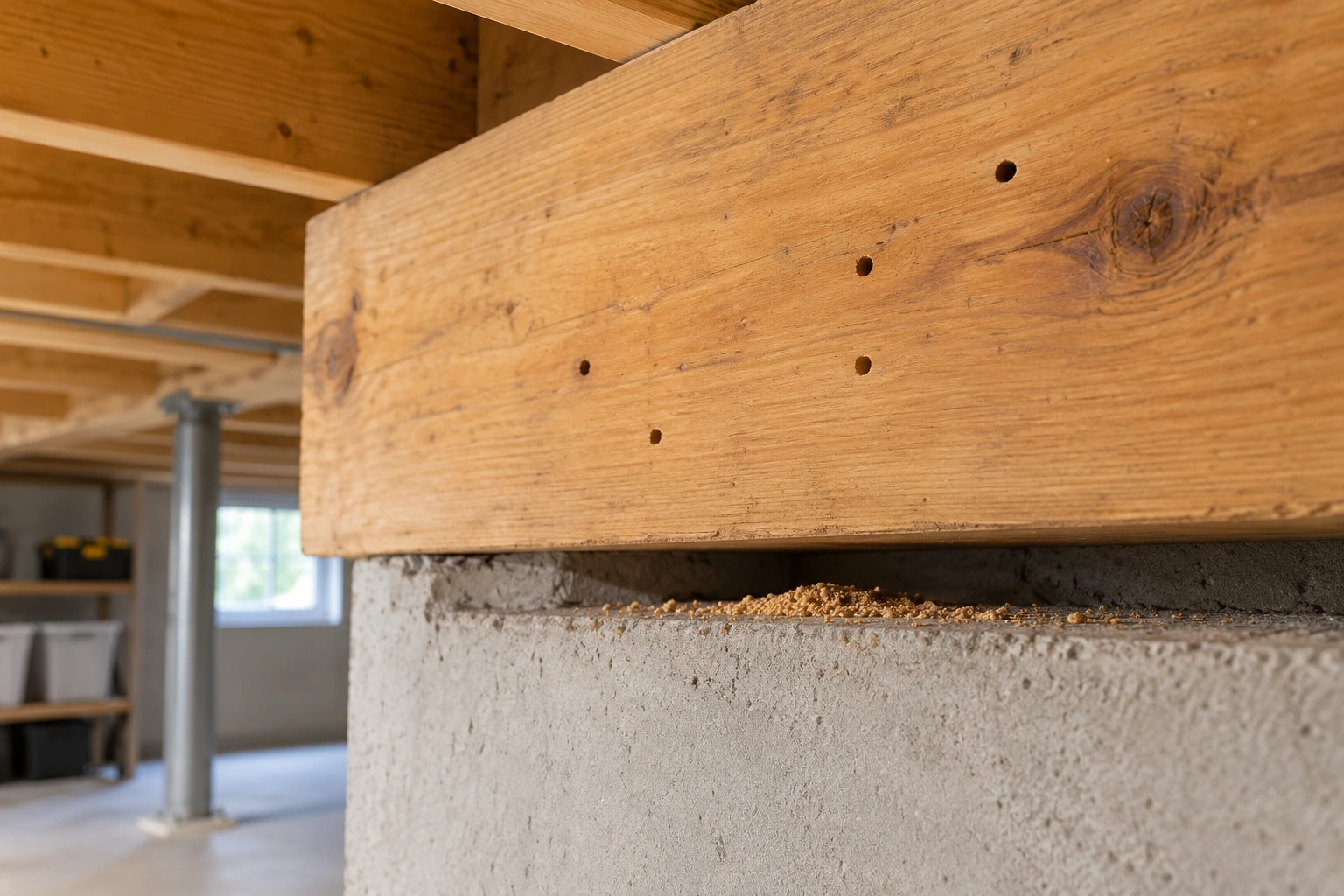
The intact wood face contains small holes with loose sawdust-like material on the ledge. Those signs raise identity, source and current-activity questions without exposing the member’s interior.
About this illustration
No species, age, reinfestation, internal gallery extent or structural finding is established. This is a conceptual teaching model, not an assessment of your home.
9 picture lessons appear beside the questions in this guide. Use them to understand the explanation, then consider what it means for your home.
What are we trying to learn from a hole, dust or an insect?
A mark in wood can raise several questions: what made it, whether activity is current, how far it extends and whether the affected member still performs its building job. Those questions need different evidence. An insect identification does not by itself determine structural capacity, while a carpenter’s repair invoice does not automatically identify the pest or establish that activity has stopped.
Begin with the actual location and material. Is the sign on furniture, finish trim, an accessible framing surface or another object? When was it first noticed, and what earlier history is available? Keep the description close to the observation. A hole noticed today may be old; dust beneath a shelf may have more than one explanation. A clear record supports assessment without inventing an arrival date.
The timber and furniture pictures keep a building member and a separate source object in different contexts. The exterior view adds the yard and foundation question without drawing a confirmed tunnel into the house. The native evidence map follows identification, current activity, material condition and structural scope as connected questions. The picture is no infestation diagnosis or permission to expose concealed framing.
This guide owns wood-associated insects and the distinction between pest and building assessment. The rodent guide owns animal entry, food and shelter. The bedbug guide owns its separate identification-to-treatment journey. Moisture and structural guides deepen their own mechanisms. A homeowner should understand how these scopes cooperate instead of assuming every pest service includes concealed damage, water repair and structural approval.
The member’s building job is worth naming early. Finish trim can cover a junction, furniture supports its own contents, and framing participates in the building’s support arrangement. An owner may not know which category applies behind a finish, and that uncertainty should remain visible. Ask the appropriate assessor to identify the actual component before a pest-related photograph becomes a structural claim. The same-looking surface mark can raise different next questions depending on the material, location and function. Appearance alone does not establish which report is needed or what work should follow.
Four questions behind a wood sign
Identification, current activity, extent and building function require different evidence. One sign cannot answer them all.
Numbers identify the parts explained below.
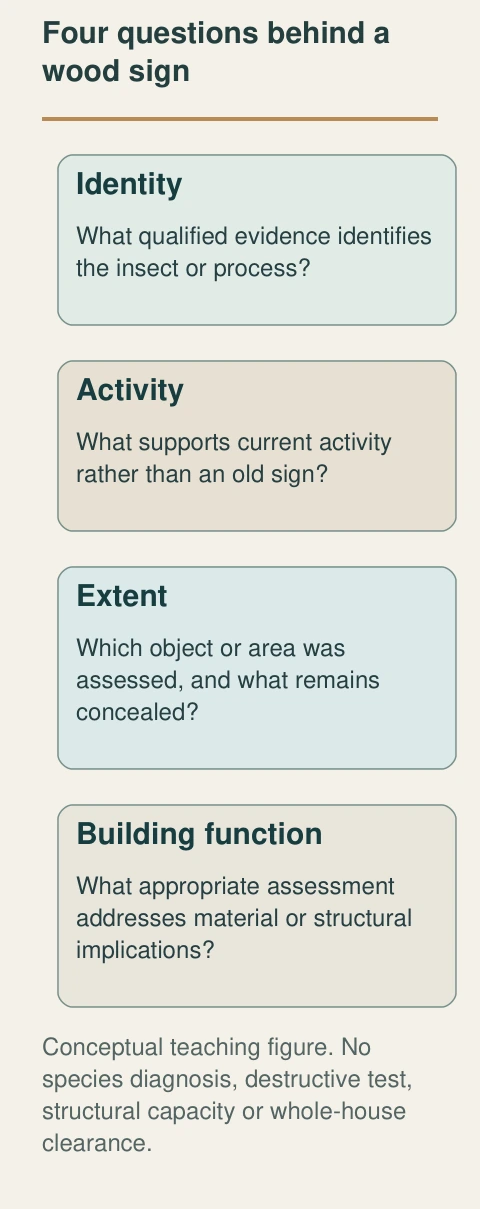
- Identity
What qualified evidence identifies the insect or process?
- Activity
What supports current activity rather than an old sign?
- Extent
Which object or area was assessed, and what remains concealed?
- Building function
What appropriate assessment addresses material or structural implications?
What does this illustration leave out?
No species diagnosis, destructive test, structural capacity or whole-house clearance. This illustration explains an idea. It is not an installation guide.
Which question does the actual report answer?
Explore this with HomeAI ↗Opens an editable question. Nothing is sent until you choose to send it.Read the complete figure
Four questions behind a wood sign
Identification, current activity, extent and building function require different evidence. One sign cannot answer them all.
- Identity
- What qualified evidence identifies the insect or process?
- Activity
- What supports current activity rather than an old sign?
- Extent
- Which object or area was assessed, and what remains concealed?
- Building function
- What appropriate assessment addresses material or structural implications?
What remains unknown: No species diagnosis, destructive test, structural capacity or whole-house clearance.
A useful question: Which question does the actual report answer?
Do carpenter ants eat wood like termites do?
Carpenter ants excavate wood to create nesting galleries, meaning passages and spaces used by the colony. They discard the removed material rather than using that wood as their food. Termites feed on wood. These are different relationships to the same building material, which is why a generic phrase wood pest can hide important questions about identification and control.
Health Canada explains the carpenter-ant nesting function and distinguishes it from termites. It also describes food sources separate from the excavated timber. The useful lesson is to ask what the identified insect does with the material, rather than assume that every sawdust-like particle means wood was eaten or that all ant activity comes from a nest inside that member.
The intact wood-face close-up shows holes and loose material without exposing a gallery. The nesting mechanism belongs in the text because the visible face cannot establish the real extent inside. Its caption keeps identification, current activity and structural capacity unresolved. Do not copy the image into a treatment or repair plan, and do not open a member to see whether its interior matches.
A suitable pest report should name the supported identification, evidence location and relevant activity question. If the provider considers a nest or related outside colony, ask what supports that relationship. An ant seen crossing a kitchen does not automatically establish a structural nest. The actual plan should connect findings with next work, leaving a tentative identification or unassessed area explicitly tentative.
A colony relationship can also extend beyond the visible ant. Health Canada discusses parent and satellite colonies and notes that ants may nest in voids without attacking structural timber. These are reasons to ask about the actual finding, not to assume every interior ant means a damaged beam. A pest plan should explain whether its scope concerns an identified nest, foraging activity, a related outside location or an unresolved possibility. The provider’s basis and access limits matter more than replacing several different questions with the broad statement that ants are in the walls.
Holes and loose material need identification and activity evidence
The intact wood face contains small holes with loose sawdust-like material on the ledge. Those signs raise identity, source and current-activity questions without exposing the member’s interior.
Numbers identify the parts explained below.
- Visible holes
Marks on the surface; cause and age require suitable assessment.
- Loose material
A source and identification question, not automatically confirmed frass.
- Intact member
Its concealed condition and building role need a separate scope.
What does this illustration leave out?
No species, age, reinfestation, internal gallery extent or structural finding is established. This illustration explains an idea. It is not an installation guide.
What evidence distinguishes an old sign from current activity here?
Explore this with HomeAI ↗Opens an editable question. Nothing is sent until you choose to send it.The hollow space is a nest; the discarded wood is not the ant's meal
Carpenter ants excavate nesting spaces and remove the wood as shavings; that timber is not their food. The cutaway makes the hollow space and discarded material visible. It does not identify the cause of loose material found in a home or show the extent of a real nest.
Numbers identify the parts explained below.
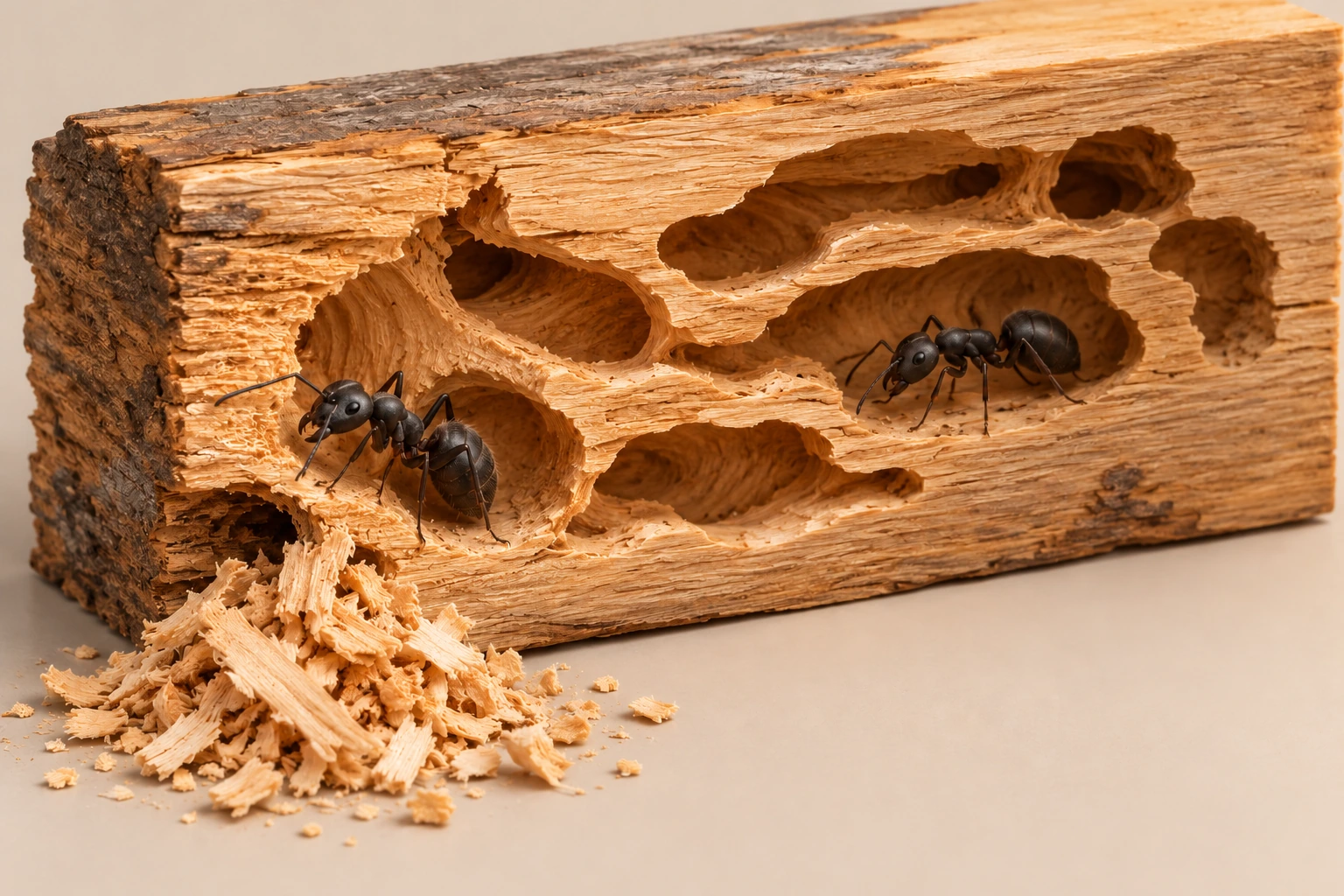
- Gallery
A passage or space excavated for nesting; the word names its function, not a measured damage extent.
- Removed shavings
Illustrate wood displaced from the nesting space, not evidence that an actual loose pile came from carpenter ants.
- Ant model
Places an illustrative insect in the nesting-space example. Food is obtained separately; no food object is depicted here.
What does this illustration leave out?
No species identification, current activity, real gallery shape or extent, measured material loss, moisture level or structural capacity. This illustration explains an idea. It is not an installation guide.
Does the pest finding concern foraging, an identified nest, an unresolved sign or another source of the loose material?
Explore this with HomeAI ↗Opens an editable question. Nothing is sent until you choose to send it.The hollow space is a nest; the discarded wood is not the ant's meal
Carpenter ants remove wood to form passages and nesting spaces called galleries. Health Canada describes that removed material as sawdust-like shavings. The important distinction is what the wood does in the insect's life: it provides space for the nest, while plant and animal foods are obtained separately. A foraging ant and a nest inside a particular timber are consequently different findings.
The open section makes an otherwise concealed space understandable. It is not a model of a real gallery's geometry or size. A loose pile in a home still needs its own source and identification evidence; an ant nearby does not establish that the pile came from that ant or that a structural member contains a nest. Ask what the provider actually located and which relationship remains uncertain.
Moisture can be relevant without becoming a diagnosis. The source describes carpenter ants' preference for moist or decaying wood and also describes sound wood and other nesting spaces. The next question may therefore concern a water source, a nest, or a void without assessed timber damage. A pest finding does not supply the remaining member dimensions, connections or structural assessment.
- Gallery: A passage or space excavated for nesting. It does not mean a measured amount of damage.
- Removed wood: Illustrates material displaced from that space. A real loose pile still requires suitable identification and source attribution.
- Food obtained separately: Explains why nesting in wood differs from eating it. An observed foraging ant does not automatically locate a nest. Food is not depicted in this edited study view.
- Moisture and member condition: Remain separate assessment questions. The conceptual cutaway supplies no moisture reading, decay finding or remaining capacity.
The illustration is not a species key, active-nest finding, real hidden-damage map, owner probing method or structural assessment.
A useful next question: What supports the identification and nest or foraging finding, and which water-source or member-condition question needs another qualified scope?
Further reading: Health Canada · Carpenter ants.
Source geography, edition and reading scope
Health Canada · Carpenter ants. Canada national pest education; current local species/activity require assessment Page details June 4, 2013; current reachable historical body, not a 2026 prevalence survey. Ant nesting excavates rather than eats wood; moisture/decay association, possible sound-wood involvement and nesting in voids. No owner cavity entry, destructive inspection, pesticide or structural replacement procedure. Complete substantive current body personally read; research/carpenterAnts.txt and .html. All procedural pesticide and destructive-access suggestions withheld.
Different relationships with wood
- Carpenter antsExcavate a nesting place; wood is not their food.
- TermitesFeed on wood within the identified species/context.
- BorersIdentity and reinfestation behaviour require suitable assessment.
No species diagnosis or current regional map.
Further reading: Health Canada · Carpenter ants; Canadian Conservation Institute · Major insect pests and their associated diagnostic signs; City of Guelph · Termite Tips.
Why can moisture and decay matter without proving the pest cause?
Moisture changes the environment and condition of wood. Health Canada associates carpenter-ant nesting with moist or decaying wood while noting that sound wood can also be involved. That relationship makes a water question relevant; it does not mean every ant observation proves a leak or that dry-looking wood rules out activity. The actual source and material condition need their own assessment.
Decay is deterioration of the wood itself, a different finding from an insect present nearby. Water entry, persistent dampness and drying conditions can involve plumbing, enclosure or other building systems. A pest provider may identify a relevant damp location while a different qualified specialist investigates where the water comes from and what repair is suitable.
The moisture-interface picture shows an ordinary timber/concrete or wall junction with a conceptual damp-looking area. It explains why the surrounding building route matters to a wood concern. The colour is not a moisture measurement, rot diagnosis or map of hidden damage. The native parallel-work figure keeps source investigation, pest assessment and material/structural decisions separate.
Ask each provider what it established. A plumbing repair can address an identified source without certifying the remaining wood. Pest control can address identified activity without restoring a damaged member. A repair to finishes can conceal the location without resolving either underlying question. Retain the sequence and remaining tasks so visible improvement does not become an unsupported whole-system completion claim.
Timing can help coordinate the water and pest enquiries without settling either one. A repeated damp pattern after rain and an insect observation in the same area are useful reported facts. Their overlap does not establish that the rain caused a colony or that the colony caused the dampness. Ask each specialist which relationship the evidence supports. If one route remains unresolved after a repair, keep that task explicit. This preserves a meaningful combined history while avoiding a single causal story that none of the professional findings actually established.
A timber junction can need a separate water enquiry
The accessible timber/concrete corner includes a subdued stain. A damp history can be relevant to wood-associated insects, while source, activity and material condition remain separate assessments.
Numbers identify the parts explained below.
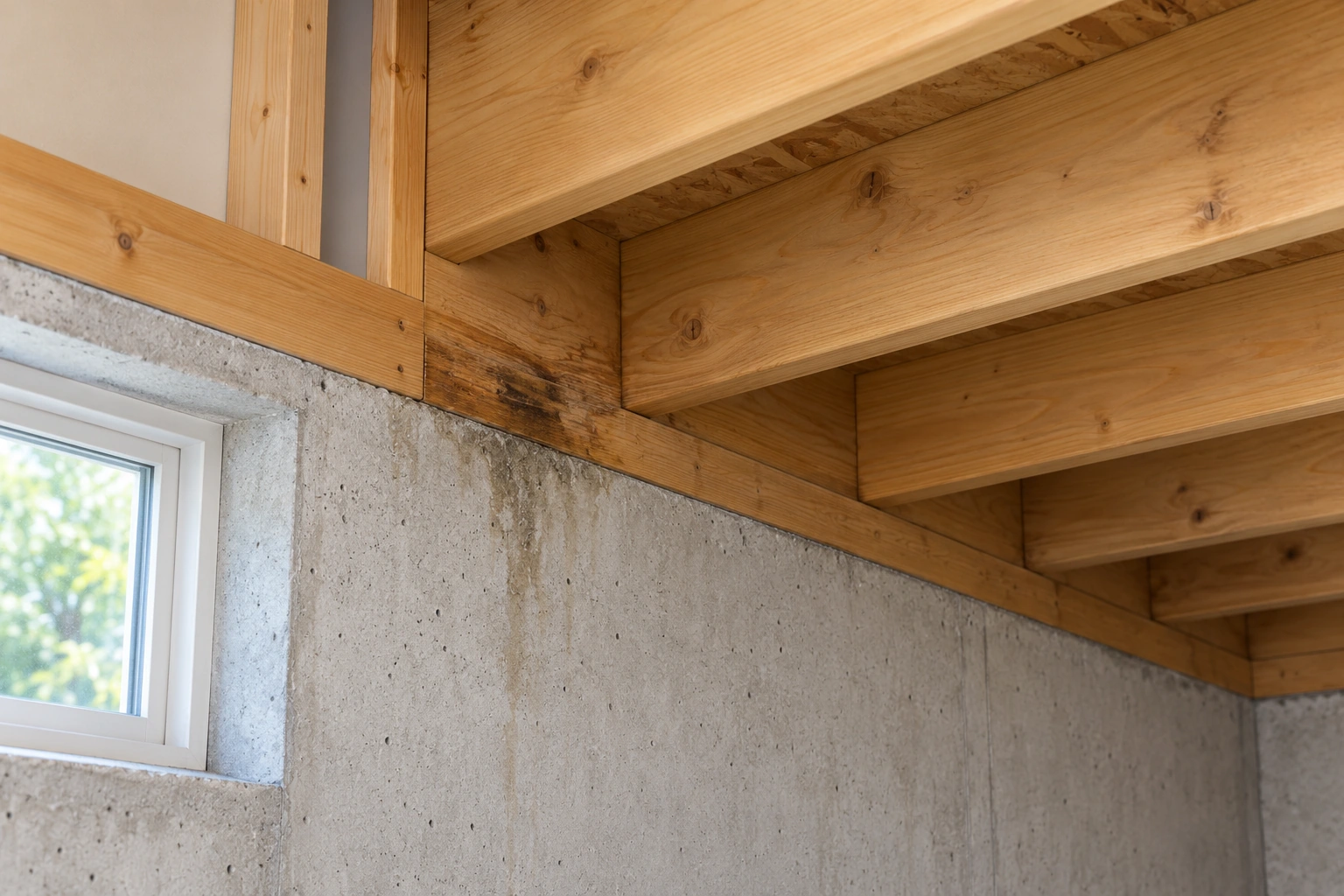
- Timber face
Accessible surface; concealed extent remains unknown.
- Wall junction
A building interface to discuss with the appropriate source specialist.
- Stain
Context for a water question, not a confirmed active route.
What does this illustration leave out?
Illustrative stain; no moisture measurement, decay diagnosis, pest identity or structural capacity. This illustration explains an idea. It is not an installation guide.
What actual source and material findings accompany the pest report?
Explore this with HomeAI ↗Opens an editable question. Nothing is sent until you choose to send it.What do holes and sawdust-like material tell us?
A hole is a visible opening in the material. Frass is a term used for insect-produced waste or boring material, but a loose pile should not be assigned that label without suitable identification. Different insects and other processes can leave different-looking signs. The Canadian Conservation Institute’s table describes several relationships in conservation and heritage contexts; it is a prompt for qualified identification, not a homeowner photo key.
Ask whether the observed material belongs to the object above it and what supports that connection. Ordinary work, movement or another source may disturb old material. A hole shape can be informative to a specialist while still leaving the species and current activity uncertain. Keep the actual image, location, scale information where safely available and date, without turning a close-up into a diagnosis.
The furniture picture shows a wood object and a conceptual small residue area. Its lesson is the source-object question, distinct from whole-house framing. The illustration is not a real specimen and supplies no reliable hole dimension or frass texture for identification. A professional should decide what evidence is suitable and how it should be retained or examined.
Do not scrape, probe, drill, dismantle or apply a product to make the sign clearer. Those actions can disturb useful evidence and introduce building or exposure hazards. Follow the actual provider’s guidance for safe assessment and any specimen handling. A reported sign is enough to begin a clear enquiry; the owner need not create destructive access to justify asking for help.
A source-object record can distinguish similar signs in different places. Give each location a familiar name and retain its original image and discovery date. Do not combine dust below a furniture shelf with a separate mark on framing unless the provider explains the relationship. A qualified identification may connect them, separate them or leave the relationship uncertain. That distinction changes the work scope and reporting question. It also prevents a dramatic close-up from representing the entire house when the actual evidence concerned one object and a limited accessible surface.
Does an old exit hole mean insects are still active?
An exit hole can remain after the insect that made it has emerged. The mark and its discovery date therefore cannot independently establish current activity. The Conservation Institute also describes insects emerging from timber long after cutting and differences in their ability to reinfest seasoned wood. Those distinctions are species- and context-dependent, which is why the identification and activity questions should remain separate.
Ask the provider what evidence supports current activity and how it distinguishes it from old signs. A newly observed live insect, repeated documented material or another suitable finding may change the investigation. This guide selects no test or monitoring interval. The actual method should have a defined purpose, suitable interpretation and stated limits for the identified object or building location.
A comparison should preserve its conditions. If a provider documents a location and later revisits it, retain both dates and what changed. A report that no new evidence was observed should state its area and method. It is useful without becoming a guarantee that every concealed location is inactive. Equally, one later sign should be identified before declaring every previous treatment unsuccessful.
Do not cover, fill or paint the evidence simply to make the room look repaired before its purpose is resolved. Ask the appropriate provider how cosmetic work fits the assessment. The record should distinguish pest-related findings from ordinary finishing decisions. Repairing a visible hole can change appearance while leaving the species, activity and hidden material questions unanswered.
A mark and an active condition are different
- Visible holePresent sign; age and cause may remain unknown.
- Current activityFinding supported by the actual method and evidence.
- Material or structural conditionSeparate assessment of the building job and damage.
No owner probing or universal clearance criterion.
Further reading: Canadian Conservation Institute · Major insect pests and their associated diagnostic signs.
How do subterranean termites connect soil and wood?
In the City of Guelph’s local explanation, subterranean termites live in colonies associated with the ground and forage toward available wood. Shelter tubes help maintain conditions along an above-ground route. The useful mechanism is the relationship among colony, protected route and food material. A tube-like mark on another property is still a suspected sign requiring identification.
This is a Guelph, Ontario source, not evidence of termites in Calgary or every Canadian region. Current local occurrence and the actual address need suitable local advice. The historical Conservation Institute table also contains regional descriptions, but it is not a fresh distribution survey. Do not use either page to declare a neighbourhood termite-free or currently affected.
The native soil/route/wood figure explains the conceptual journey without depicting an actual colony under the house. It gives the reader a useful question: which supported evidence connects an identified pest to this material? No depth, tube dimension, treatment barrier or foundation repair is prescribed. A diagram’s continuous arrow does not establish the real concealed route.
If termites are suspected, arrange the appropriate local pest assessment and ask which building questions require another professional. The Guelph page directs treatment discussion to a licensed company; its owner probing, yard alteration and borate suggestions are not reproduced here. A homeowner should not damage a suspected tube or cut into wood to determine activity from this conceptual lesson.
A protected route is part of the mechanism, not proof that every visible tube-like feature is biologically active. Guelph describes new shelter tubes and live termites in its local activity discussion. The actual provider should interpret suspected evidence and determine what examination is appropriate. This guide does not reproduce its destructive inspection suggestions. Retain a safe account and let the qualified scope address identification, route and activity. The absence of a conspicuous surface route during an ordinary visit should likewise remain a bounded observation rather than a whole-building clearance.
Yard wood and the building are separate assessment locations
The foundation and siding sit beside a yard with a wood rack and stump. These material and moisture contexts help frame a local pest assessment without drawing a confirmed route into the house.
Numbers identify the parts explained below.
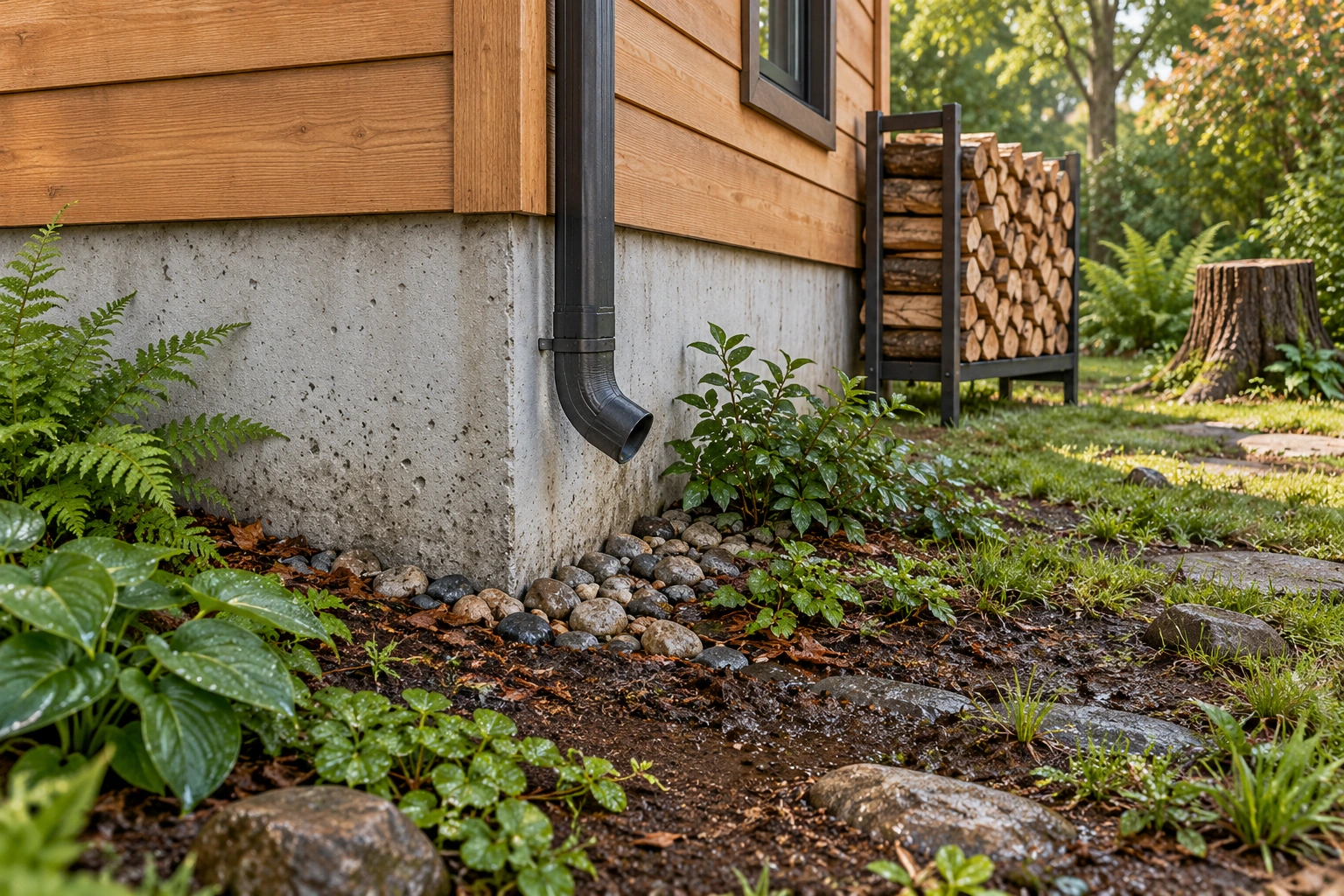
- Building junction
A location whose actual condition needs suitable assessment.
- Stored wood
A separate object/location; the image sets no placement rule.
- Stump and ground
Local context, not a colony finding or current regional map.
What does this illustration leave out?
No approved separation, measured dampness, termite presence, root condition or treatment recommendation. This illustration explains an idea. It is not an installation guide.
Which actual evidence connects the yard and building questions?
Explore this with HomeAI ↗Opens an editable question. Nothing is sent until you choose to send it.A local example of ground-to-wood foraging
Guelph describes subterranean colonies, protected shelter routes and wood food. This mechanism is separate from current occurrence at an address.
Numbers identify the parts explained below.
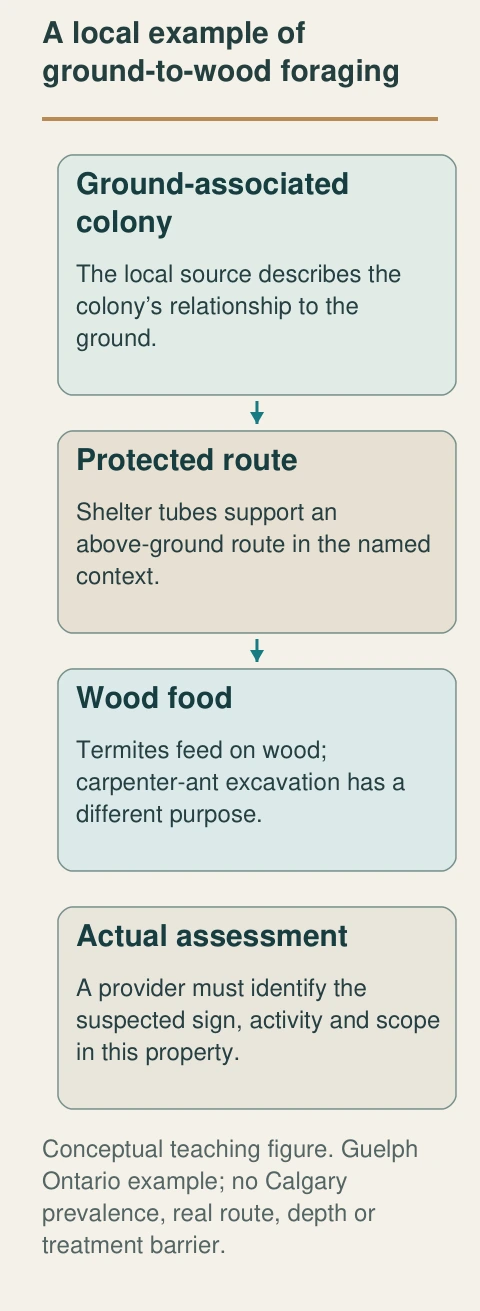
- Ground-associated colony
The local source describes the colony’s relationship to the ground.
- Protected route
Shelter tubes support an above-ground route in the named context.
- Wood food
Termites feed on wood; carpenter-ant excavation has a different purpose.
- Actual assessment
A provider must identify the suspected sign, activity and scope in this property.
What does this illustration leave out?
Guelph Ontario example; no Calgary prevalence, real route, depth or treatment barrier. This illustration explains an idea. It is not an installation guide.
What current local evidence connects the suspected pest with this material?
Explore this with HomeAI ↗Opens an editable question. Nothing is sent until you choose to send it.The protected route reaches wood as food in this local example
In Guelph's local explanation, subterranean termites travel from ground-associated colonies through protected routes and feed on available wood. This separate model connects the shelter route to the wood-food question. It is not evidence of a live route, local occurrence or building damage at an address.
Numbers identify the parts explained below.
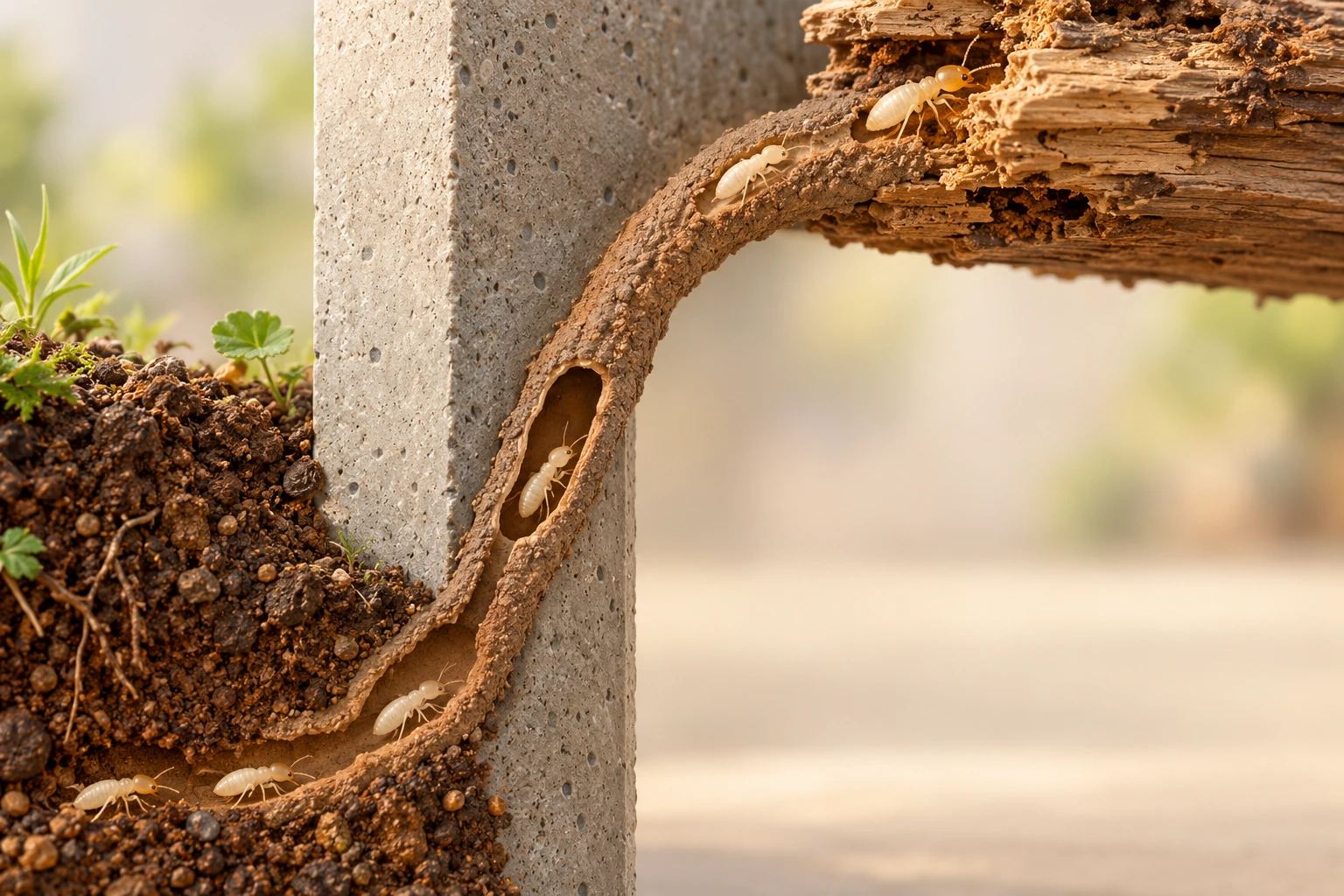
- Ground relationship
Locates the local source's colony/foraging explanation; it is not a finding under the illustrated property.
- Shelter route
Protects an above-ground travel route in the described mechanism; a tube-like mark still needs qualified identification.
- Wood-food interface
Shows the feeding relationship, distinct from carpenter-ant nesting excavation; it supplies no measure of remaining wood or strength.
What does this illustration leave out?
Guelph Ontario mechanism context only; no current Canadian distribution, property identification, complete colony, real route, depth, activity or structural finding. This illustration explains an idea. It is not an installation guide.
What supports the local pest identification, and which separate assessment addresses the affected material and its building job?
Explore this with HomeAI ↗Opens an editable question. Nothing is sent until you choose to send it.The protected route reaches wood as food in this local example
Guelph describes eastern subterranean termites in a ground-associated colony and explains their foraging toward available wood. A shelter tube encloses an above-ground route and helps maintain the conditions described by that source. The model joins those functions: ground context, protected travel, then a wood-feeding interface. It is a separate specimen from the carpenter-ant nesting example.
Feeding and nesting are therefore different questions even when both can involve passages in wood. Do not use a hollow-looking illustration, a surface hole or one insect colour to decide what is present. The actual pest assessment should explain the evidence, location and current-activity basis. A material or structural assessor addresses the affected member's condition and building role.
Keep the geography with the explanation. The source concerns Guelph, Ontario and its termite context; it is not a current survey of Canada or evidence of termites at a Calgary address. The conceptual route has no meaningful depth or damage scale. A tube-like mark, a quiet interval and the absence of a visible route each remain observations requiring their own scope and interpretation.
- Ground context: Locates the colony/foraging relationship described in the Guelph source. It does not locate a colony under a real home.
- Shelter tube: Provides protected above-ground travel in that mechanism. A similar-looking mark still needs qualified identification.
- Wood-food interface: Explains the feeding relationship, rather than carpenter-ant nesting excavation. The view measures neither the amount consumed nor remaining strength.
- Separate building scope: Examines the actual material and member function when needed. A pest identification does not replace that assessment.
Guelph Ontario mechanism context; no current prevalence, property route, species diagnosis, damage extent, treatment barrier or structural approval.
A useful next question: Which evidence connects the identified local pest to this material, and who assesses the remaining building question?
Further reading: City of Guelph · Termite Tips.
Source geography, edition and reading scope
City of Guelph · Termite Tips. Guelph, Ontario local termite-management context; not nationwide or Calgary prevalence Undated current substantive page; historical former-management-area references retained, no revision or present site status inferred. Subterranean colony, shelter tube and wood-food relationships; local provider treatment scope. No owner probing, stump cutting, pesticide/borate work or municipal requirement generalized elsewhere. Complete substantive current body personally read; research/termiteTips.txt and .html. No linked local programme or map independently adopted.
Read the complete figure
A local example of ground-to-wood foraging
Guelph describes subterranean colonies, protected shelter routes and wood food. This mechanism is separate from current occurrence at an address.
- Ground-associated colony
- The local source describes the colony’s relationship to the ground.
- Protected route
- Shelter tubes support an above-ground route in the named context.
- Wood food
- Termites feed on wood; carpenter-ant excavation has a different purpose.
- Actual assessment
- A provider must identify the suspected sign, activity and scope in this property.
What remains unknown: Guelph Ontario example; no Calgary prevalence, real route, depth or treatment barrier.
A useful question: What current local evidence connects the suspected pest with this material?
Can a furniture insect be different from a structural infestation?
A wood object has its own origin and history. An insect emerging from furniture may concern that object rather than every framing member in the room. CFIA describes historical Canadian incidents involving insects in imported furniture, decorative objects and flooring products. Those examples explain why the source object and appropriate identification matter; they do not identify the insect in another household.
Keep the object description, purchase or origin information already available and the date of the safe observation. If a provider or CFIA considers a plant-health reporting question, follow its current guidance for the actual item and specimen. This guide supplies no capture, transport, quarantine, disposal or treatment procedure. Do not take an unfamiliar object outdoors or move it to another property to investigate.
The source-object cutaway keeps the furniture visibly separate from structural framing. It teaches an assessment boundary, not a barrier guaranteed to contain insects. The native evidence map can then record the object question and the building question separately. A house inspection should not be inferred from a furniture finding, and a structural repair report should not be inferred to identify an imported pest.
Ask what the confirmed identification means for next work and any reporting responsibility. CFIA’s retained 2021 examples remain historical; they are not a current outbreak announcement or proof that a present retail product is affected. Preserve the actual qualified response and outstanding task rather than using a dramatic past incident as a diagnosis or a reason to discard unrelated belongings.
A source object is different from structural timber
The shelving unit has small holes and residue near its base, while house framing remains visibly separate. An object-related insect finding does not automatically establish a structural infestation.
Numbers identify the parts explained below.
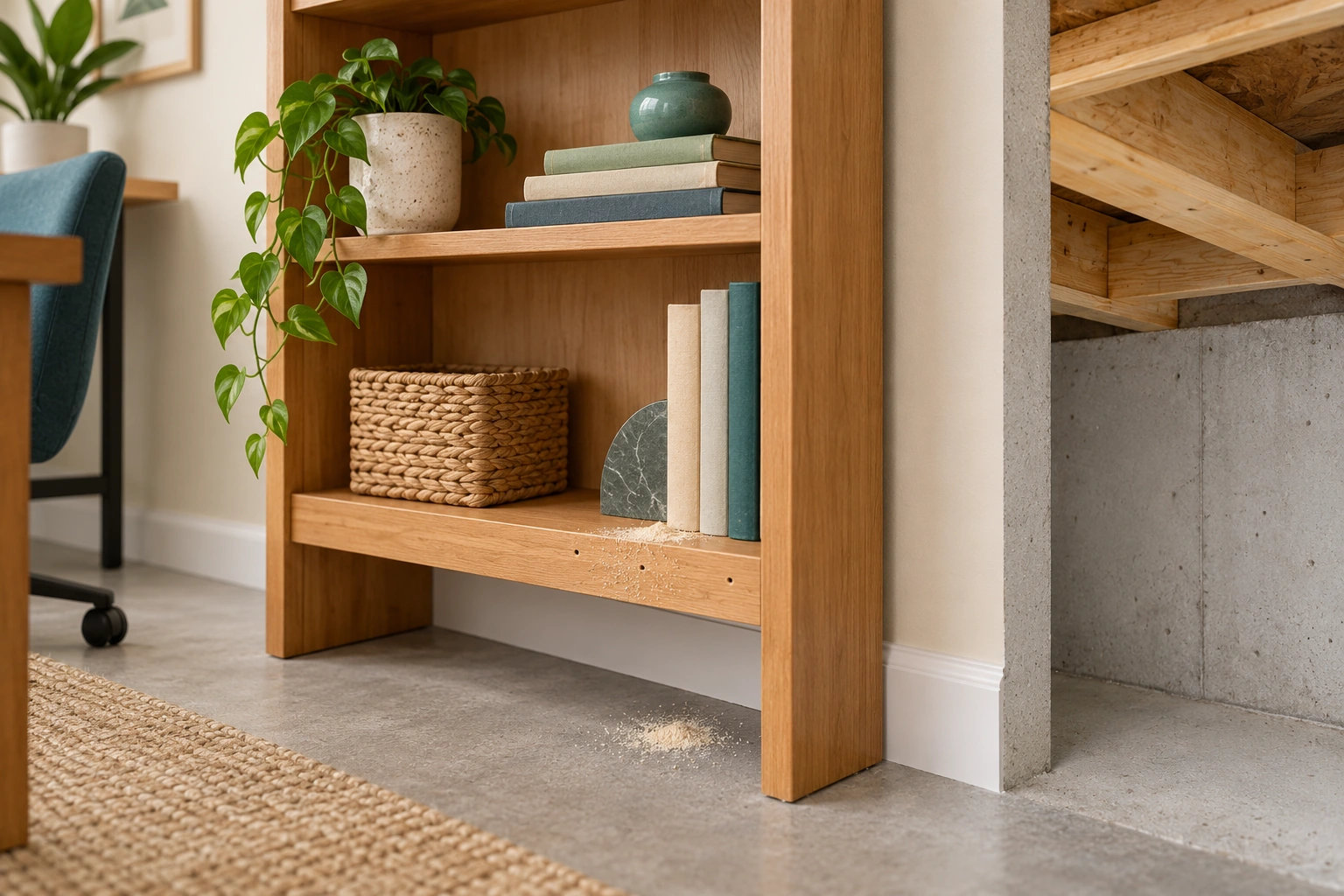
- Shelf object
Its origin and signs form a source-object question.
- Residue below
A visible material needing suitable interpretation.
- Separate house framing
An independent building assessment boundary.
What does this illustration leave out?
No imported-pest identity, current outbreak, transfer route or household framing assessment. This illustration explains an idea. It is not an installation guide.
Which object and reporting scope does the actual identification concern?
Explore this with HomeAI ↗Opens an editable question. Nothing is sent until you choose to send it.What should the pest professional’s report answer?
Begin with identification, inspected locations, access and evidence. Ask the provider to distinguish observed signs from conclusions about activity, nest or source. If the identification is tentative, the report should say what would resolve it. A confident species name without its basis is less useful than a bounded explanation connected to the actual material and room.
Then ask how the proposed control addresses the supported finding. Which area or object is included? Which work, follow-up and prevention questions are covered? Does a moisture concern need another provider? Does suspected material loss need a structural assessment? A pest-control assignment can be valuable while leaving those additional tasks outside its professional scope.
For a product-based proposal, the provider should identify the actual registered product and applicable use and safety instructions. Health Canada emphasizes label-matched use. This guide supplies no pesticide, bait, injection, dust, chemical concentration or application route. Treatment from a neighbouring property or old article is not a substitute for the current actual plan.
Keep an itemized completion account and the follow-up question. A treatment invoice should not be expanded into confirmed control or structural safety without the relevant finding. If the provider can establish only the accessible area, preserve that boundary. The next specialist needs to know what is supported and what remains open, rather than inherit an unexplained statement that the house has been treated.
Ask how a provider will communicate a changed finding. An initially suspected pest may be identified differently, or access may reveal that the affected extent differs from the first proposal. The new account should say what evidence changed the plan and which earlier assumption is superseded. Retain the original uncertainty as history rather than deleting it. This makes subsequent treatment, building assessment and any source-object reporting understandable to another professional. A revised scope is not automatically evidence of poor earlier work; its explanation and support are what make it reviewable.
When does the building need a separate structural assessment?
A wood member performs a building job according to its actual size, material, supports, connections and condition. Visible surface damage is only part of that relationship. An insect identification does not calculate the remaining capacity, and a clean-looking outer face does not reveal every concealed loss. Where damage or movement raises a structural concern, obtain the appropriate qualified building or engineering assessment.
Ask the assessor which member and load path are involved, what access is required and what remains concealed. A load path is the connected route by which building forces pass through members and supports. The native parallel-work figure keeps this structural question beside the pest question. It does not show a replacement size, allowable hole, shoring arrangement or repair to copy.
Do not probe, remove finishes, cut a member or add temporary supports as an owner experiment. If a building area appears unstable or presents an immediate hazard, keep people clear and obtain appropriate urgent qualified help. The need for a better photograph does not justify entering beneath suspect construction. Access and safeguards belong to the actual assessment and work plan.
Retain the structural finding separately from the pest finding and source repair. A professional may determine that a member needs work while pest activity remains uncertain, or find a limited material issue without broader structural implications. Those are possible scoped outcomes, not conclusions supplied here. The relevant report should explain the basis, proposed action and remaining exclusions in terms the owner can connect to the property.
Material loss and repair suitability are property-specific questions. A surface image cannot show the complete cross-section, support or connection arrangement. Ask the assessor to explain what additional access or information is needed and which conclusion can be supported now. A limited visual review can still be useful when it names those limits. Do not treat a familiar member size, a nearby intact member or a neighbour’s repair as a design for this location. The actual repair scope should come from the responsible professional and the relevant local work requirements.
Why must moisture repair, pest control and wood repair be coordinated?
These are three different functions. Moisture repair addresses an identified water source or drying problem. Pest control addresses an identified insect/activity scope. Wood repair addresses the material or structural task established by the relevant assessment. Completing one can help the overall project without automatically completing the others. The plan should explain their relationship and the responsible provider for each.
Sequence matters when later work conceals earlier evidence. Before a cavity is closed or a surface refinished, ask which findings, source work and material decisions need documentation. The responsible professionals should coordinate access and timing. This guide prescribes no universal sequence because actual infestation, construction and safety conditions differ. It supplies the questions that keep a handover from losing the unresolved part.
Photographs taken by people with appropriate safe access can document the actual stage and location. Keep a wider location reference with close detail and the provider’s explanation. A photo of one repaired corner does not establish the scope of every cavity. A picture of new timber also does not prove the pest question is resolved or the water source permanently controlled.
Define completion by task. Source work completed, specified pest work performed and identified member repair accepted have different supporting records. Ask what follow-up remains and who coordinates it. Avoid compressing the entire project into wood replaced, therefore finished. A readable record helps the next owner understand both the completed work and the conditions that still need attention.
Coordination also needs one clear owner for the next decision. If the pest report asks for moisture investigation, name who arranges that work and how its finding returns to the plan. If structural access is needed, establish the responsible qualified scope before finishes are disturbed. A task list with named responsibilities reduces the chance that each provider assumes another has resolved the difficult interface. It does not give the homeowner permission to perform the work; it makes the agreed handover and remaining evidence understandable across the separate assignments.
Three providers can answer different parts
Moisture/source work, pest work and material/structural work are parallel scopes. Their records connect without becoming one clearance.
Numbers identify the parts explained below.
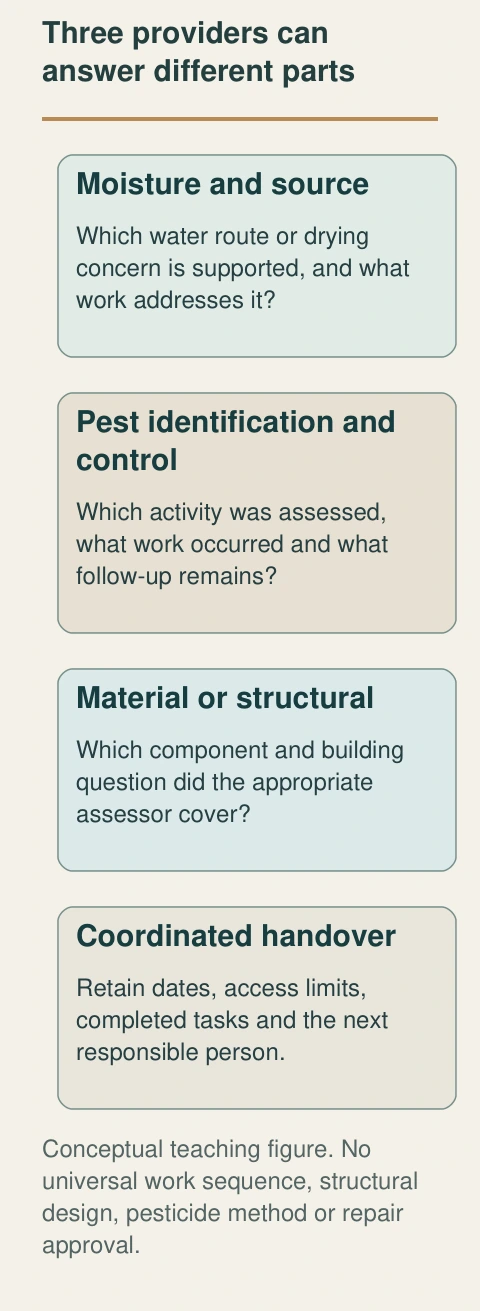
- Moisture and source
Which water route or drying concern is supported, and what work addresses it?
- Pest identification and control
Which activity was assessed, what work occurred and what follow-up remains?
- Material or structural
Which component and building question did the appropriate assessor cover?
- Coordinated handover
Retain dates, access limits, completed tasks and the next responsible person.
What does this illustration leave out?
No universal work sequence, structural design, pesticide method or repair approval. This illustration explains an idea. It is not an installation guide.
Which scope still needs evidence before finishes conceal the area?
Explore this with HomeAI ↗Opens an editable question. Nothing is sent until you choose to send it.Three connected work scopes
- Moisture/sourceIdentify and address the actual water question.
- PestIdentify and address supported activity.
- Material/structuralAssess and address the actual member or assembly task.
Organizing relationships; no structural or treatment design.
Further reading: Health Canada · Carpenter ants.
Read the complete figure
Three providers can answer different parts
Moisture/source work, pest work and material/structural work are parallel scopes. Their records connect without becoming one clearance.
- Moisture and source
- Which water route or drying concern is supported, and what work addresses it?
- Pest identification and control
- Which activity was assessed, what work occurred and what follow-up remains?
- Material or structural
- Which component and building question did the appropriate assessor cover?
- Coordinated handover
- Retain dates, access limits, completed tasks and the next responsible person.
What remains unknown: No universal work sequence, structural design, pesticide method or repair approval.
A useful question: Which scope still needs evidence before finishes conceal the area?
What changes with location, building type or earlier history?
Local species and conditions matter, but a regional page cannot identify an address. Confirm current local advice with the relevant pest professional or authority. Guelph’s termite-management references belong to Guelph, and CFIA’s historical examples belong to their stated incidents. Canadian national education does not become a current neighbourhood prevalence map merely because it names familiar insects.
Shared buildings introduce access and responsibility questions. A unit’s finish, common framing, exterior moisture route and adjacent spaces may involve different people. Tell the appropriate owner or manager about the actual observation and ask who coordinates assessment. Do not alter shared assemblies or expand treatment into another area without the relevant authorization and qualified plan.
Earlier records can be useful if their scope is clear. A historic treatment receipt, renovation photo and structural report may concern different locations and dates. Ask how they relate to the equipment or material now present. An older absence-of-evidence observation should retain its original conditions, while a past infestation should not be assumed active forever without current support.
For a transaction, describe what the actual file establishes and what requires further assessment. A property professional can help organize the records and specialist questions; pest, structural, moisture and legal findings remain with the appropriate qualified roles. This guide supplies no disclosure law, insurer acceptance, warranty entitlement, property valuation or universal inspection requirement.
What should follow-up look for after the work?
Follow-up should match the question the provider intended to resolve. Pest monitoring concerns evidence of the identified activity under its method. Moisture follow-up concerns the source and assessed material conditions. Structural follow-up concerns the actual repair and any specified observation or acceptance. A single generic return visit may not cover all three.
Ask what observations should prompt contact and which areas or conditions the follow-up covers. Keep the actual instructions with their date and responsible source. This guide provides no checking interval, probing method or universal treatment-success threshold. A reported quiet period can be useful without establishing permanent absence or the condition of every concealed member.
If a new sign appears, retain its location and time without immediately assigning a cause. The provider should determine whether it relates to the earlier pest, old disturbed material, another insect or another process. A new dust pile does not automatically establish failed control, and a dry-looking surface does not establish that the source repair worked under every relevant weather condition.
Close only the task supported by the finding. Preserve remaining access limits and follow-up responsibilities in the home-care record. If another provider takes over, the dated sequence should show what was identified, what work occurred and why the next question remains. This makes finite successful work useful without turning it into an unsupported whole-house pest or structural certification.
How would a fictional owner organize a timber-and-dust concern?
Morgan is a fictional owner who notices sawdust-like material below accessible trim beside a window. An ant was seen in the room, but its identification and connection to the material are unknown. The window area has a reported damp history without a confirmed current source. No structural finding is available. These are related questions to investigate, not one established carpenter-ant diagnosis.
Morgan records the safe observation and asks an appropriate pest provider to identify the evidence and define the inspected scope. A suitable building specialist addresses the water route, and any concern about a member’s condition is referred for the appropriate structural assessment. Morgan does not scrape the material, open the wall or apply a product to see what emerges.
In the invented pest report, the photographed ant is identified as a carpenter ant, but the provider has not located a nest or attributed the material below the trim. A separate source-inspection proposal concerns the damp window junction; it contains no structural assessment of concealed framing. Morgan therefore asks each quote to name the finding it addresses. Insect control cannot stand in for the unresolved water route or member condition, and a water-repair quotation cannot establish what produced the material. No wall is opened or pesticide applied by the owner.
The example ends with a connected record and an explicit remaining question. It supplies no actual species, source diagnosis, structural capacity, treatment success, repair design or price. Its purpose is to show how an owner can connect the evidence without allowing one familiar sign to answer every question about the insect, water and building.
What should the final record help the next person understand?
Keep the original observation, supported identification, current-activity assessment and examined locations together. Add moisture/source findings, material or structural reports, completed work and follow-up instructions with their dates. Each document should retain its area, author and exclusions. A generic treated label is less useful than a short explanation of which task the document actually addresses.
Separate conceptual understanding from property evidence. The cutaways explain nesting, source objects, moisture interfaces and separate assessment roles. They identify no actual pest and assess no member. Reported observations and professional findings belong to the actual house record. A buyer, owner or service provider should be able to distinguish those states without reconstructing the entire conversation.
Use the moisture guide for recurring dampness and source-control lessons, the relevant structural guide for building relationships, and the distinct rodent and bedbug guides for their own pest questions. The home-care record can retain dated tasks and completed reports. Keep each specialist’s actual role and the scope of their finding with the relevant work record.
The reader should finish able to explain why carpenter-ant excavation differs from wood feeding, why old holes differ from current activity and why pest and structural assessment are separate. They should know which safe observations help the next provider and which work remains outside an owner’s role. That understanding supports an appropriate next step without manufacturing certainty about the actual house.
Keep learning about the connected parts
- Rodent signs at home: understand entry, food, shelter and the work that helps
- Why damp walls and mould keep coming back
- Water leaks explained: find the right question before the repair
- Build a home-care record that the next person can understand
- Bedbugs: understand identification, treatment and follow-up
- How a house is supported: floors, walls, beams and changes
Canadian context and authorities · Visual atlas · Learning labs
Practice the distinction.
Morgan connects signs without inventing one cause
Fictional sawdust-like material, unidentified ant and reported damp history near trim; activity, source and structural condition are unresolved.
Reported observations
- The fictional pest report identifies the photographed ant but does not locate a nest or attribute the material.
- A separate window-source proposal does not assess concealed framing.
- No owner scraping, wall opening or trial treatment occurs.
Compare the explanations
Expand each possibility to see the evidence needed to distinguish it. Similar symptoms can have different mechanisms.
Pest evidence supports a defined plan
Identification and current-activity findings can guide suitable control.
Qualified pest report with locations and access limits.
Another building question remains
Water source and member condition are not answered by insect identity.
Appropriate source and material/structural findings with completed-work records.
A useful next question
Ask each quote to connect its work to the supported finding, coordinating pest, water-source and any required material/structural assessment before concealment.
No real species, current outbreak, structural capacity, treatment success, repair design or price.
Know what the words mean.
- Gallery
- A passage or space excavated in material, such as wood used for a carpenter-ant nest.
- Frass
- Insect-produced waste or boring material; a loose pile needs suitable identification before receiving that label.
- Exit hole
- An opening left by emergence; its presence alone does not establish current activity.
- Load path
- The connected route through which building forces pass among members and supports.
- Assessment boundary
- The actual object, material, area and question covered by a professional’s finding.
Questions to bring
to the conversation.
- Which actual object or material carries the sign?
- What supports identity and current activity?
- Which source and material/structural questions require separate scope?
- What completed work and remaining follow-up are documented?
Separate a showing observation, an existing record and a new professional assessment. Unknown means a question remains; it does not automatically mean a defect.
Use the evidence planner ↗Go to the source.
Original HomeAI explanation informed by these public references. Sources support the underlying guidance; they have not reviewed or endorsed HomeAI. Diagrams are conceptual, and calculator outputs depend on your inputs.
Complete substantive current reachable Health Canada, CCI, Guelph and CFIA bodies personally read October 14. Historical 2013/2017/2021 dates and Guelph local context retained. No current distribution/outbreak map, species diagnosis, destructive access, pesticide/borate/wood replacement procedure, transport/disposal instruction, structural capacity, repair design or clearance supplied. Pest/moisture/structural boundaries remain distinct; fictional Morgan case is not property evidence. Complete substantive CWC legacy-host assessment body additionally read October 14 for appearance limits and appropriate structural/source specialist scope. All probing, cutting, chemical and repair prescriptions are withheld; linked references not independently read.
Publication & source review
First published .
Sources reviewed .
Have a question about your home?
Start with the symptom, timing and what you have observed.
Ask HomeAI