- The pit, pump, discharge, backup and backwater valve have separate jobs.
- Identify the actual incoming water and protected drain routes before planning around the equipment.
- A closed backwater gate can restrict household wastewater leaving through that route.
- An active electrical flooding hazard or suspected sewage takes priority over an equipment investigation.
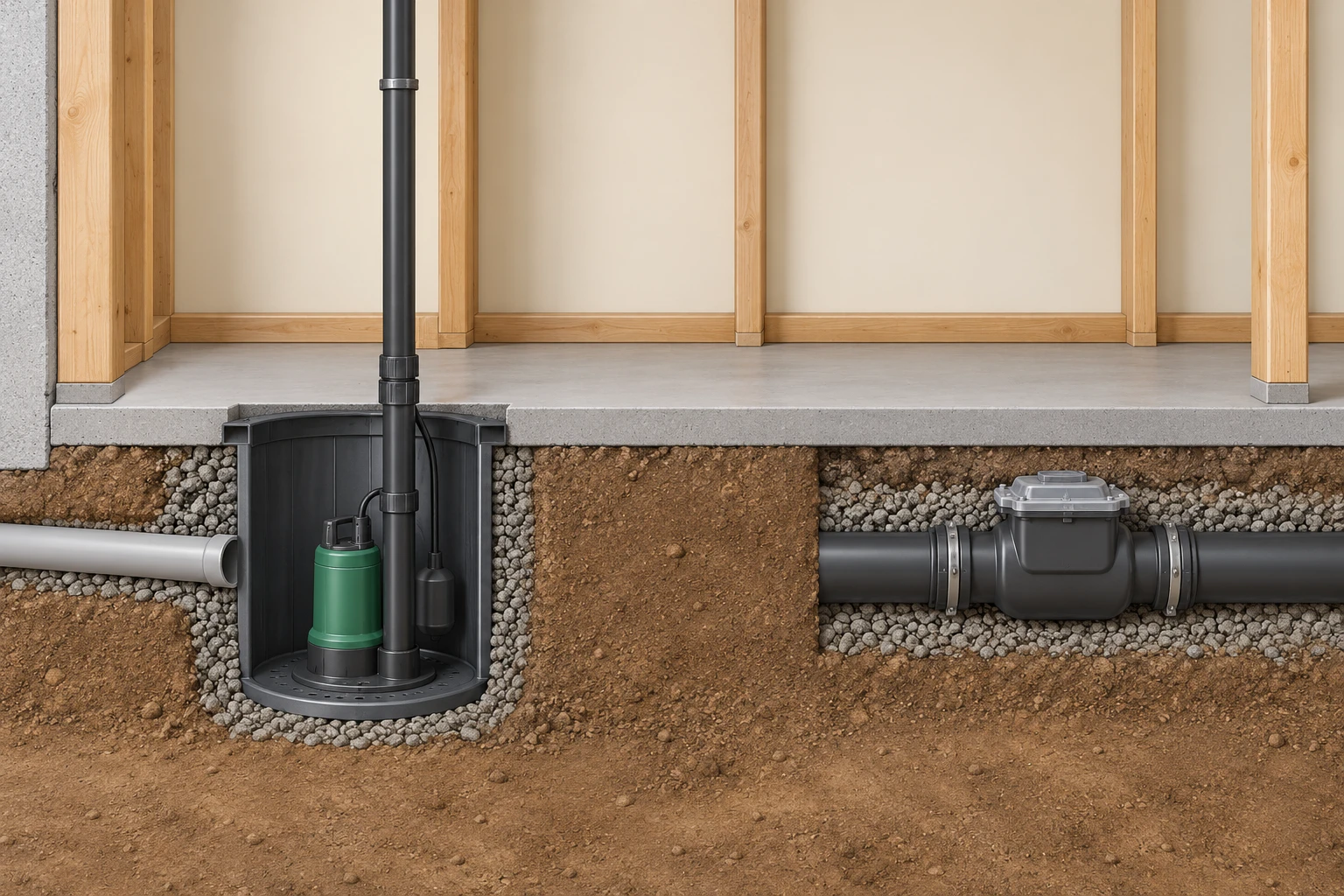
The pump and collection pit are on the left. The drain-valve housing is on the right, with no connection drawn between these two routes.
About this illustration
This is a conceptual comparison. It does not establish your pipe connections, the pump’s final discharge, the valve’s internal position or working protection. This is a conceptual teaching model, not an assessment of your home.
4 picture lessons appear beside the questions in this guide. Use them to understand the explanation, then consider what it means for your home.
How does groundwater reach a sump—and leave again?
The drain collects water outside the foundation. The pit receives it below the floor. The pump then lifts it to a separate discharge route. Follow one successful fictional cycle through all three jobs.
Paused. Read at your own pace or play once through the eight steps.
The closer view follows the selected part. Choose “Whole system” to see the connected route again.
STEP 1 OF 8 · FOLLOW THE WATER
Rain or melting snow wets the ground
Rain and melting snow add water at the surface. Some water runs away; some soaks into the ground. This lesson follows one possible below-ground route. A shower does not necessarily make a pump start immediately.
The weather, ground conditions and drainage around the home influence what happens next. The animation advances at a reading pace, not at the speed water travels through a real property.
Useful next question: What weather and ground conditions were recorded when water reached this home?
Each picture uses a conceptual layout. Compare the part’s job across the views; actual equipment, buried connections and receiving routes vary.
Rain or melting snow wets the ground
Rain and melting snow add water at the surface. Some water runs away; some soaks into the ground. This lesson follows one possible below-ground route. A shower does not necessarily make a pump start immediately.
The weather, ground conditions and drainage around the home influence what happens next. The animation advances at a reading pace, not at the speed water travels through a real property.
Useful next question: What weather and ground conditions were recorded when water reached this home?
Water reaches the soil beside the foundation
The footing is the wider concrete base beneath the foundation wall. Water in the surrounding ground can reach this area. The blue marks remain outside the basement: they show the water the drainage system is intended to intercept.
A wet area indoors still needs its own investigation. Roof runoff, a window well, a wall leak, a plumbing leak and sewer backup are different routes; a sump cannot explain or prevent all of them.
Useful next question: Which observations support groundwater as the source, and which other routes remain possible?
Water can reach the drainage without crossing the room
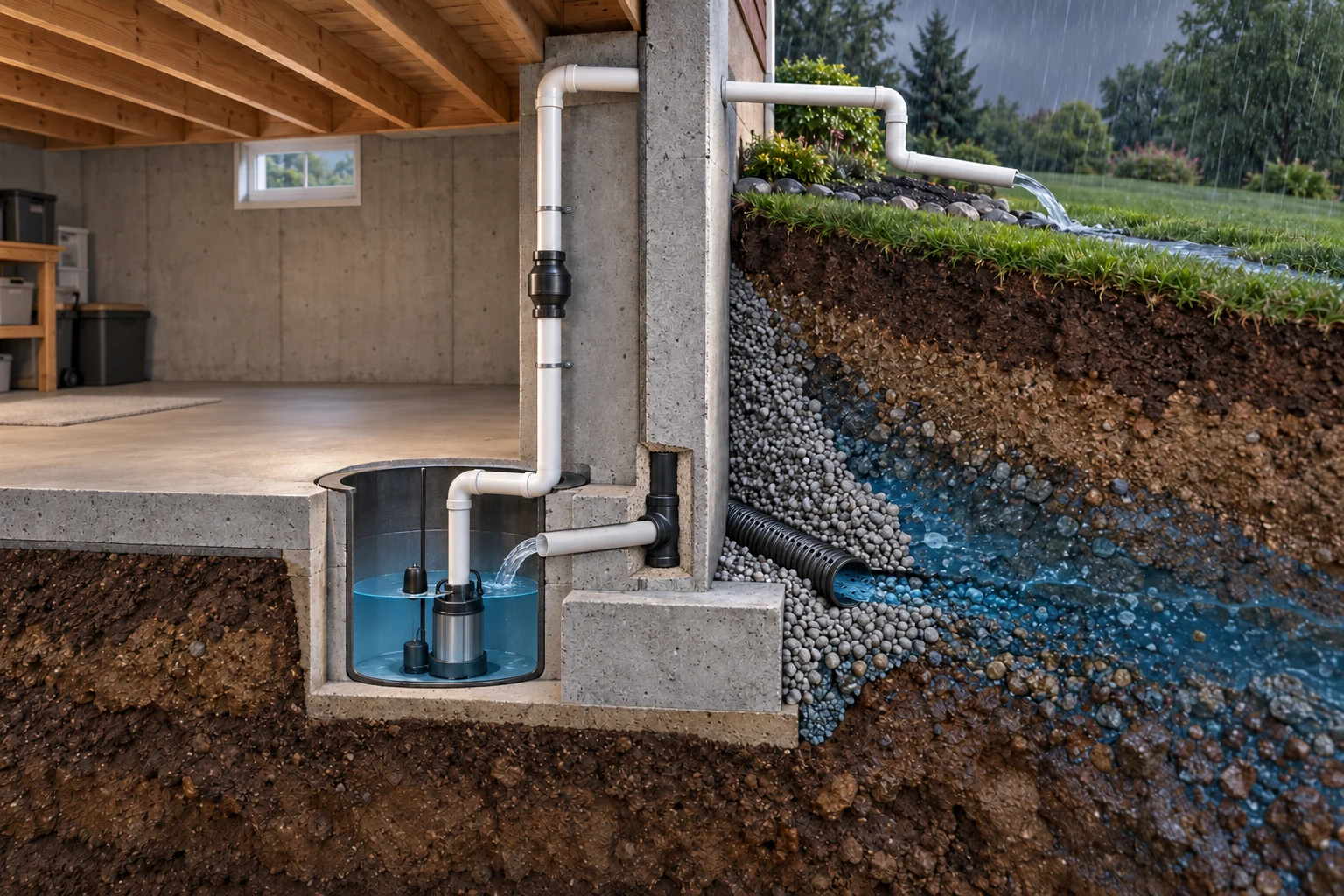
- Outside the wall
- Wet soil and a wet basement are different observations. The collection system is intended to intercept groundwater outside the occupied room.
- Below the floor
- The basin holds incoming drainage water between pumping cycles. The illustration opens covered parts to make their jobs visible.
- A separate route upward
- The pump discharge carries water out. It has a different job from the lower collection inlet.
The perimeter drain collects water outside
A perimeter drain, also called a foundation drain or weeping tile, collects groundwater near the foundation. In this cutaway, water enters the buried collection pipe beside the footing.
The collected water stays in the drainage route. It does not need to cross the occupied basement floor to reach the sump. The drawing shows one external drain arrangement; the location and condition of a real buried drain need records and appropriate assessment.
Useful next question: Where is the actual foundation drain, and what evidence establishes its connection and condition?
The connected inlet carries water into the pit
For the layout drawn here, the connected inlet carries collected water by gravity to a basin below the basement floor. The basin is the sump pit: it holds incoming drainage water until the pump moves it onward.
Follow the continuous blue route from the outside drain through the inlet into the basin. This is a groundwater sump, not a sewage pit. Other homes may use a different drain destination or may not need a sump pump.
Useful next question: Which pipes actually enter this pit, and where do they come from?
Look into the pit: inlet, float and pump
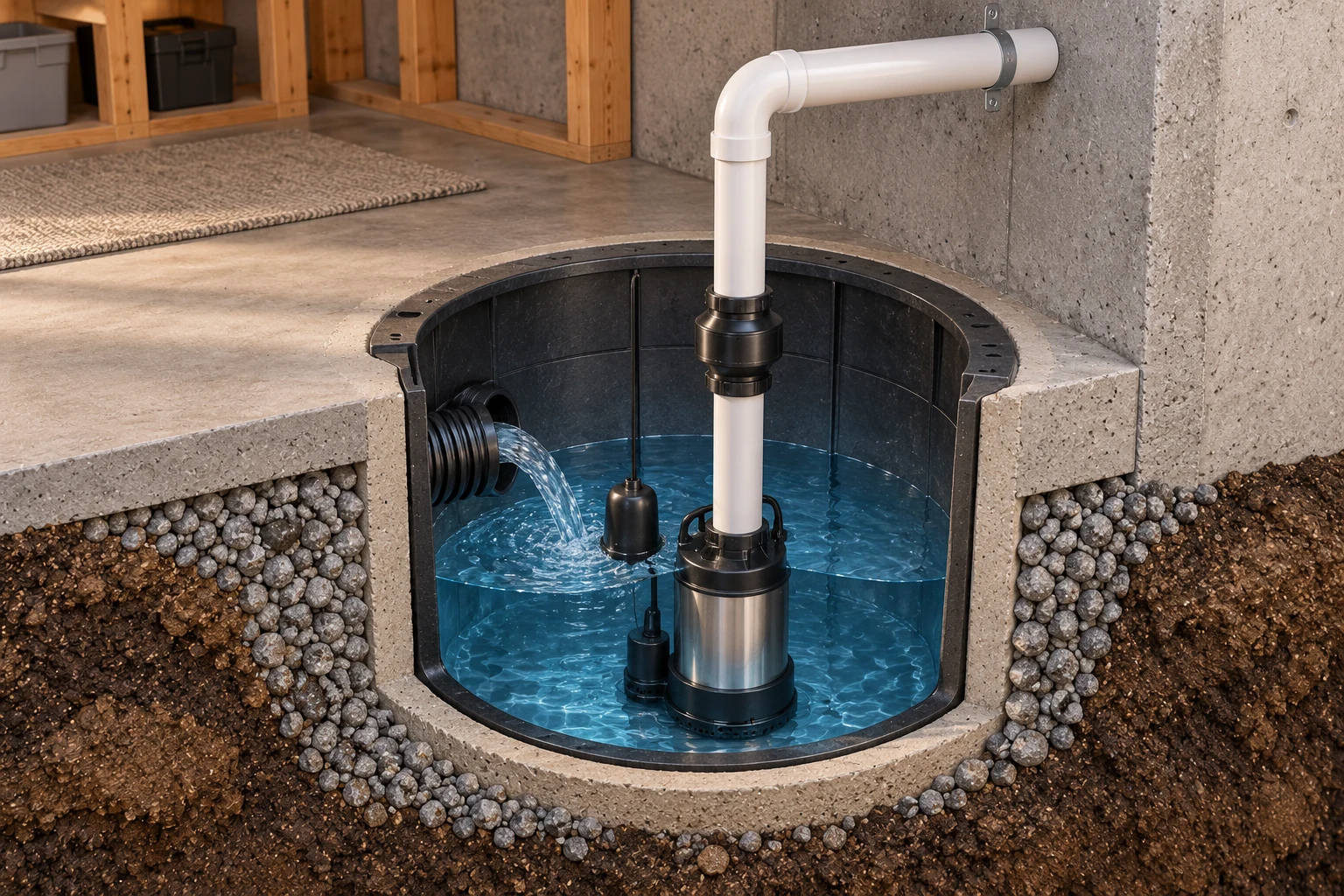
- Inlet: water comes in
- Trace the pipe entering the basin separately from the pipe connected to the pump. Their different jobs help explain what a drainage assessment needs to cover.
- Float: level controls operation
- A rising float can operate the start switch. The actual float shape, space and start/stop settings come from the installed equipment and its instructions.
- Pump: water goes out
- The pump supplies the upward lift. Seeing these parts in a picture does not establish their condition or performance at a real home.
Rising water lifts the float and starts the pump
As water collects, its level rises inside the basin. In the float-controlled example, the rising float operates the switch that starts the pump. The float is a level control; it is not a measurement of the whole property’s flood risk.
The picture simplifies the control so its job is visible. Float shape, clearances and start level depend on the equipment and installation. A working cycle also needs a functioning pump and its required power supply.
Useful next question: What control and power supply are installed, and what do their instructions require?
The pump lifts water through the discharge pipe
The pump draws water from the basin and pushes it up the discharge pipe. That lift is the change gravity alone cannot make in this drawn route. Follow the moving dots upward from the pump; the outside collection inlet has a different job.
The check valve in the discharge helps limit pumped water returning when the pump stops. Its body is shown on the riser. This lesson does not establish a real valve’s operation, pump capacity or suitability for a particular discharge route.
Useful next question: Has the pump, check valve and full discharge route been assessed together?
Follow the discharge beyond the wall exit
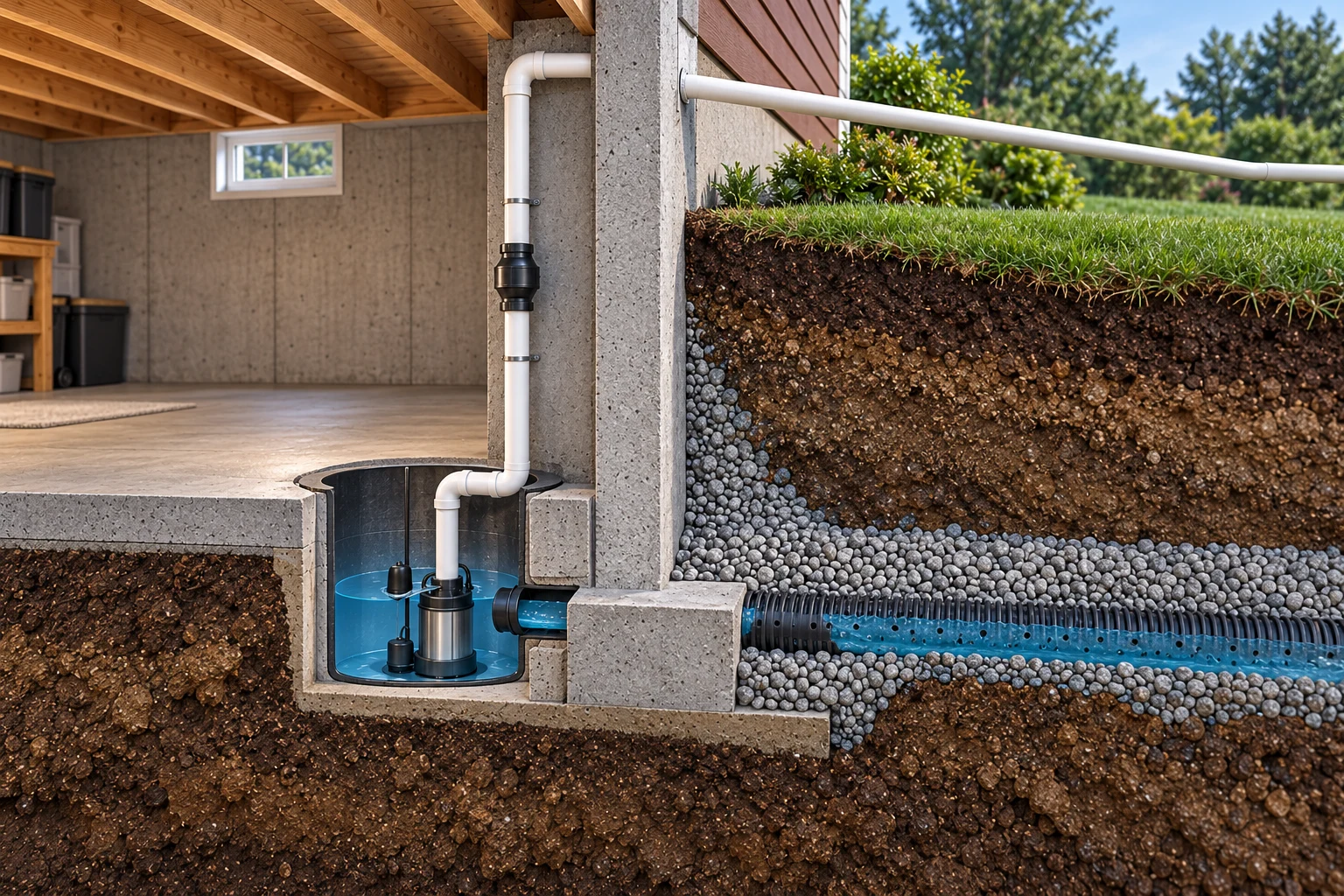
- Collection heads toward the pit
- A connected drain and inlet serve the basin in this drawn layout. Other homes can have different drainage arrangements.
- Discharge heads away
- A wall exit is only part of the route. Ask where the full line ends and whether water could return toward the foundation.
- The outside destination matters
- Local requirements, freezing and effects on neighbouring property belong in the assessment. This picture supplies no approved outlet position or installation dimensions.
Water reaches its locally permitted receiving route
The pumped water must reach the receiving arrangement permitted for the property. The outgoing line here continues away from the foundation to a schematic exterior destination. Its endpoint is a teaching symbol, not an approved surface outlet or a storm-service design.
Water discharged beside a wall can return toward the foundation drainage. A blocked or frozen exterior route can also interfere with pumping. Confirm the permitted destination, effects on neighbouring property and winter plan locally; do not copy this drawing’s geometry.
Useful next question: Where does this exact line end, and what local approval and winter instructions apply?
The level falls and the control stops the pump
In this successful fictional cycle, the pump removes water faster than new water enters. The basin level falls until the float control stops the pump. Some water remains; the illustration does not suggest that every pit should become completely dry.
More inflow can start another cycle. Inflow beyond the system’s capacity, a failed control, lost power or an obstructed discharge can change the outcome. This normal sequence is an explanation of the parts, not a flood guarantee or an instruction to test or adjust them.
Useful next question: What is the documented maintenance, backup-power and failure-response plan for this installation?
Trace two water routes and one level control
The inlet and discharge do different jobs. Use this map to keep them separate when reading a drainage report or asking a professional about the actual system.
Collect water near the foundation
- Water in the ground
- Foundation drain
- Connected inlet
- Sump basin
In the layout drawn here, collected water reaches the lower basin by gravity. Ask which actual drains connect to the pit; a buried route needs records and appropriate assessment.
Lift water to its receiving route
- Water in the basin
- Pump
- Discharge and check valve
- Locally permitted receiving route
The pump supplies the lift. Follow the discharge beyond the wall exit: its destination, winter arrangements and effect on neighbouring property need local confirmation.
Start and stop with the water level
These are qualitative states in a float-controlled example. The installed control, start/stop levels, power and maintenance instructions depend on the equipment.
A useful next conversation: Which pipe brings water into this pit, where does the pumped water end up, and who has assessed the control and power supply?
Sources, dates and what this lesson leaves open
Read October 11, 2026. The Government of Canada’s sump-pump explanation and foundation-drain explanation both display March 23, 2026. They support the collection, float-start, pumping and check-valve jobs, and the need for local advice.
Blainville’s float-control note supports qualitative start and stop at water levels; its publication date is not established. Its adjustment dimensions are not adopted.
Winnipeg’s sump-pit drainage explanation (updated January 22, 2025) explains return flow toward the foundation. Its discharge and winter FAQ (updated April 11, 2024) explains frozen-route and ice hazards. These are municipal examples; their hose changes and discharge rules are not national instructions. The Ontario Electrical Safety Authority’s flood-safety guidance supports staying clear of flooded electrical areas; no revision date is established.
This is a Canadian teaching scenario, not a provincial code summary. Receiving routes, equipment controls, approvals, maintenance and winter instructions need confirmation for the actual property.
What do a sump pump and backwater valve do?
A sump pit collects water. A pump moves that water through a discharge pipe to its receiving location. A backwater valve has a different job: it acts on an identified drain route to limit water coming backward from the sewer. These are separate functions, even when both devices are in the basement.
Ottawa’s protective-plumbing FAQ describes a common groundwater arrangement: foundation drains carry water to the pit, and a rising water level activates the pump. Your home’s actual connections need confirmation. A pit used to pump sewage from low fixtures is another arrangement; a lid or pump shape cannot identify the contents.
Follow that water all the way through the system. A foundation drain collects it near the footing and a connected inlet carries it into the below-floor basin. Rising water lifts a float, which operates a switch to start the pump. The pump lifts water through the discharge pipe; a check valve helps limit water returning down that pipe. As removal lowers the pit level, the automatic control stops the pump at its model-specific lower level. The outside receiving route still needs to be suitable and locally permitted. This is one groundwater arrangement, not a description of every home.
Start with three familiar questions: what comes into this pit, where does the pumped water go, and which drains are behind the backwater valve? A qualified plumber can identify uncertain routes. A picture of a pump or the words flood protection cannot answer all three.
If flooding is happening now, put safety ahead of this investigation. Stay clear of sewage and water that may contact electrical equipment. Do not cross water to reach a pump, plug or panel. The immediate-response chapter below explains who to contact; routine observations wait until access is safe.
Which water does each device handle?
The pump and collection pit are on the left. The drain-valve housing is on the right, with no connection drawn between these two routes.
Numbers identify the parts explained below.
- Sump and pump
A sump collects the water routed to it. The pump moves that water through its discharge route.
- Drain and backwater device
A backwater device has a different job: limiting reverse flow on the identified drain route. A plumber confirms which connections it protects.
- Two separate routes
Identify the actual route before relying on the device’s name. A pump and a backwater valve do not cover every way water can enter.
What does this illustration leave out?
This is a conceptual comparison. It does not establish your pipe connections, the pump’s final discharge, the valve’s internal position or working protection. Use the actual manual and a qualified plumber to resolve unknown connections. Do not open hazardous components or stage flooding.
Which water enters this sump, and which household drains does the backwater device protect?
Explore this with HomeAI ↗Opens an editable question. Nothing is sent until you choose to send it.Three parts, three different jobs
- Sump pitReceives water from its identified connections. · What water actually enters this pit?
- Pump and dischargeMoves collected water toward its receiving route. · Where does that route go, and what remains unverified?
- Backwater valveActs against reverse flow on its protected drain route. · Which connections are behind this valve?
How do I identify the actual devices and routes?
Use labels and existing records to name the pump, backup equipment, valve and any alarm. A pump model helps find its manual. A valve cover may help locate access. Neither tells you every pipe connection or whether the equipment will perform during the event you are planning for.
Ask the plumber for a simple route sketch using the parts actually identified: water entering the pit, pump, discharge, receiving location, sewer connection, valve and protected branches. Mark concealed or uncertain sections plainly. An installation drawing describes intended work; the current inspected arrangement is a separate question.
Keep model instructions, installation or permit records and service findings together. If a receipt says valve cleaned, ask which valve, what was done and whether its function was checked. If records describe different arrangements, keep both and ask what changed rather than choosing the more reassuring description.
An alarm also needs a name and a response instruction. It could concern high water, a pump, a valve or another device. Ask what your actual signal means and whom to call. Do not open a sealed pit, reach into water or dismantle a valve to improve an identification photo.
What changes when a backwater valve closes?
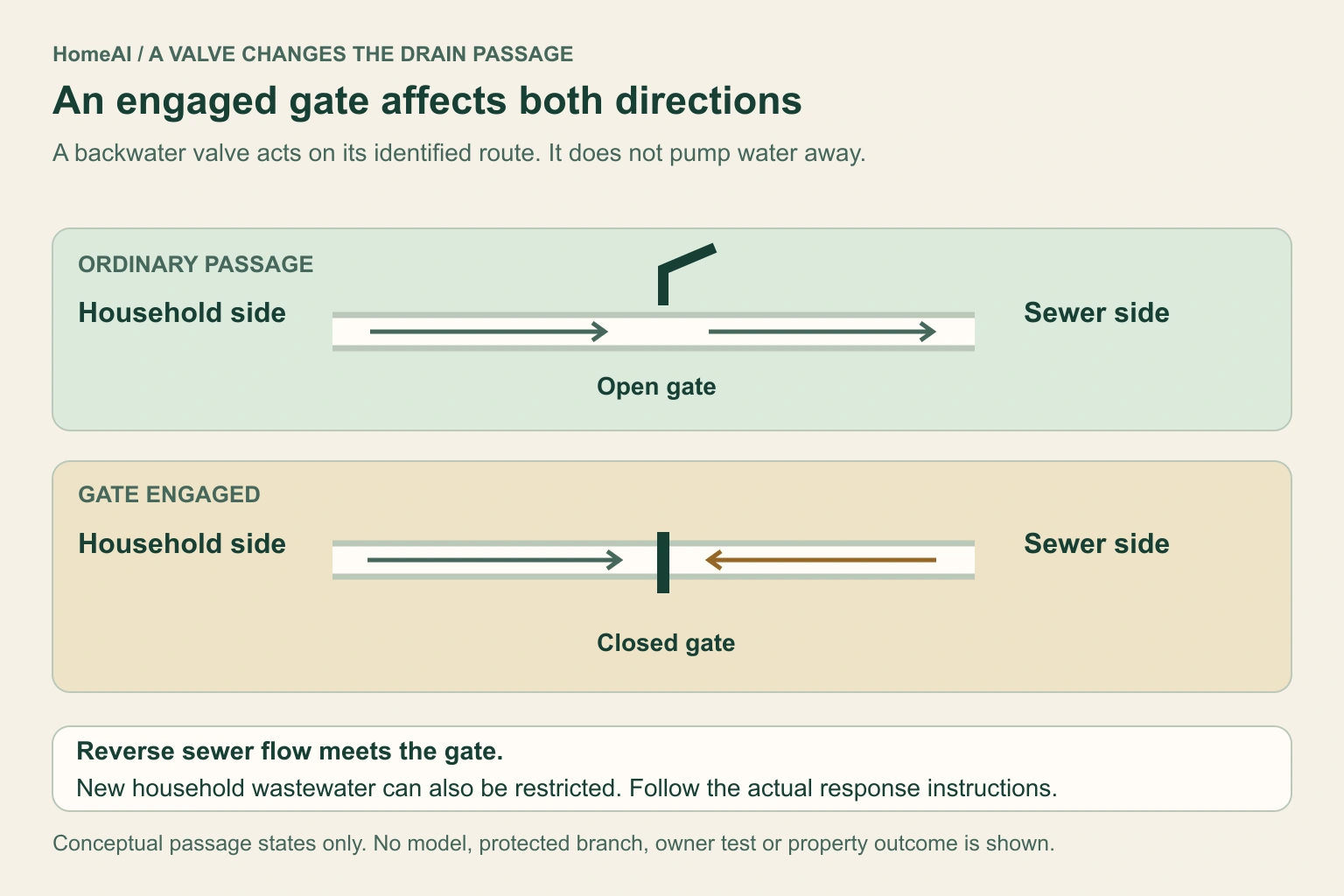
Normally, household wastewater leaves along the connected drain route. During sewer surcharge, the sewer level rises and can push water backward toward connected homes. Ottawa’s FAQ describes a gate that closes against this reverse flow. Its position changes the available passage; it does not pump water away.
A closed gate can also prevent new household wastewater from leaving through that route. Ottawa therefore warns against showering, flushing toilets or washing clothes while its described valve is engaged. Ask the plumber how that warning applies to your model, protected connections and any alarm. Keep the actual response instructions accessible.
Do not force the gate open, silence an unexplained alarm or assume every upstairs and downstairs fixture is protected. Different branches can have different arrangements. The useful question is which connections lie behind the actual valve and what the household should do when that passage is restricted.
Maintenance follows the actual model and safe access. Ottawa points owners to the manufacturer and a licensed plumber when condition or required work is uncertain. A service note should distinguish cleaning, an observed movement check and any excluded connection. This guide gives no universal Canadian interval or owner disassembly procedure.
A closed gate changes both directions of passage
The open and closed passages explain why a backwater gate has a different job from a pump.
Numbers identify the parts explained below.
- Ordinary passage
Household wastewater follows the identified route toward the sewer while the applicable gate is open.
- Reverse flow and closed gate
A rising sewer level can push water back. The described gate closes against that reverse-flow path; it does not pump water elsewhere.
- Household discharge also changes
A closed passage can restrict new wastewater leaving through that route. Follow the actual model and plumber’s response instructions; do not force a gate open.
What does this illustration leave out?
The drawing identifies no property’s protected branches. Ask which actual connections lie behind your valve and what its response instructions require. Conceptual Ottawa FAQ mechanism only. Not a model-specific gate drawing, installation layout or owner valve test.
Which connections and household instructions apply when my actual valve is engaged?
Explore this with HomeAI ↗Opens an editable question. Nothing is sent until you choose to send it.Read the complete picture lesson
A closed gate changes both directions of passage
A backwater gate changes the available drain passage. The open state permits ordinary flow toward the sewer. The engaged state acts against reverse flow and can also restrict household wastewater leaving through that route.
- Ordinary passage
- Household wastewater follows the identified route toward the sewer while the applicable gate is open.
- Reverse flow and closed gate
- A rising sewer level can push water back. The described gate closes against that reverse-flow path; it does not pump water elsewhere.
- Household discharge also changes
- A closed passage can restrict new wastewater leaving through that route. Follow the actual model and plumber’s response instructions; do not force a gate open.
Ottawa’s protective-plumbing FAQ gives this mechanism and warns against adding household wastewater while its described valve is engaged. Confirm the actual model, protected branches and household response with the qualified plumber. Do not force a gate open or use this diagram as a test.
What remains unknown: No property route, gate condition, alarm response, approval or future flood outcome has been established.
Useful next question: Which connections and household instructions apply when my actual valve is engaged?
What does the pump need during an outage?
An electrically driven pump needs available power, functioning equipment and a usable discharge route. Calgary’s flood-readiness page highlights loss of power. A backup arrangement can address a particular dependency, but the word backup does not describe its pump compatibility, condition, operating limits or care requirements.
Ask the qualified installer to explain what the backup actually powers and how its readiness is assessed under its instructions. A battery cabinet may belong to a particular pump system; its appearance is not proof of a working connection. Keep the models and service findings with the household plan.
Follow the discharge beyond the pump in the discussion. A pump running briefly does not show the whole receiving route or its conditions during freezing weather or a storm. Record a safely visible outlet’s location and apparent obstruction for professional review, without deciding that appearance proves a blockage or an approved destination.
Ask what happens if power is lost, the discharge is restricted or inflow exceeds what the arrangement can handle. Keep the documented limits, not a guessed protection time. Do not unplug equipment to stage an outage, disconnect pipes, add extension cords or reroute water toward another property.
What does the pump need to move water?
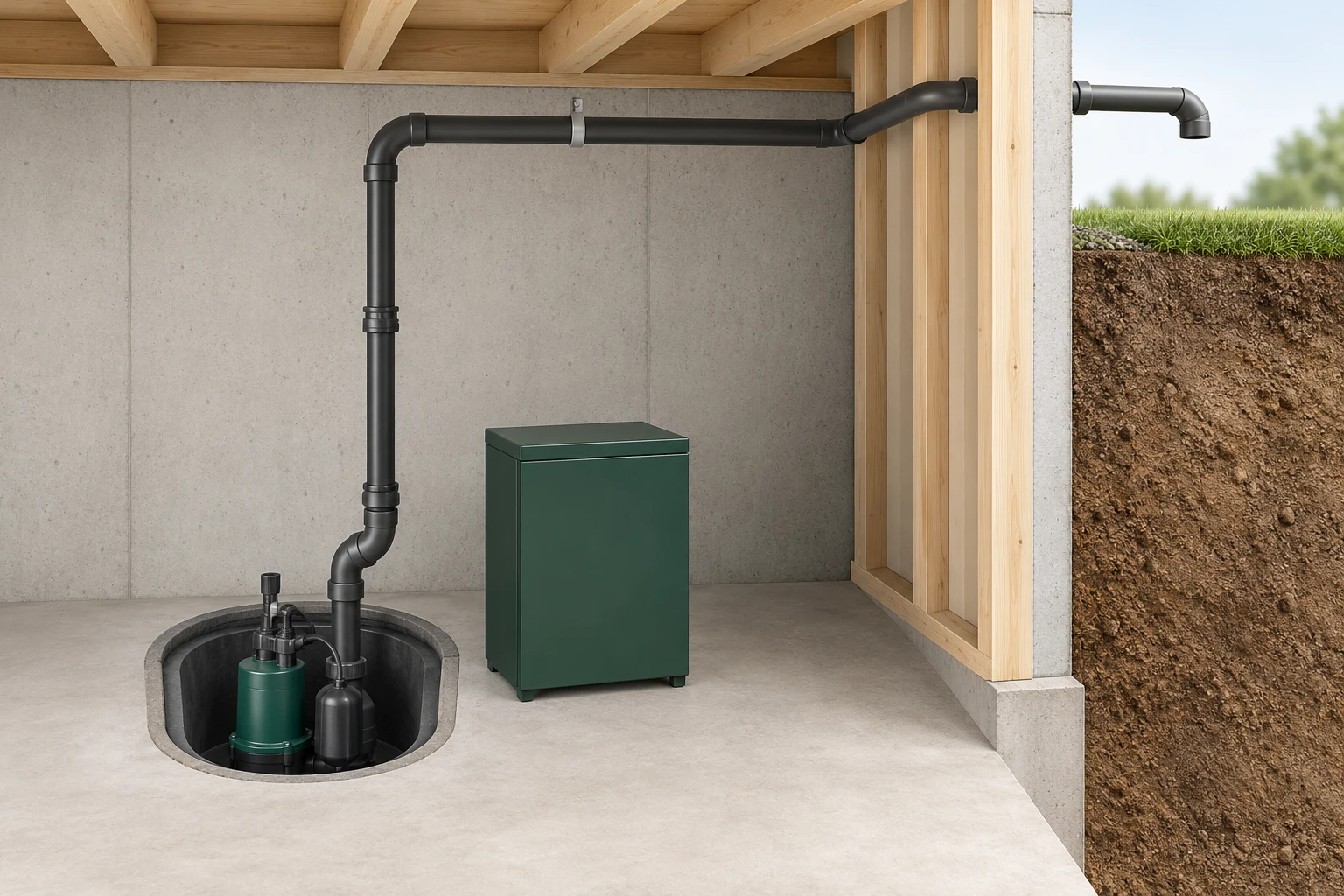
The pump, rising discharge pipe and outside end are visible. A closed cabinet stands nearby, with no electrical connection shown.
Numbers identify the parts explained below.
- Pump
Ask which pump is installed, what activates it and what its manual requires.
- Available power
Ask what actually supplies this pump during an outage and how that arrangement is checked.
- Discharge route
The route must carry collected water away. Ask about its real destination and the sections that were assessed.
What does this illustration leave out?
The outside end is illustrative, not an approved discharge location. The cabinet proves no connection, battery condition, backup runtime or successful operation. Do not open the cabinet, improvise wiring or reroute the outlet from this drawing. Follow equipment instructions and local professional advice.
What powers this pump during an outage, and where does its discharge actually go?
Explore this with HomeAI ↗Opens an editable question. Nothing is sent until you choose to send it.Can water enter somewhere else?
Yes. A backwater valve acts on its protected drain route. A sump arrangement collects and moves the water that reaches its pit. Ottawa’s FAQ distinguishes those jobs from water entering through walls or window wells, roof-drainage problems, poor lot drainage and water sources inside the home.
Record where water first became visible, when it appeared and what ordinary weather or household use preceded it. Note roof discharge, surface pooling and visible interior dampness only from safe accessible places. Water can travel before appearing, so the wettest spot is not automatically its entry point.
A dry spell does not establish how the home will respond to a demanding event. Likewise, an operating pump does not rule out a plumbing leak or wall-entry route. Ask the professional which observations support the proposed source and what evidence would distinguish the remaining possibilities.
Property grading affects how surface water moves around the home. Current federal guidance advises checking local requirements and consulting a professional before changing it. Do not copy another property’s slope, pipe destination or landscaping solution. The proposal should explain the actual water route and why its work addresses that route.
Different water routes need different questions
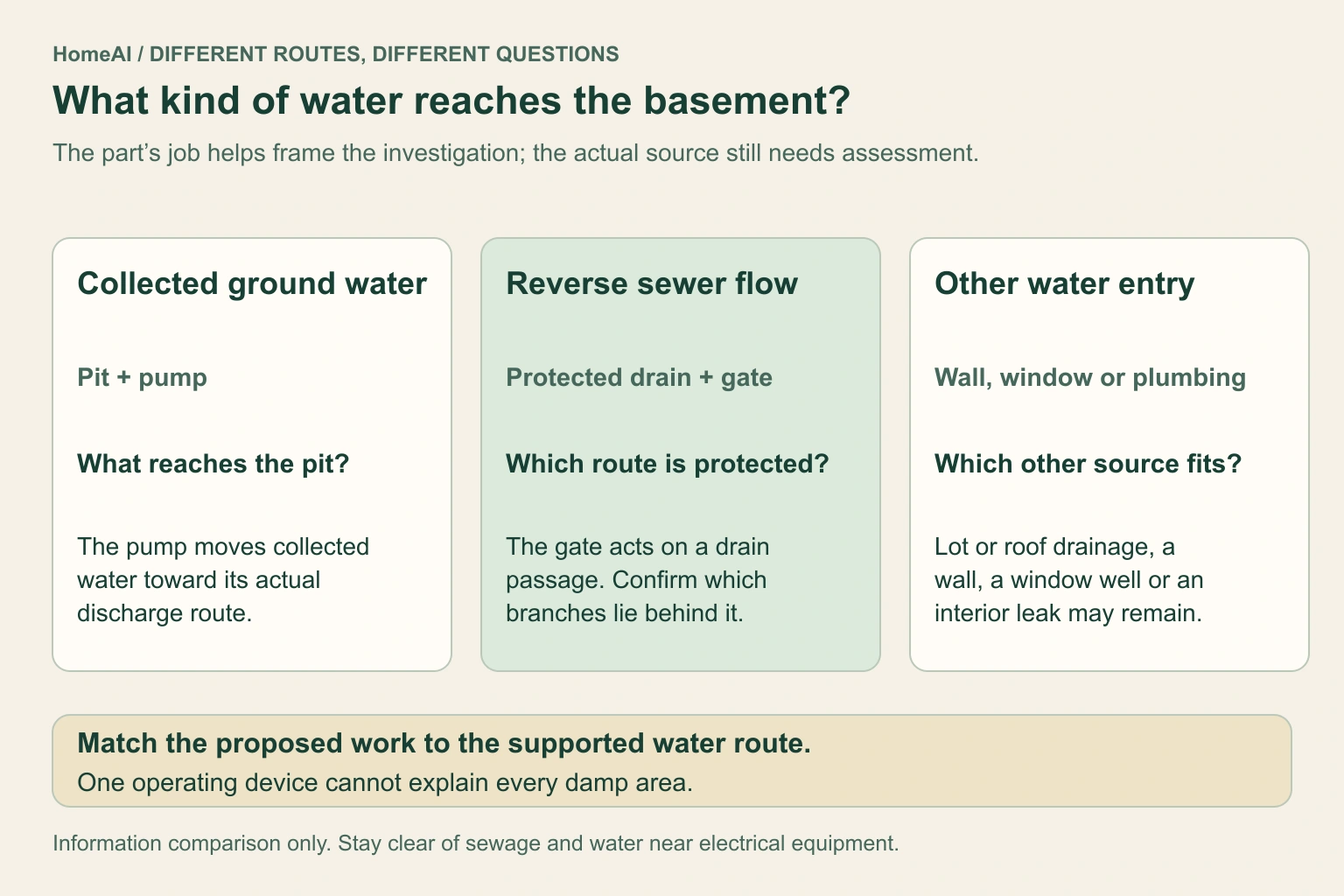
The cards connect each kind of water route to a useful investigation question.
Numbers identify the parts explained below.
- Collected ground water
Foundation drains can carry water into an identified sump pit. Its pump then moves collected water toward the discharge route.
- Reverse sewer flow
A backwater valve acts on its identified protected drain route. Its presence does not identify every branch or control every possible water source.
- Other water entry
Walls, window wells, roof or lot drainage and interior plumbing can remain separate source questions. Record timing and location, then ask which route the findings support.
What does this illustration leave out?
One operating device cannot identify the source of every damp area. Ask which route the actual observations and findings support. Information comparison only, after safe access is established. Stay clear of sewage and water near electrical equipment.
Does the proposed work address the water route actually supported by the findings?
Explore this with HomeAI ↗Opens an editable question. Nothing is sent until you choose to send it.Read the complete picture lesson
Different water routes need different questions
A sump and backwater valve answer different water-route questions. Other entry routes can remain relevant even where one device operates.
- Collected ground water
- Foundation drains can carry water into an identified sump pit. Its pump then moves collected water toward the discharge route.
- Reverse sewer flow
- A backwater valve acts on its identified protected drain route. Its presence does not identify every branch or control every possible water source.
- Other water entry
- Walls, window wells, roof or lot drainage and interior plumbing can remain separate source questions. Record timing and location, then ask which route the findings support.
Keep the ordinary timing, location and safely visible water observations with the professional’s findings. The proposed work should name which route it addresses and which other sources remain unresolved. Ottawa’s FAQ distinguishes protective plumbing from wall, window-well, roof, lot and interior water entry.
What remains unknown: This comparison identifies no actual source or defect and does not promise protection. Active flooding, sewage or electrical hazards need the appropriate immediate response before observations.
Useful next question: Does the proposed work address the water route actually supported by the findings?
What should I do if flooding is happening now?
Keep out of water that may contact electrical systems. Do not walk through a flooded area to reach a panel or unplug a pump. Ontario’s Electrical Safety Authority advises calling the local electric utility for disconnection when water creates an electrical hazard. Contact your applicable utility or emergency services from a safe place.
Electrical equipment affected by floodwater needs the appropriate qualified assessment before use or restoration. ESA’s licensing and restoration process applies in Ontario; your local authority and utility govern elsewhere. A pump that still runs or a light that still works does not establish that a flooded area is safe to enter.
Suspected sewage requires keeping people and animals out of the affected area and seeking municipal or qualified cleanup advice. Calgary’s maintenance guidance distinguishes sewage contamination from an ordinary clean-water observation. Avoid unnecessary household wastewater use during a suspected backup, and document only from a safe location.
Never run a fuel-burning generator indoors, in a garage or shed. Follow current Health Canada outdoor-siting guidance; do not improvise a connection for the pump. If a CO alarm sounds or exposure is suspected, leave immediately without searching for a source. Call emergency services from outside. Return only after the problem has been fixed by a professional.
What does an outage plan look like in practice?
In this fictional example, Nolan has a pump label, a closed backup cabinet and a receipt saying valve cleaned. There has been no reported flood. His family wants a useful outage plan. The three records identify things to ask about; they do not describe every connection or establish a future outcome.
Nolan asks the plumber to name the pit’s purpose, sketch the collected-water and protected-drain routes, and identify the actual alarm. He asks the backup installer for the matching manual and service scope. The family does not stage flooding, remove a cover or interrupt power to find out what happens.
Suppose a hypothetical service report describes an accessible pump check but excludes a buried discharge section. Nolan retains that exclusion and asks how the receiving route will be resolved. The report would support its stated check, while the buried section would remain a different investigation. This is a teaching example, not an actual inspection result.
The family’s plan names the ordinary care tasks, missing records and event contacts. It also states what to do during a valve warning or electrical flooding hazard. No battery runtime, flood probability, completed approval or promise of a dry basement is calculated from this fictional file.
What should the readiness record and service visit answer?
Keep one readable folder: route sketch, models, manuals, alarm response, maintenance findings, backup instructions, discharge questions and local contacts. Separate a request sent from a finding received, and work billed from function actually checked. Home Plan can organise these tasks; its status is not a flood-risk score.
Ask the provider to connect each finding to a part and a scenario. What was examined? What happened during the stated check? What remained inaccessible? Which care or repair is recommended, and how will it be followed up? A useful answer explains the arrangement without turning one inspected component into whole-home protection.
Canadian municipalities can have different sewer arrangements, discharge requirements and permit processes. Ottawa and Calgary are named examples. Confirm proposed changes with the actual local authority and qualified provider. A service label, neighbouring installation or generic animation cannot establish permission for this property’s discharge.
Before buying or selling, share the actual records and unresolved route questions. If you use a HAUSE-connected team, ask about the people’s actual training, licence, technical role and local availability. A realtor can coordinate records within their role; qualified plumbing, electrical and drainage professionals establish their own technical findings.
Keep learning about the connected parts
Connect the record to the question
- Model label and manualWhich device and instructions have been identified. · Its current installed connections and readiness.
- Service findingsWhat was examined, done or checked within the stated scope. · Excluded sections and future operating conditions.
- Household response planWho to call and what the actual instructions say. · A future flood outcome or numerical risk grade.
Practice the distinction.
Nolan builds an outage plan from incomplete records
Fictional learning scenario: a pump label, closed backup cabinet and valve-service receipt are available, but the connections and response instructions are not yet clear.
Reported observations
- The pump label is available.
- Backup instructions are missing.
- The valve receipt does not name every protected connection.
Compare the explanations
Expand each possibility to see the evidence needed to distinguish it. Similar symptoms can have different mechanisms.
An identified arrangement with specific limits
The devices may serve useful separate jobs when their actual routes and readiness are established.
Matching manuals, a confirmed route sketch and scoped findings.
A missing power or discharge answer
An accessible pump check may leave backup power or a buried receiving route unresolved.
The responsible provider’s stated assessment and exclusions.
A useful next question
Ask the qualified plumber and backup provider to identify the arrangement, alarm response and remaining investigation.
No actual inspection, guaranteed runtime, flood probability or discharge approval is established.
Know what the words mean.
- Surcharge
- A raised sewer water level that can push water backward along connected drains.
- Protected route
- The confirmed drain branch or connection on which a particular backwater device acts.
- Dependency
- Something a device needs for its job, such as available power or a usable discharge route.
Questions to bring
to the conversation.
- What does the pit receive, and is it a groundwater or sewage arrangement?
- Where does the discharge go, and which branches are behind the backwater valve?
- What does each actual alarm mean, and what should the household do?
- Which power, discharge and maintenance questions were assessed or left unresolved?
Separate a showing observation, an existing record and a new professional assessment. Unknown means a question remains; it does not automatically mean a defect.
Use the evidence planner ↗Go to the source.
Original HomeAI explanation informed by these public references. Sources support the underlying guidance; they have not reviewed or endorsed HomeAI. Diagrams are conceptual, and calculator outputs depend on your inputs.
Concepts reviewed for this refresh on October 5, 2026. Ottawa’s protective-plumbing FAQ supports the device concepts and engaged-valve warning. Calgary arrangements and Ontario ESA advice are regional; Health Canada provides national CO guidance. Match maintenance and backup instructions to the actual equipment, discharge route and local authority.
Publication & source review
First published .
Sources reviewed .
- City of Ottawa · Preventing basement flooding
- City of Ottawa · Protective-plumbing questions
- City of Calgary · Flood readiness
- Electrical Safety Authority · Flood safety
- Health Canada · Preventing carbon-monoxide exposure
- Government of Canada · Property grading
- City of Calgary · Home maintenance
- Government of Canada · Sump pumps
Where this reference applies
Jurisdiction: Canada; national educational guidance
Reading scope: Full substantive body and page details, freshly read October 11, 2026.
Pit, float-switch start, pump lift, discharge and check-valve functions. No numeric outlet distance, owner test, service interval or property design adopted.
- Government of Canada · French drains, trench drains and weeping tiles
Where this reference applies
Jurisdiction: Canada; national educational guidance
Reading scope: Full substantive body and page details, freshly read October 11, 2026.
Foundation-drain groundwater collection and separate gravity or pumped receiving routes. No universal dimensions, age inference or approval adopted.
- Ville de Blainville · Float-switch operation
Where this reference applies
Jurisdiction: Blainville, Quebec; municipal conceptual float-control explanation
Reading scope: Complete short PDF freshly read October 11, 2026. No publisher revision date established.
Rising level starts and falling level stops an automatic pump. No model set point, switch adjustment or owner test is reproduced.
Have a question about your home?
Start with the symptom, timing and what you have observed.
Ask HomeAI